
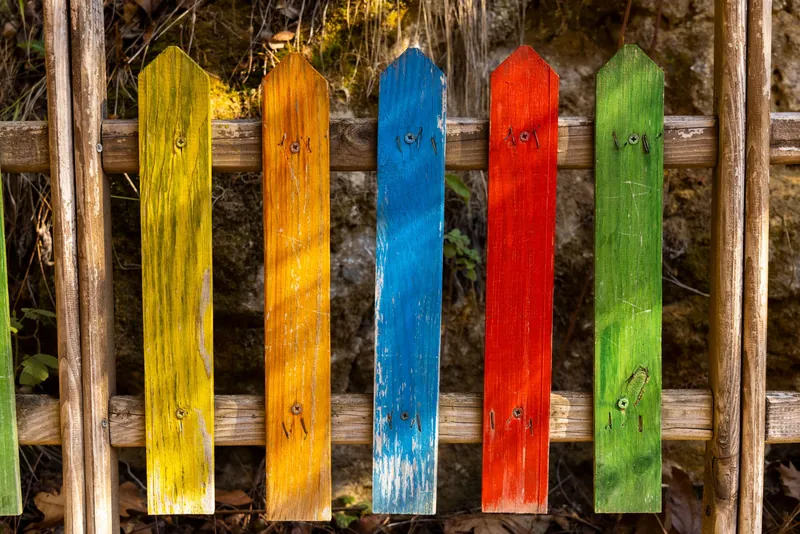
Soft, muted colours that sit close in tone to your planting tend to make a small garden look bigger: pale blue-greys, sage and soft stone in shaded or bare gardens, deeper muted greens or charcoal where the fence is hidden behind planting. Contrast is what shrinks a garden, so steer clear of bright orange-brown stains and stark white, paint posts and trellis the same colour, and test two coats on a full board before you buy.
What fence paint colours make a small garden look bigger?
The colours that make a small garden look bigger are the ones that stop the eye noticing where the garden ends. In many UK gardens that means soft, slightly muted shades: pale blue-greys, sage, soft stone and creams. Tikkurila’s garden colour advice says that for small gardens, neutral fence paint colours are the way to go, that greens can open up a space and that light blue can work well in a smaller garden. The common thread is low contrast with what sits in front of the fence.
A fence makes a garden feel small when it reads as a hard line. Bright orange panels against green shrubs do that. So does brilliant white against a dark lawn. Pick a colour that sits close in tone to the planting, the paving and the light you actually get, and the boundary blurs.
Why soft, cool colours make a garden feel larger
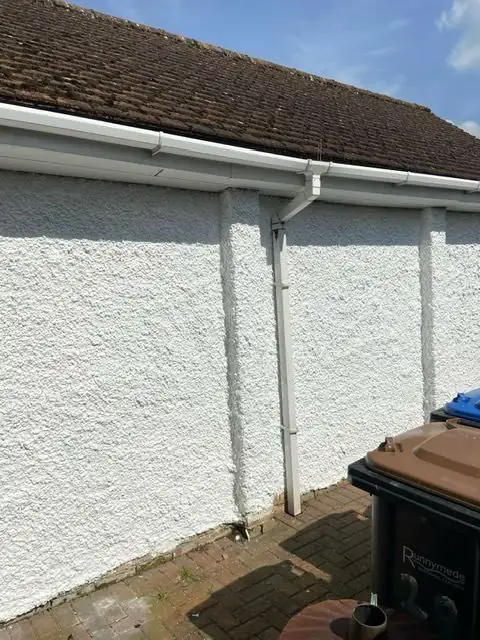
Soft, cool colours tend to make a garden feel larger because they draw less attention than warm, strong ones, so the fence seems to sit further back. Greys with a hint of blue or green look like distance and foliage. Saturated warm colours, such as orange-brown “red cedar” stains, pull the boundary towards you. Low contrast matters as much as hue: a fence close in tone to its surroundings reads as background.
Think about what you see from the back door. If the eye travels across the lawn and stops dead at a bright, contrasting band of fence, the garden ends there. If it drifts from planting into a muted fence of a similar depth, it has nowhere obvious to stop. That is why a decorator will often steer people away from the stronger orange and red-brown fence stains in a small plot, even though many fences already wear them.
Light or dark: which fence colour suits your garden?
Choose light when the garden is shaded, bare or used mostly in the evening, because pale colours bounce what light there is back into the space. Choose deeper, muted shades when the fence is well covered with planting and gets good sun, because a dark background makes leaves and flowers stand forward and the fence drops away. Tikkurila warns that black or dark brown can feel overwhelming in a courtyard-style garden.
Use this as a starting point. The example shades are taken from the Cuprinol and Ronseal colour ranges listed on their websites in October 2026. Test them on your own fence before buying in bulk.
| Your garden | Colour direction | Example shades to test |
|---|---|---|
| Small, shaded or north-facing, little planting | Light, slightly warm neutrals or soft blues | Cuprinol Coastal Mist or Morning Breeze; Ronseal Warm Stone or Summer Sky (Summer Sky is Garden Paint only) |
| Small, sunny, borders well planted | Mid to deep muted greens and grey-greens | Cuprinol Willow, Wild Thyme or Seagrass; Ronseal Sage or Willow (Willow is Garden Paint only) |
| Courtyard or paved yard, few plants | Pale, soft colour; avoid black and dark brown | Cuprinol Clouded Dawn; Ronseal Pebble or Mountain Mist |
| Larger plot, dense evergreen planting | Deep, muted colour that disappears behind leaves | Cuprinol Old English Green or Holly; Ronseal Charcoal Grey |
| Modern new build with grey paving and render | Grey-greens or blue-greys that pick up the paving | Cuprinol Blue Slate or Emerald Slate; Ronseal Slate or Pewter Grey |
The Cuprinol names come from its blue and green colour ranges, and the Ronseal names from its Garden Paint and Fence Life Plus ranges. Not every shade is sold in every product: Fence Life Plus, for example, comes in a shorter list of 12 colours than Garden Paint. Check the colour is available in the paint you plan to use.
Which green fence paint works best?
The best green for a fence is usually one a step lighter or greyer than the planting in front of it. Tikkurila’s advice is to stick with a shade that’s lighter than your lawn, so the fence doesn’t merge into a flat dark mass. Sage, willow and soft grey-greens suit most gardens. Bright greens tend to compete with the plants and look artificial.
A good test is to hold a tester card or a painted offcut against the leaves of your main shrubs in daylight. If the colour looks brighter or more yellow than the leaves, it will shout. If it looks greyer and slightly lighter, it will sit back. In older Northampton gardens with mature laurel, privet or conifer hedges, a muted mid-green often does this well. In new-build gardens with young planting and a lot of bare fence, a lighter sage or grey-green is usually the safer choice until the borders fill in.
Is a dark or black fence a mistake in a small garden?
A dark fence is not automatically a mistake in a small garden, but it works best when something sits in front of it. Behind lush, layered planting, charcoal or deep green makes the fence vanish and the plants glow. On a bare boundary with little planting, the same colour can close the space in, which is the effect Tikkurila warns about for courtyard gardens. Decide on planting first, then colour.
There are two practical points to weigh up. First, patchy touch-ups tend to be easier to spot on a dark fence once it starts to weather, so plan on keeping up the recoats. Second, going from dark to light later is a bigger job. A pale colour over charcoal will often need extra coats to cover evenly, and Cuprinol advises you to test a small area first for colour and adhesion over an old coating. If you are not sure, a mid grey-green is a safe middle ground in most light.
How do you test a fence colour before you commit?
Test a fence colour by painting a full board or a full panel width, not a small square, with two coats exactly as the tin says, and then look at it from where you usually sit. Check it in morning light, at midday and in the evening, and after rain. Fence colours can look quite different on rough timber and in shade, so treat the chart on the tin as a rough guide only.
Here is the order a decorator will usually work through before painting or staining a fence:
- Clean a test area first. Algae and grey fibres change how a colour takes.
- Use the real product. Garden Shades, for example, is listed in a 125ml size as well as 1, 2.5 and 5 litre tins, which is a cheap way to try a couple of boards.
- Paint two coats. One coat on rough timber looks patchier and darker than the finished result.
- Test two or three colours side by side, on the sunniest and the shadiest stretch of fence.
- Wait a few days. Look from the back door and from an upstairs window, which is how most people see the garden in winter.
- Check it against the plants, paving and house, not against the colour chart.
Expect the colour to look a little darker on rough sawn panels than on smooth planed boards. Rough timber also drinks paint. Cuprinol gives coverage for Garden Shades of 3 to 5 square metres per litre by brush on rough sawn wood, against 10 to 12 square metres per litre on smooth planed wood. So a rough sawn fence can need several times the paint that the same area of smooth timber would.
Other ways to make the boundary disappear
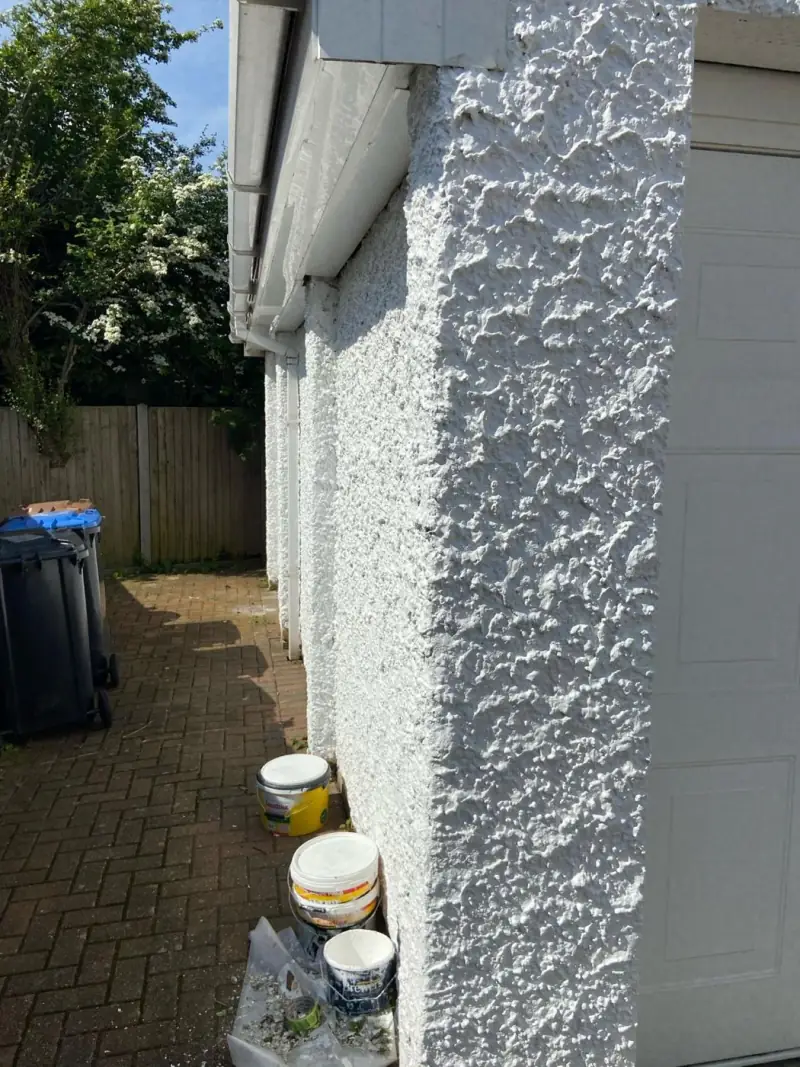
Colour does most of the work, but how you apply it matters too. The aim is one calm, continuous backdrop with no hard lines. These details help in a small garden, and they cost little extra if you plan them before you start:
- Paint everything on the boundary the same colour: posts, gravel boards, trellis toppers and capping rails. A contrasting post every six feet chops the fence into blocks and makes it look shorter and closer.
- Bring the shed and any garden walls into the same family. Either the same colour or one shade deeper. A bright shed against a muted fence tends to become the new focal point.
- Treat all sides of the garden the same. One colour on three sides blurs the corners, and corners are where the eye measures the size of a space.
- Keep the strong colours for small things, such as pots, a bench or a door, where they draw the eye into the garden rather than to its edges.
How do you get fence paint to last?
Fence paint lasts when it goes on clean, dry, sound timber in the right weather, at the number of coats the maker specifies. Cuprinol says Garden Shades needs a minimum of two coats, applied above 5°C in dry conditions, and claims six years of protection. Ronseal says Fence Life Plus needs a warm, dry day with temperatures above 10°C, takes two coats on rough sawn wood and three on smooth planed, and that its colour lasts up to five years. Ronseal’s Garden Paint also asks for above 10°C with no rain forecast, and three coats.
Those claimed lifespans assume good preparation and normal exposure. Thorndown notes that paint on timber exposed to direct sunlight, heavy rain, frost, or strong winds will wear faster, and Tikkurila suggests aiming to repaint once every couple of years, or once every 12 months in harsh conditions. A south-facing fence in full sun and a shaded fence by a damp hedge will not age at the same rate.
Before painting, check the fence for rot, loose boards and posts that rock. Paint will not fix any of those. Scrub off algae and let the wood dry completely; Thorndown says wood should be completely dry before painting, particularly after cleaning or wet weather, and advises against painting in rain, frost or very strong sunlight. New timber is a special case, and the makers differ. Ronseal’s Garden Paint instructions say new wood should be left to weather for six weeks before painting, while Fence Life Plus can be used on new rough sawn timber. Cuprinol says new wood for Garden Shades should first be pre-treated with an appropriate wood preserver. Read the tin for the product you have chosen.
Autumn fog and heavy dew can leave a fence wet until late morning, even on a day with no rain. Paint over damp boards and the finish can stay patchy or fail early. Late spring to early autumn is the usual painting season, and our month-by-month guide to outdoor painting weather covers it in more detail.
Do you need permission to paint a fence?
Painting your own fence is usually treated as maintenance, so most homeowners don’t need planning permission. The Planning Portal says you can alter, maintain or improve an existing fence without permission, but that right does not apply where the site is a listed building or within the curtilage of a listed building, or where an Article 4 direction or planning condition removes it. The page doesn’t mention painting specifically, so if your home is listed, in a conservation area or covered by an Article 4 direction, check with West or North Northamptonshire Council before changing the colour.
Ownership is the other question. If the fence is yours, the side facing next door is still their view of it, so it is good manners to talk to them about the colour. If the fence is theirs, ask before painting either face. Paint and spray also drift on a windy day, so tell your neighbours before you start and cover their plants and car if they are close to the line. A short chat beforehand heads off a lot of fence disputes.
Should you paint the fence yourself or get a decorator?
Painting a short run of fence yourself is a reasonable weekend job if the panels are sound, the weather is settled and you are happy with a brush or a pump sprayer. Get a decorator when the fence is long, overgrown or patched with old finishes, when you are changing from dark to light, or when you want the fence, shed and gates done as one consistent scheme.
Where a professional earns their keep is the preparation and the consistency. Cleaning back algae, dealing with old flaking coats, working colour into the overlaps of lap panels and keeping the finish even along a whole boundary takes time. As a painter and decorator in Northampton, Dean carries out fence and gate staining and painting, either on its own or as part of wider exterior painting. If you can’t settle on a shade, our colour advice service can help you test options in your own garden. We work across Northampton, including Duston, and in nearby towns such as Wellingborough and Daventry. Paint a test board before the visit and Dean can judge the colour against your planting on the day. The number is 07539 779 036, and the quote is free.
Sources
- Best colours for a garden fence, Tikkurila UK (accessed 2026-10-09)
- Cuprinol Garden Shades product information, Cuprinol (accessed 2026-10-09)
- Blue colour range, Cuprinol (accessed 2026-10-09)
- Green colour range, Cuprinol (accessed 2026-10-09)
- Fence Life Plus product information, Ronseal (accessed 2026-10-09)
- Garden Paint product information, Ronseal (accessed 2026-10-09)
- How to prepare and paint exterior wood, Thorndown Wood Paint (accessed 2026-10-09)
- How long does exterior wood paint last?, Thorndown Wood Paint (accessed 2026-10-09)
- Fences, gates and garden walls: planning permission, Planning Portal (accessed 2026-10-09)
Header photo: Engin Akyurt on Pexels.
Last updated by Dean, DH Painter & Decorator.


