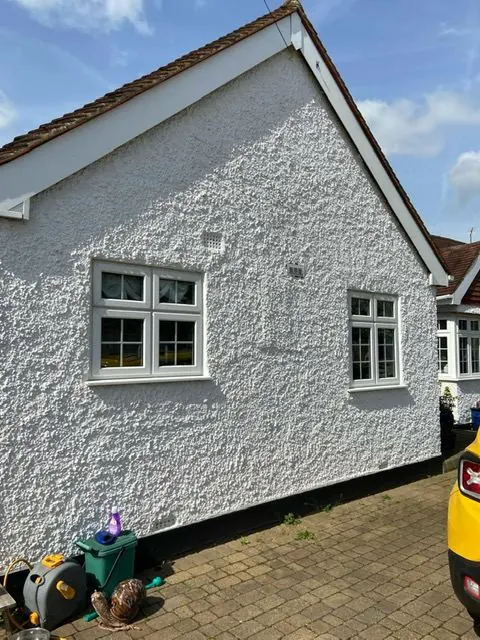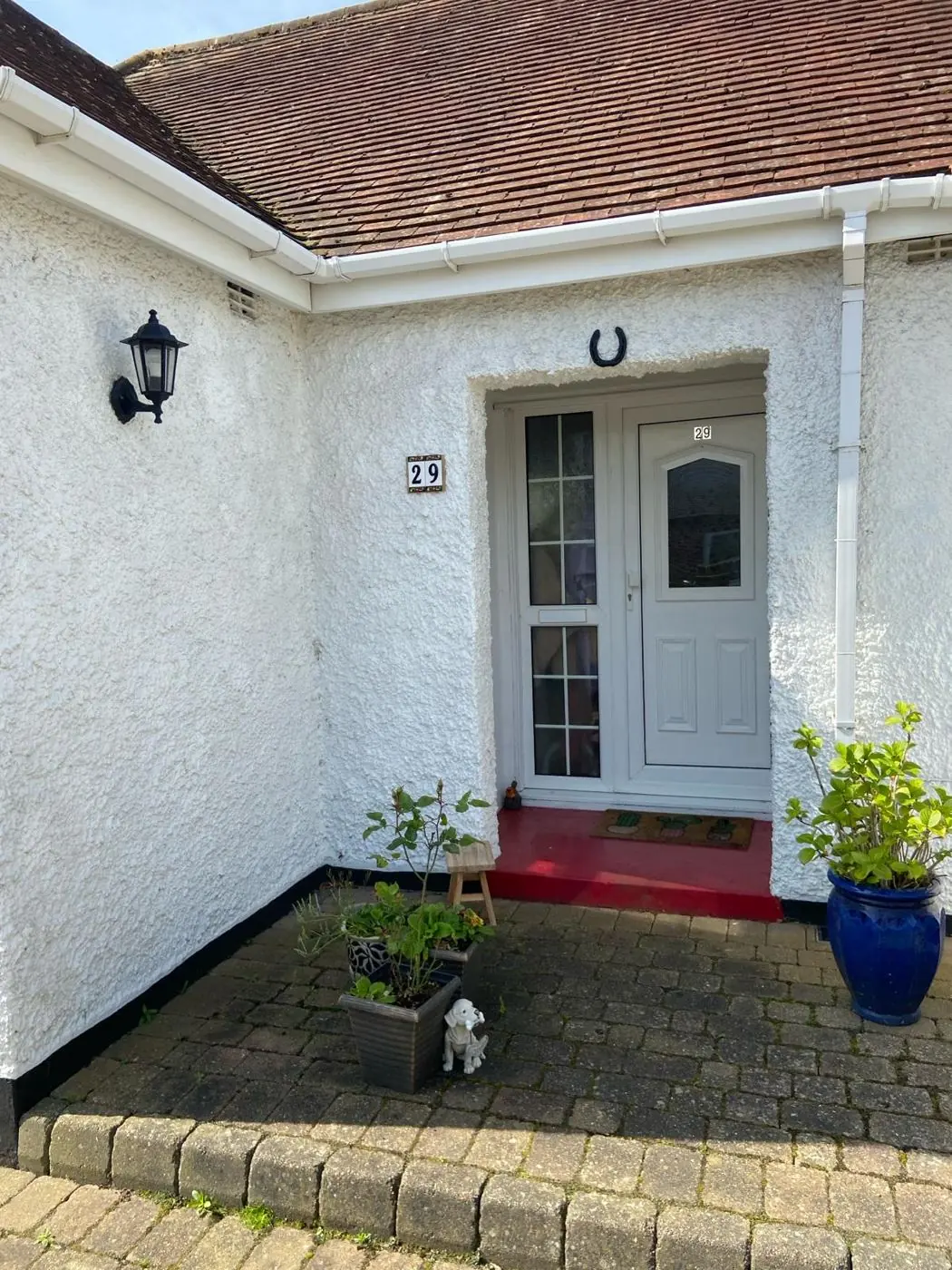

For most sound cement render, roughcast and pebbledash, a good trade-quality water-based acrylic smooth masonry paint in two coats is the right choice. Use a stabilising primer only on walls that stay chalky after washing, a Pliolite solvent paint for cold-weather work, and limewash or mineral paint on lime render. Silicone and through-coloured render usually only needs washing, not painting.
What is the best masonry paint for render?
For most sound cement render, roughcast and pebbledash, the best masonry paint is a good trade-quality water-based acrylic, applied as a thinned sealer coat on bare areas and then two full coats. Swap it out in four cases: chalky walls (stabilise first), cold-season work (a Pliolite solvent paint), silicone or through-coloured render (usually don’t paint it at all) and lime render on older walls (limewash or mineral paint).
The same tin that lasts years on sound render can peel early on a chalky wall or trap damp in an old lime-rendered cottage. Pick the paint to suit the wall, then pick the brand. The table below is the decision a decorator makes standing in your drive.
| Your wall | Paint to use | Why |
|---|---|---|
| Sound smooth cement render | Water-based acrylic smooth masonry paint | Good cover and colour, easy to touch up later |
| Roughcast or pebbledash | Acrylic smooth masonry paint, worked in with a long-pile roller and brush | Coverage drops to 4 to 6 m² per litre, against up to 16 m² on smooth render, so budget for more paint |
| Old paint that comes off on your hand | Stabilising primer, then masonry paint | Binds the chalk so new coats don’t peel |
| Exposed gable, hilltop or dirty roadside wall | A high-exposure grade masonry paint | Made for harsh environments; shower resistant in 15 minutes |
| Work that has to happen in cold months | Pliolite (solvent-based) masonry paint | Can go on down to 0°C, against 7°C for standard water-based paint |
| Silicone or through-coloured render | Usually nothing; wash it. Otherwise the maker’s own silicone paint or colour refresher | Ordinary masonry paint can cancel the render’s water repellency |
| Lime render, old solid walls, listed homes | Limewash or mineral paint | Lets damp out of the wall; plastic paint can trap it |
| Facing brick in good condition | Think twice before painting at all | It’s hard to undo, and common or Fletton bricks shouldn’t be painted |
For the full prep-to-finish method, see our practical guide to painting render and roughcast. This post is about choosing the right product.
Smooth vs textured masonry paint
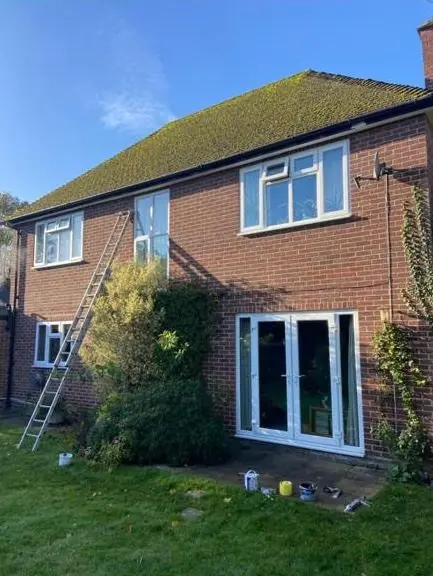
Choose smooth masonry paint for most walls, including roughcast and pebbledash, because the texture is already in the render. Textured masonry paint contains fine grit that helps hide patched repairs and fine crazing on smooth render, but it’s harder to apply evenly, picks up more dirt and is harder to change later. On sound render, smooth paint is usually the better long-term choice.
People often assume a rough wall needs a rough paint. It doesn’t. Pebbledash already has plenty of texture of its own. What it needs is a paint that flows into the gaps between the stones. A smooth acrylic does that well when it’s pushed in properly.
Textured paint earns its place on smooth render that has been patched in several places, where a smooth finish would show every repair as a flat, shiny island. It also bridges very fine hairline crazing. It won’t hide a real crack or hollow render. Those need repairing first, and our render and masonry painting service covers that preparation.
How much masonry paint do you need for pebbledash?
Pebbledash can take two to three times as much paint as smooth render. Dulux Trade’s datasheet for its Weathershield Smooth Masonry Paint gives up to 16 m² per litre on smooth, low-porosity surfaces such as render, but only 4 to 6 m² per litre on textured, low-porosity surfaces such as pebbledash. Two coats on a pebbledashed semi can easily run into tens of litres.
Those figures come from the Weathershield Smooth Masonry Paint technical data sheet (issued 08/25), which also warns that spreading rates vary with roughness and porosity and suggests a trial area if in doubt. Here is a quick way to work out your own quantity:
- Measure each wall: width times height, in metres. Gables are roughly half the triangle’s width times its height.
- Subtract big openings such as garage doors and patio doors. Leave small windows in; the extra covers wastage.
- Multiply by two for two coats.
- Divide by the spreading rate: use about 5 m² per litre for pebbledash or roughcast and about 12 m² per litre for smooth render, which is below the maximum to allow for real walls.
So 80 m² of pebbledash, two coats, at 5 m² per litre is 32 litres. The same area of smooth render at 12 m² per litre is about 13 litres. MyJobQuote’s exterior painting cost guide (last updated 6 October 2026) says a three-bed semi needs around 30 to 50 litres of masonry paint for two coats, which is in line with that sum. Buy all your tinted paint in one batch, as the datasheet advises, so the colour matches from wall to wall.
Masonry paint for cold or damp weather
A Pliolite solvent-based masonry paint is the usual choice when a wall has to be painted in cold weather. Dulux Trade says its Weathershield All Seasons Pliolite can be applied down to 0°C, provided the surface temperature is above freezing. Standard water-based masonry paint is far less forgiving: the Weathershield Smooth datasheet says not to apply it below 7°C, in rain or fog, or above 80% relative humidity.
That humidity and fog limit matters around here. On autumn mornings the Nene valley can sit in mist, and render facing north can stay damp well into the day. A wall can feel dry and still be too wet for a water-based paint.
The All Seasons Pliolite product page lists shower resistance within 15 minutes, a recoat time of 6 hours and coverage of up to 10 m² per litre. It also says brush or roller only: for health and safety reasons relating to solvent-based paints, spraying is not recommended. Solvent paint smells strongly and brushes need cleaning in white spirit, so it suits work that can’t wait for spring more than a normal summer repaint. For timing a water-based job, our guide to the best time for exterior painting explains how a decorator plans each wall around sun and dew.
Do you need a stabiliser or primer before masonry paint?
Only if the wall is chalky or powdery after cleaning. Sound bare render needs no primer, just a first coat of the masonry paint thinned with water. Dulux Trade is explicit that its stabilising primer is for surfaces that stay powdery after preparation and “should not be used as a general purpose sealer on normal or sound surfaces.” Using it everywhere adds cost and time for no benefit.
The test takes ten seconds. Rub your palm firmly across the old paint. White or coloured powder on your hand means chalking. The Weathershield datasheet says to wash down chalking paint with detergent, rinse and dry, and to seal any area that is still powdery with the stabilising primer. For new or sound bare surfaces it recommends a sealer coat of up to 1 part water to 5 parts paint instead.
The Weathershield Stabilising Primer page lists it as solvent-based, thinned with white spirit and recoatable after 16 to 24 hours. That overnight wait is why stabilising adds a day to a job.
Green algae or black mould needs killing first. The Weathershield Fungicidal Wash datasheet says to scrape off what you can, apply the wash, leave it at least an hour until dry, then brush or wash off the dead growth. It warns that skipping the removal step can discolour the new paint, and that growth trapped between old coats means those coats need to come off.
Should you paint silicone or through-coloured render?
Usually not. Silicone and through-coloured renders, used on many newer houses, carry their colour in the render and are designed to shed water while letting vapour out. K Rend’s FAQ says you shouldn’t need to paint it, just wash it down, and warns that painting it means you “will lose the water repellency and breathability the product provides.”
If you live in a newer house, at Upton or Grange Park for example, check whether the render is through-coloured before buying paint. It is easy to mistake for painted render when it gets grubby or green. Your house paperwork or the builder can tell you what render was used. The K Rend FAQ recommends washing it down, and says any power hose should be on a gentle fan setting.
If you do want a colour change, use a product the render maker approves. K Rend’s paints and coatings range includes a silicone masonry paint rated Class I for high water vapour permeability, a mineral paint and an acrylic Colour Enhance coating made to keep the render’s properties. A standard acrylic masonry paint isn’t on that list.
What paint should you use on lime render and older walls?
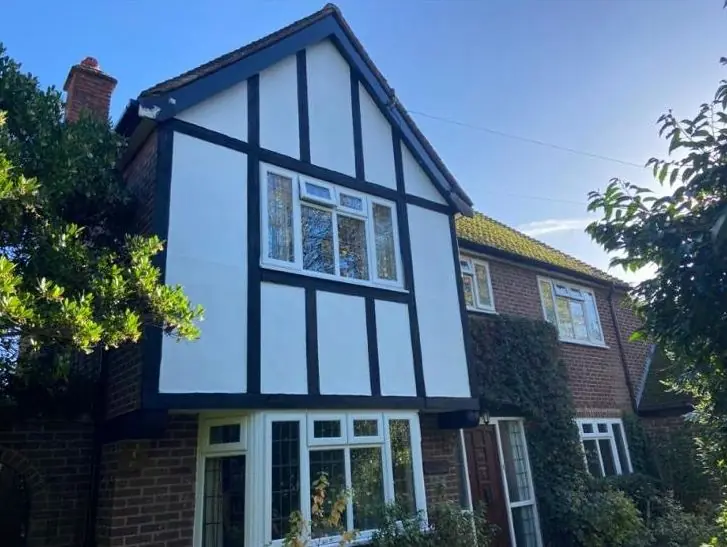
Use limewash or a mineral paint, not ordinary acrylic masonry paint. Older solid walls and lime render need to let moisture out. Babergh and Mid Suffolk councils’ conservation guidance says masonry paints “tend to be relatively unbreathable compared to limewash,” while mineral paints “tend to have similar breathability.” Breathability matters because damp needs a way out of a solid wall.
That limewash and paints guidance (October 2025) adds that where the paint surface breaks, moisture can be trapped between the plaster and the paint, which can lead to the disintegration of the plaster surface in extreme cases. The SPAB, a building conservation charity, says limewash is “considerably more ‘breathable’ than most modern paints” and suits lime render, but takes less well to cement render.
Around Northampton this applies to ironstone villages such as Moulton, older cottages with lime render, and some Victorian terraces with lime-based finishes. As a rough trade check, render on a pre-war house that is soft enough to mark with a key may be lime, so get it checked before choosing paint. If the wall is already covered in modern masonry paint, a decorator or building surveyor can advise whether to continue with it or plan a move back to a breathable finish.
Masonry paint on brick: when it works
It can, on the right brick, but think hard first because it is very hard to undo. Dulux Trade’s datasheet says its masonry paint suits brickwork “normally suitable for painting, such as rustic or sand faced bricks”, while common or Fletton bricks should not be painted. It also calls painting parapet, free-standing and retaining walls below ground-level damp-proof course inadvisable.
The reason is moisture. Those walls get wet from both sides or from the ground, and the same datasheet warns it may be difficult to prevent moisture getting in, leading to failure of the paint, and may increase the risk of frost damage and spalling. Garden walls and the low walls in front of terraces are typical examples.
If your brick looks tired rather than damaged, cleaning and repointing often look better than paint and keep the wall breathing. Once brick is painted, you are committed to repainting it every several years, and stripping it is slow and specialist work.
Do you need permission to paint the outside of your house?
Usually not. Painting a building’s exterior is permitted development under Class C of the General Permitted Development Order 2015. There are two big exceptions. Listed buildings need listed building consent for changes affecting their character, and some conservation areas have Article 4 directions that remove the right to paint without permission.
One local example: Northampton’s Abington Park Conservation Area Article 4(2) Direction (2007) lists the painting of the exterior of any part of a dwellinghouse which fronts a highway among the works it brings under control. Other conservation areas can have their own directions, and West Northamptonshire Council’s Article 4 directions page confirms these can cover exterior painting, so check with the council before changing colour. West Northamptonshire Council’s listed buildings page explains when consent is needed.
How long should masonry paint last?
A good two-coat system on a well-prepared wall can last many years. Dulux Trade says that in normal conditions two coats of Weathershield Smooth, properly applied, will perform satisfactorily for up to 15 years (as part of BBA certificate 97/3383). In practice, north faces, leaking gutters, overhanging trees and skipped prep all shorten that, which is why preparation matters more than the tin.
Exposure counts too. Dulux Trade’s Weathershield Maximum Exposure is made for harsh environments, with shower resistance in 15 minutes (the standard smooth datasheet gives 30 minutes) and application down to 7°C. It’s worth considering on exposed gables or walls beside busy roads. On a sheltered semi, standard trade masonry paint is normally enough.
Paint it yourself or get a decorator?
A single-storey wall of sound, smooth render is a fair DIY job if you check the forecast and use the right paint. Two-storey pebbledash, chalky or cracked walls, silicone or lime render, and anything near a conservation area are where a decorator usually saves you money and a repeat job.
Height is the deciding factor for most people. The HSE says ladders can be a sensible option for low-risk, short-duration tasks, and a full elevation of pebbledash is rarely either. On a two-storey house it normally means a tower or scaffold. If you are scraping old paint on windows, sills or metal near the render, take care: the Weathershield datasheet warns that pre-1960s paint over wood and metal may contain harmful lead, and the HSE’s lead FAQs say people are most at risk when removing paint in properties built before the 1980s.
For a sense of budget, MyJobQuote’s 2026 guide estimates labour alone at £300 to £800 for a semi with smooth walls and £600 to £1,400 for one with textured walls, and £2,600 to £5,700 all in for a three-bed semi. It calls these rough national estimates, and access and repairs can move them. Our painter and decorator cost guide explains what moves the price. A written quote after a visit is the only real figure.
If you would like a second opinion on which paint your walls need, Dean has more than 30 years in the trade and will come and look at the render, tell you what’s under it and give you a free written quote. Call 07539 779 036 or request a free quote.
Sources
- Weathershield Smooth Masonry Paint technical data sheet (418, issued 08/25), Dulux Trade (AkzoNobel) (accessed 2026-10-09)
- Dulux Trade Weathershield Maximum Exposure Smooth Masonry Paint, Dulux Trade (AkzoNobel) (accessed 2026-10-09)
- Dulux Trade Weathershield All Seasons Pliolite Smooth Masonry, Dulux Trade (AkzoNobel) (accessed 2026-10-09)
- Dulux Trade Weathershield Stabilising Primer, Dulux Trade (AkzoNobel) (accessed 2026-10-09)
- Weathershield Fungicidal Wash technical data sheet (1027, issued 10/23), Dulux Trade (AkzoNobel) (accessed 2026-10-09)
- Frequently asked questions, K Rend (accessed 2026-10-09)
- Paints and coatings, K Rend (accessed 2026-10-09)
- Limewash and paints: conservation advice (3rd edition, October 2025), Babergh and Mid Suffolk District Councils (accessed 2026-10-09)
- Limewash, Society for the Protection of Ancient Buildings (SPAB) (accessed 2026-10-09)
- The Town and Country Planning (General Permitted Development) (England) Order 2015, Schedule 2 Part 2 Class C, legislation.gov.uk (accessed 2026-10-09)
- Abington Park Conservation Area Article 4(2) Direction 2007, West Northamptonshire Council (accessed 2026-10-09)
- Listed buildings, West Northamptonshire Council (accessed 2026-10-09)
- Cost to Paint a House (Exterior), last updated 6 October 2026, MyJobQuote (accessed 2026-10-09)
- Ladders, Health and Safety Executive (accessed 2026-10-09)
- Lead: frequently asked questions, Health and Safety Executive (accessed 2026-10-09)
- Article 4 directions, West Northamptonshire Council (accessed 2026-10-09)
Header photo: Jan van der Wolf on Pexels. Photos of our own work appear further down the page.
Last updated by Dean, DH Painter & Decorator.