
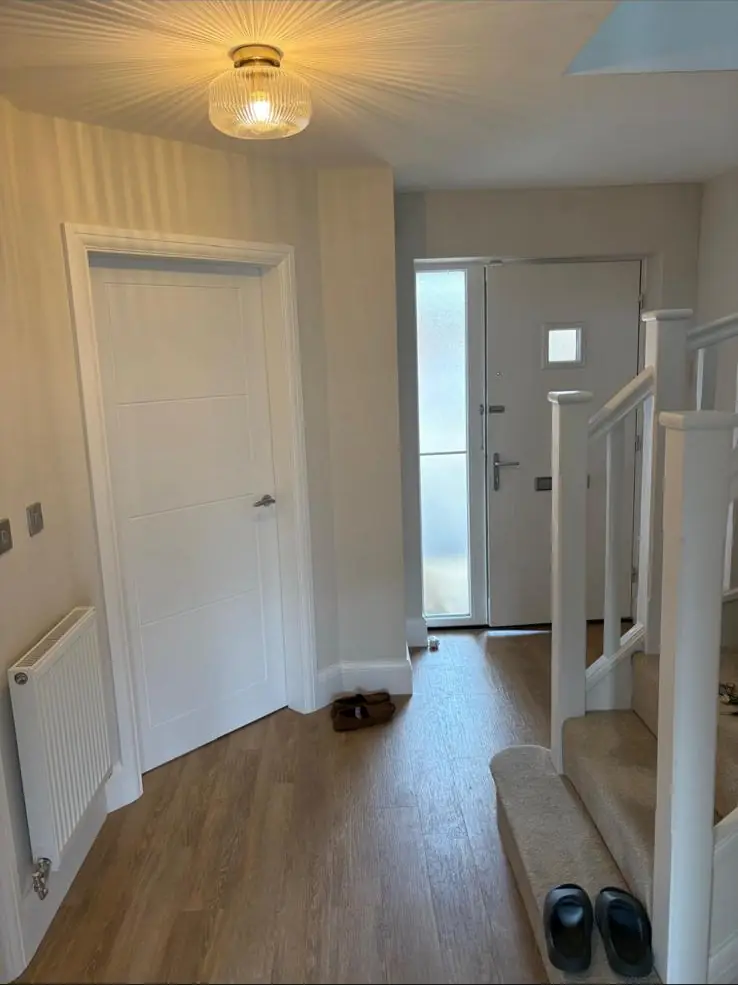
Warm mid-tones such as stone, putty, mushroom and soft sage are a safe all-round choice for most hallways, because they hide scuffs better than white or very dark shades and stay welcoming under artificial light. In a dark or north-facing hall, keep the upper wall and ceiling a warm off-white, put a deeper colour on the lower half, and use a durable matt on walls with satinwood on the woodwork.
What are the best paint colours for a hallway?
The best hallway colours are warm, slightly muted mid-tones and off-whites: stone, putty, mushroom, soft sage, warm grey-greens and earthy pinks. They reflect enough light to keep a narrow hall from feeling like a tunnel, and they’re deep enough not to show every handprint. Brilliant white and very dark shades both show wear faster. For the walls, pair the colour with a durable matt, and use satinwood on the woodwork.
A hallway has two jobs: it has to look good in poor light, often with no window of its own, and it has to survive coats, bags, shoes, bikes and hands on the way up the stairs. So the colour, the finish and where the colour stops all count.
Hallway colour ideas: named shades to try
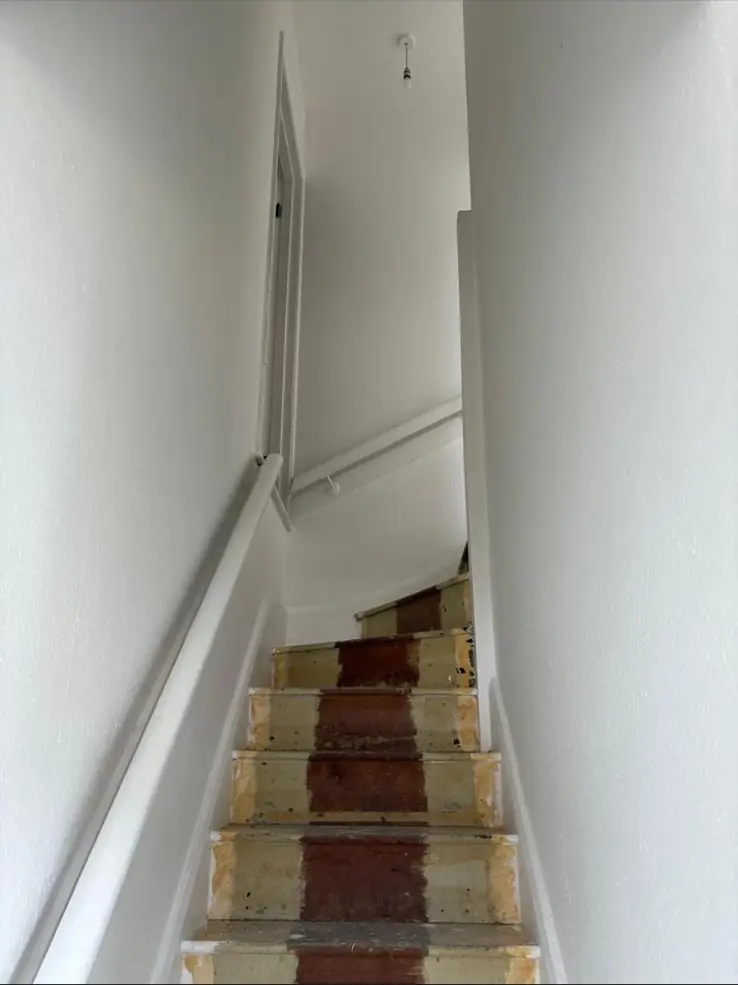
If you want a starting shortlist, both big makers publish hallway and low-light picks. The shades below are warm neutrals, stone and putty tones, and soft greens that suit the scuff-hiding, low-light brief. Order a tester of two or three, then follow the testing routine further down before committing. Colours look different on screen, so judge them on your own walls.
- Warm neutrals for a dark hall: Dulux suggests pale neutrals such as Gentle Fawn in its dark hallway advice, and warmer shades such as Desert Wind and Morning Light for north-facing rooms.
- Stone, putty and mushroom: Farrow & Ball’s neutral hallway colours include Purbeck Stone No. 275, Elephant’s Breath No. 229, School House White No. 291 and Joa’s White No. 226. They work well on the lower wall, or all over in a hall with decent light.
- Soft greens: the maker’s green hallway colours include French Gray No. 18 and Treron No. 292, a muted green-grey with an olive lean that suits a lower band under an off-white.
Which hallway colours hide scuffs best?
Mid-tone colours with a warm, slightly greyed or earthy base hide scuffs best. Think stone, taupe, olive, clay and grey-green. Scuffs are usually either dark marks (rubber, dirt, fingerprints) or pale marks where something has rubbed the surface. Pure white shows the dark marks. Deep navy, charcoal and black show the pale ones. A mid-tone shows neither strongly, so it buys you time between cleans.
A busy colour or pattern works the same way. Dulux’s hallway advice notes that a bold pattern “can hide a multitude of sins“, from crayon to mud, especially on the lower part of the wall. Here’s how the main colour families behave in a hallway:
| Colour family | Hides scuffs? | In a dark hallway | Decorator’s note |
|---|---|---|---|
| Brilliant white | Poor: shows dirt and handprints | Bright, but can look grey and flat with no daylight | Fine on ceilings. Hard work on hallway walls. |
| Warm off-white and cream | Fair | Good: keeps the hall bright without going cold | A good choice for the upper wall and ceiling of a dark hall |
| Cool grey and blue-grey | Fair to good | Poor in north light: can turn cold and dull | Test under your own bulbs before committing |
| Warm mid-tones (stone, putty, mushroom, sage) | Good | Good: soft and welcoming under warm bulbs | A safe all-rounder for most halls |
| Earthy deep tones (olive, clay, ochre) | Good | Cosy if lit well, gloomy if not | Ideal below a dado line or on the lower half |
| Very dark (navy, charcoal, near-black) | Poor for pale scuffs and rubs | Dramatic with good artificial light | Needs flat, well-prepared walls and a tough matt |
What colour makes a dark hallway look lighter?
Warm off-whites and softly muted pale shades make a dark hallway look lighter. Farrow & Ball says warm off-whites and softly muted shades can brighten spaces with little natural light. Avoid pale colours with a blue or grey base if the hall faces north, because northern light tends to bring out the cooler tones in a colour, and the result can look cold and grubby.
Dulux’s advice for dark halls is blunt: “Dark-coloured paint makes for a dark hallway“. It suggests pale neutrals, a large mirror to bounce light around, and carrying a light colour from the inside of the front door across the ceiling. For a north-facing space, Dulux recommends warm neutrals because warmer shades counteract the blue-tinged northern light.
Light-reflecting emulsions can help a little. Dulux Trade says its Light & Space paint reflects up to twice as much light as its conventional emulsions of a similar hue, though it adds that it may not do so in every case, depending on the colour chosen. Treat it as a small boost. It won’t rescue a colour that is too dark or too cool for the space.
Three practical points for a dark hall:
- Keep the ceiling lighter than the walls. In a hall with no window, the ceiling is the main reflector for the light fitting.
- Keep the landing and the hall the same colour. A change of colour halfway up the stairs chops a small space into two smaller ones.
- Check the colour where the light is worst. That’s usually the wall at the bottom of the stairs or behind the front door, not the bright patch by the glazed panel.
Should you paint a hallway a dark colour?
You can paint a hallway dark if it’s well lit by artificial light and you want it to feel enclosed and welcoming rather than airy. Farrow & Ball points out that a deep hallway colour creates contrast with the rooms coming off it, making them appear lighter and larger. It suits halls that get little daylight anyway, where a pale colour would only look grey.
Going dark has practical costs. Deep colours usually need more coats to cover, so check the coverage on the tin and allow extra. Every dent, filler patch and uneven joint shows more on a dark wall, so the preparation has to be better. Pale scuffs from bags and shoes stand out against deep shades too. A sensible compromise is to put the dark colour on the lower part of the wall or on the woodwork and keep the upper wall and ceiling light. Farrow & Ball suggests a bolder shade on woodwork as a simpler way in.
Two-tone walls: the decorator’s answer to hallway scuffs
A two-tone hallway puts a darker, tougher colour on the lower part of the wall, where bags, shoes and hands do the damage, and a lighter colour above to keep the space bright. Dulux recommends exactly this for busy halls: a darker colour for the lower half, which will better disguise marks, with a lighter shade above.
The split height matters. Dulux suggests dividing lines at picture rail or dado height. In a hallway, a decorator will usually set it so it clears the worst of the wear: the height of a pushchair handle, a school bag or a hand trailing down the stairs. On the staircase wall, the line should run parallel to the string or handrail rather than stay level, so it reads as one band from the hall to the landing.
The other benefit is cost. When the lower half gets tired in a few years, you repaint that band and the woodwork, not the full stairwell. That matters because the tall wall over the stairs is the part that needs platforms and staging to reach, which usually takes the most time and access equipment on a hall, stairs and landing job. If you’re unsure which split or colour pairing suits your hall, our colour and finish advice is part of the job when you book us to decorate.
Which paint finish should you use in a hallway?
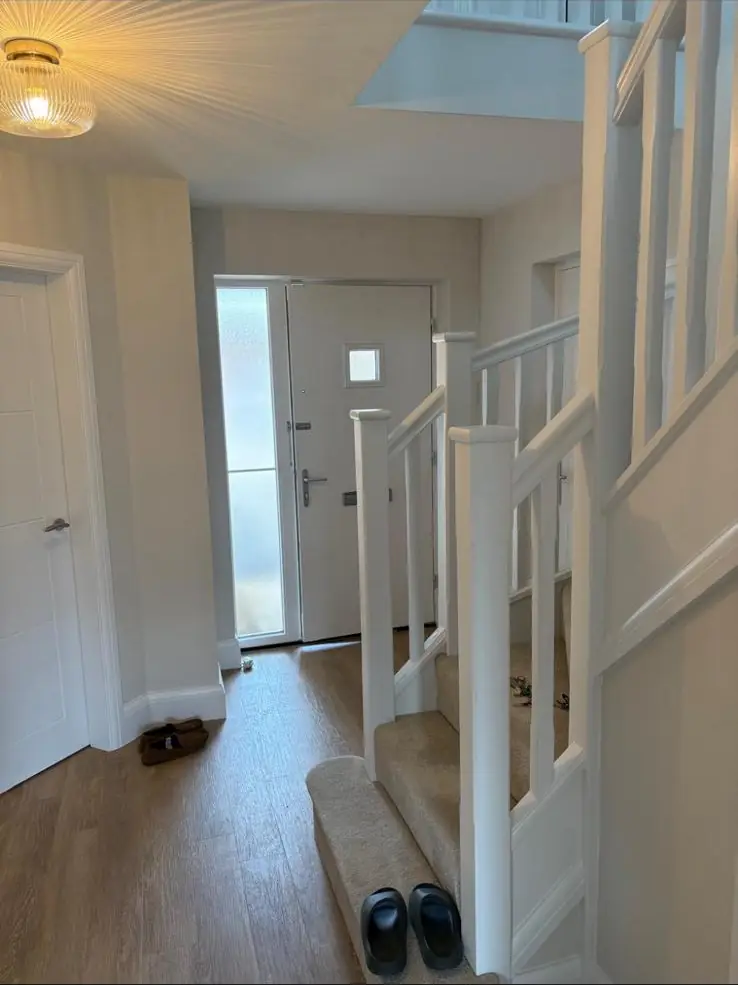
Use a durable or scrubbable matt on hallway walls and a satin finish on the woodwork. Standard matt helps to hide imperfections but is less tough, which shows in a busy hall. Silk wipes clean, but Dulux notes that on silk all the lumps and bumps may show up a bit more, which is a problem on old hallway plaster. A durable matt gives you the flat look with better washability.
For skirting, doors, spindles and the handrail, a satinwood is the usual choice. Dulux Trade Diamond Satinwood is non-yellowing and designed for high-traffic areas such as corridors, stairways and access areas, and the maker gives a recoat time of 6 hours. Satin is also easier to wipe than a flat finish. You can find out more about our approach to skirting, door and woodwork painting.
What is the most scuff-resistant paint for a hallway?
The most scuff-resistant wall paints for a hallway are durable matts rated Class 1 for wet scrub resistance, such as Dulux Trade Diamond Matt or Johnstone’s Trade Acrylic Durable Matt. EN 13300, the European standard for interior wall paints, has five wet abrasion classes, with Class 1 the most resistant and Class 5 the least. A tin that only says “tough” or “washable” gives you no test result, so look for the class on the data sheet.
What four durable matts claim, from the makers’ own pages and data sheets:
- Dulux Trade Diamond Matt is rated Class 1 under ISO 11998 and Type C under BS 7719, tested to 10,000 scrubs, and marketed for busy environments. Its data sheet says it contains scrub, scuff and stain resistant technology.
- Johnstone’s Trade Acrylic Durable Matt has a Class 1 scrub rating under ISO 11998, and Johnstone’s describes it as tough, durable and washable, and ideal for busy areas.
- Dulux Easycare Washable & Tough Matt is described as 20 times tougher than standard Dulux Matt, with hallways among its listed uses and stain repellency that makes liquid spills bead. Dulux recommends a soft, non-abrasive damp cloth for cleaning.
- Farrow & Ball Modern Emulsion is a 7% sheen matt that the maker describes as washable, wipeable, scuff and stain resistant.
The Diamond Matt data sheet adds two points that matter in a busy hall. Full durability develops 7 days after the paint goes on, and vigorous scrubbing or abrasive cleaners may impair the matt finish. So go easy on new walls for the first week, and take marks off with a soft cloth and soapy water rather than a scourer.
One trade tip: keep the leftover wall paint, labelled with the colour and room. Tougher matts can show a slightly different sheen where they’re patched, so touch-ups work best from the same tin and are feathered out, or taken corner to corner on a small wall.
How to test hallway colours in low light
Test hallway colours on large painted sheets, moved around the hall and stairs, and judged at the times you actually use the space, under your own bulbs. Dulux suggests taping A4 sheets painted with your colours to the walls and checking them at different times of day. In a hallway, that should include early morning and evening, under artificial light.
Bulbs change how a colour looks. Farrow & Ball notes that halogen and incandescent bulbs make wall colours appear warmer, cool white bulbs give a cooler cast, and neutral white bulbs most accurately replicate daylight. If your hall has cool white LEDs, a warm stone may look grey and a grey may look blue. Decide on the bulbs first, then pick the colour under them.
A decorator’s testing routine for a hallway looks like this:
- Paint two coats of each sample onto white card or lining paper, not straight onto the old wall colour.
- Put one sheet at the darkest point, usually by the bottom of the stairs, and one on the landing.
- Look at them with the front door shut, the lights on and coats hanging where they normally do.
- Hold each sample against the skirting and the floor. A cool grey beside a warm oak floor or orange-toned pine stair often looks wrong.
- Live with them for two or three days before buying the full amount.
Northampton hallways: terraces, estates and new builds
The type of house changes the right hallway colour. Long, narrow Victorian terrace halls in areas such as St James, Semilong and Abington often get daylight only through a fanlight or a glazed front door. They suit warm off-whites above and a mid-tone below. The 1970s Development Corporation estates often have open-plan halls and stairwells that work better in one calm colour throughout. New builds at Upton and Grange Park usually have bright, open stairwells, but plain contract matt on the walls can mark easily, so a durable matt is worth considering at the first repaint.
Older houses bring one safety point. HSE says you are most at risk from lead if you regularly remove existing paint coatings in properties built before the 1980s, dry sand old paint, or strip it using blow lamps or gas torches. Where paint is in good condition, it advises wet abrasive paper to key it. Older terrace hallways may still have early coats on the skirting, door frames and spindles, so don’t dry-sand old woodwork until you know what’s in it. That applies across Northampton and the surrounding villages, where pre-1980s housing is common.
Should you paint your hallway yourself or hire a decorator?
A flat hallway with no stairwell, or a ground-floor hall where you can reach everything from a stepladder, is a reasonable DIY job if you take time over the prep and testing. Bring in a decorator when the job includes the tall wall over the stairs, a lot of spindles, old woodwork that may contain lead, or a two-tone line that has to run cleanly up a staircase.
The stairwell is usually the hardest part to do yourself. Reaching it safely needs proper stair ladders, platforms or staging, not a ladder on a tread. If you are torn between two colours, paint both on large boards and leave them at the bottom of the stairs for a week: the hall’s worst light will make the choice for you. Dean is a painter and decorator in Northampton who can help you settle the colour and the split height on a visit. See how we handle hallway, stairs and landing decorating, or call 07539 779 036 for a free written quote.
Sources
- How to brighten dark hallways and stairs, Dulux (accessed 2026-10-09)
- Dr Dulux: how to childproof your hallway, Dulux (accessed 2026-10-09)
- Dr Dulux: paint finishes explained, Dulux (accessed 2026-10-09)
- Colour know-how: how lighting can affect your wall colours, Dulux (accessed 2026-10-09)
- How light affects colour, Farrow & Ball (accessed 2026-10-09)
- Hallway ideas, Farrow & Ball (accessed 2026-10-09)
- Dulux Easycare Washable & Tough Matt, Dulux (accessed 2026-10-09)
- Dulux Easycare frequently asked questions, Dulux (accessed 2026-10-09)
- Dulux Trade Diamond Matt, Dulux Trade (AkzoNobel) (accessed 2026-10-09)
- Dulux Trade Vinyl Matt Light & Space, Dulux Trade (AkzoNobel) (accessed 2026-10-09)
- Dulux Trade Diamond Satinwood, Dulux Trade (AkzoNobel) (accessed 2026-10-09)
- Lead: frequently asked questions, Health and Safety Executive (accessed 2026-10-09)
- How to create a two-tone wall, Dulux (accessed 2026-10-09)
- Dr Dulux: how to decorate a north-facing room, Dulux (accessed 2026-10-09)
- Modern Emulsion, Farrow & Ball (accessed 2026-10-09)
- Neutral hallway colours, Farrow & Ball (accessed 2026-10-09)
- Green hallway colours, Farrow & Ball (accessed 2026-10-09)
- Gentle Fawn colour details, Dulux (accessed 2026-10-09)
- Desert Wind colour details, Dulux (accessed 2026-10-09)
- Morning Light colour details, Dulux (accessed 2026-10-09)
- Purbeck stone no. 275, farrow-ball.com (accessed 2026-10-09)
- Elephant's breath no. 229, farrow-ball.com (accessed 2026-10-09)
- School house white no. 291, farrow-ball.com (accessed 2026-10-09)
- Joa's white no. 226, farrow-ball.com (accessed 2026-10-09)
- French gray no. 18, farrow-ball.com (accessed 2026-10-09)
- Treron no. 292, farrow-ball.com (accessed 2026-10-09)
- Dulux Trade Diamond Matt product data sheet (issued 08/25), Dulux Trade (AkzoNobel) (accessed 2026-11-16)
- Acrylic Durable Matt, Johnstone's Trade (accessed 2026-11-16)
- EN 13300: the quality standard for our interior paints, Brillux (accessed 2026-11-16)
Last updated by Dean, DH Painter & Decorator.


