
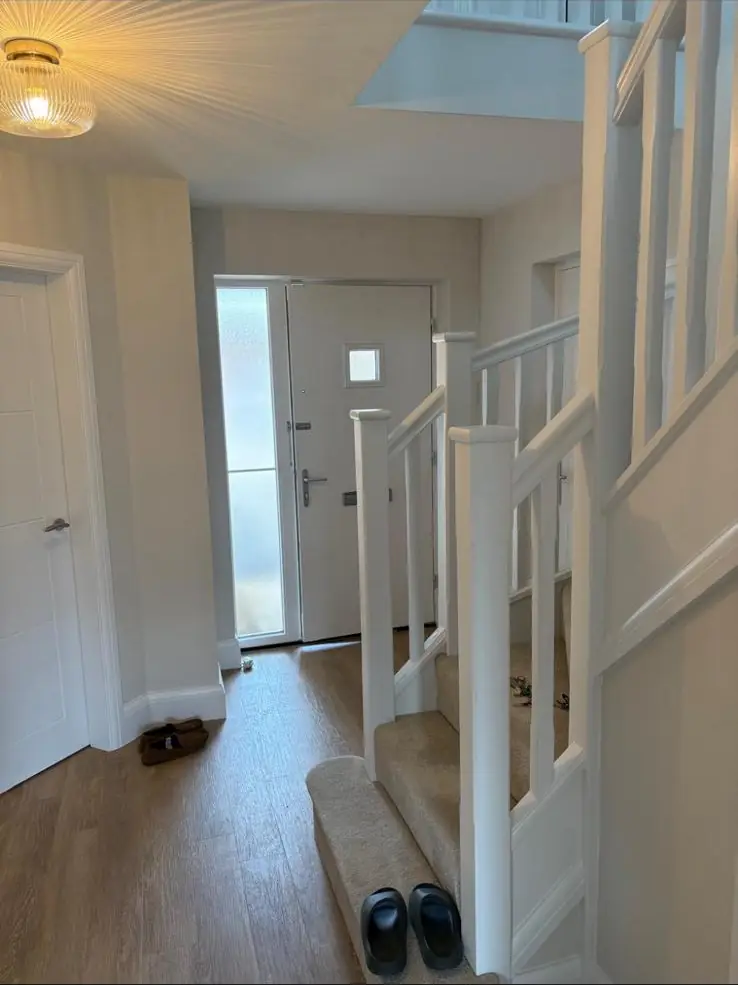
The staircase ideas that last put colour on the spindles, strings, newel posts and risers, and keep the walking line in floor paint, varnish or carpet. White spindles under a timber handrail, dark spindles, a painted runner and a colour-drenched stairwell all work, provided each part gets the right finish and every tread edge stays easy to see.
Staircase painting ideas that last
The staircase ideas that look good for years put paint where hands touch and shoes don’t: spindles, newel posts, strings and risers. Painting the treads works too, but only with a floor-grade paint and a plan for grip. Reliable choices are white or off-white spindles under a natural or dark handrail, dark spindles against pale walls, a painted runner with contrasting edges, or the whole stairwell painted in one colour.
| Idea | What gets painted | Wear on the paint | Suits |
|---|---|---|---|
| Classic two-tone | Spindles, strings, risers in white; handrail and treads left natural or dark | Low | Almost any house |
| Dark spindles, light walls | Spindles and newel post in charcoal, navy or soft black | Low | New builds and plain modern halls |
| Painted runner | Centre strip of each tread and riser in one colour, edges in another | Medium to high | Bare timber stairs with no carpet |
| Colour-drenched stairs | Walls, skirting, strings, spindles and handrail in one colour | Medium (handrail) | Narrow terrace halls |
| Painted risers only | Risers in a colour or pattern, treads carpeted or varnished | Low | Families wanting carpet underfoot |
| Fully painted treads | Every surface, including the walking line | High | Low-traffic or occasional stairs |
Which staircase ideas work best in a real house?
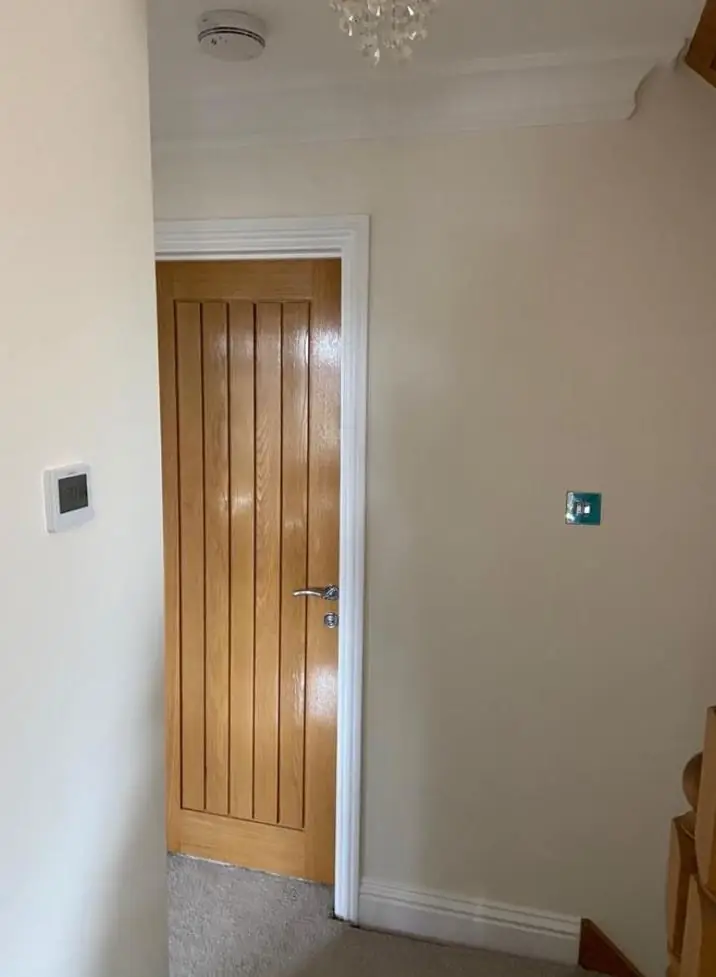
Pick the idea by how hard the stairs get used. In a busy family hall, keep paint off the walking line and put colour on the spindles, strings and risers. On a quieter staircase, painted treads and a painted runner are realistic. Whichever you choose, the handrail needs the toughest finish, because it is the part hands touch on every trip up and down.
1. White spindles, natural or dark handrail
Spindles, newel posts, strings and risers are painted in a soft white or off-white, and the handrail and treads stay as timber or are stained darker. It hides wear well because the white parts are rarely touched. A warm white such as Farrow & Ball Pointing No. 2003, which the maker calls “a warm and delicate white”, sits more gently against oak than a brilliant white. Many new-build staircases, including those in estates around Upton and Grange Park, are supplied with spindles ready for a top coat, so this scheme often means finishing what the builder started.
2. Dark spindles against pale walls
Painting just the spindles and newel posts in a deep colour gives a modern outline without touching the walls or treads. Farrow & Ball Railings No. 31 is described by the maker as “a soft black with blue undertones”, a softer option than pure black. Dark colours show dust and pale scuffs more than white does, so a wipeable satin or eggshell is worth paying for, and expect to need an extra coat over a white primer.
3. A painted runner
A painted runner is a strip of colour down the middle of each tread and riser, with the outer edges in a second colour or left as timber. It reads like a carpet runner. Mark it out with a measured template, not by eye, or the edges wander up the flight. Keep the front edge of each tread (the nosing) clearly visible; the safety section below explains why.
4. Colour-drenched staircase
Colour drenching means painting walls, skirting, strings, spindles and often the handrail in one colour, sometimes with the ceiling a shade lighter. It suits narrow Victorian terrace halls in areas like Abington or St James, where a two-tone scheme can chop a small space into stripes. Deep shades such as Farrow & Ball Hague Blue No. 30 (“a deep dark blue”) or Inchyra Blue No. 289 (“a dark blue grey”) are typical choices. Use a durable matt or eggshell on walls and a satin on the woodwork so the colour matches but the wood still wipes clean, and check the lighting (see below).
5. Painted or papered risers
If you want carpet or a runner on the treads, put the colour on the risers instead. Plain painted risers, a pattern or a stencil all work because risers take fewer knocks than treads. Toes do catch the bottom of each riser, so a satin finish there is more practical than flat matt.
6. Contrast string and skirting as one line
The string is the board that runs up the side of the stairs, holding the treads. Painting it and the skirting in the same colour, darker than the walls, draws one clean line from the hall to the landing. It makes a staircase look finished and hides the scuffs from hoovers and shoes that show on white strings.
7. Treat alternating coloured steps with caution
Rainbow or alternating coloured steps look fun in photos. An HSE research report on stairs for limited access (RR1228, 2026) modelled step colours on alternating tread stairs and found that alternating the colour of each step “provides some clarity”, but the tread edge on each side “may be lost” through lack of contrast between steps. That study looked at a special stair type, not a normal flight, but the point carries over: if you want multi-coloured steps, give every tread a clear contrasting edge. If the wall up the stairs is being panelled too, our hallway panelling ideas cover heights and finishes.
The right paint for each part of the staircase
Use a floor paint on any tread you walk on, a hard-wearing satin or eggshell on spindles, strings and risers, and the toughest finish you can on the handrail. Ordinary wall emulsion is not made for foot traffic, and on a busy staircase it wears through first at the centre of each tread, where every foot lands.
Read the data sheet before you buy. The Little Greene Intelligent Floor Paint data sheet (January 2026) describes a water-based acrylic recommended for concrete and wooden floors “subject to light to medium traffic”, applied in two to three coats with a recoat time of 1 to 4 hours minimum. It says a complete cure “can take 10-14 days”, depending on how thick the coats are and the drying conditions, and to avoid placing heavy objects on the surface for at least 10 to 14 days after painting. Farrow & Ball says its Modern Eggshell is a mid-sheen finish “tough enough for floors”. For spindles and strings, Dulux Trade says Diamond Satinwood is a water-based satin designed for high-traffic areas “such as corridors, stairways and access areas”, recoatable after 6 hours.
| Part of the staircase | Sensible finish | Why |
|---|---|---|
| Treads (walking surface) | Floor paint, or clear floor varnish on bare timber | Made for foot traffic and repeated washing |
| Risers | Satin or eggshell | Takes toe scuffs and wipes clean |
| Strings and skirting | Satin | Hoover and shoe marks wipe off |
| Spindles and newel posts | Satin or eggshell | Hard-wearing without high gloss showing every brush mark |
| Handrail | Varnish or oil on timber, or a hard satin if painted | Constant hand contact softens weaker finishes |
Preparation matters as much as the tin. The same Little Greene sheet asks for existing paint to be degreased with sugar soap, rinsed, and rubbed down with medium-grade sandpaper, and for timber moisture to be below 15% before painting. On new softwood it asks for knots to be sealed and a primer coat first. Old varnish on the treads should be sanded to a dull key, or new paint is likely to peel at the nosings.
Are painted stairs slippery?
Painted treads can be more slippery than carpet or bare sanded timber, especially in socks or when wet, and falls on stairs are a serious risk at home. RoSPA estimates that over 700 people die and over 43,000 are hospitalised every year in England due to a fall on stairs in the home, as quoted in HSE’s 2026 stair safety report.
Three things keep a painted staircase safer:
- Grip: floor paints can take an anti-slip aggregate. The Little Greene datasheet calls it essential for “safety critical areas, such as external stairways, steps and floors that are frequently wet”, and warns that polishing floor cleaners “may produce a dangerous high slip surface”. For indoor stairs used by children or older people, consider the aggregate or a fixed runner.
- A visible edge: the HSE report says increasing the conspicuity of the nosing “improves depth perception reducing the probability of foot misplacement, especially when descending”, and participants said it can be hard to tell where one tread ends when treads and nosings blend in. Approved Document K asks for a contrasting nosing at least 55mm wide on steps in buildings other than dwellings. It is not required in a house, but it is a useful benchmark for a painted runner.
- Lighting: a dark staircase with dark treads hides the step edge. If you choose deep colours, check the light on the landing and at the bottom of the flight.
What order do you paint a staircase in?
Work from the top down and from the least-touched surfaces to the most-walked: ceiling, walls, handrail, spindles, newel posts, strings and skirting, risers, then treads last. Paint the treads on alternate steps so the stairs stay usable while the first set dries, then do the rest once the recoat time has passed.
- Ceiling and stairwell walls first, from stair ladders or a stair platform made for the job. HSE guidance on where ladders should be used says to use ladders only on firm, level ground, with “proprietary levelling devices, not ad-hoc packing such as bricks, blocks, timbers”. An ordinary ladder propped on stair treads does not meet that.
- Handrail, working from the top so you don’t lean on wet paint.
- Spindles, one at a time, top to bottom on each, watching for runs on the far side. This is the slowest part of the job.
- Newel posts, strings and skirting.
- Risers, then the treads on every other step, finishing at the bottom so you can walk out.
- Second coats in the same order once the recoat time on the tin has passed.
Expect the job to stretch over several days, mostly waiting for paint to dry. MyJobQuote’s staircase painting guide (updated September 2026) says it takes approximately 8 hours in total, spread over 4 days. Treat painted treads gently for 10 to 14 days while floor paint cures.
Checks before painting an old staircase
Before you sand an older staircase, check three things: whether the old paint may contain lead, whether the house is listed, and whether you are replacing spindles rather than just painting them. Each one can change a weekend job into one that needs different methods, the council’s consent or attention to building regulations guidance.
Lead paint. Victorian and Edwardian staircases, common in Northampton’s older terraces, often carry many layers of old paint. HSE says you are most at risk when you remove existing paint coatings in properties built before the 1980s, dry sand old paint, or strip it with blow lamps or gas torches. It advises only stripping old paint “if it is flaking, chipping or it is a risk to children”, using chemical stripper, wet abrasive paper and on-tool extraction where paint is in poor condition, and wet abrasive paper to prepare paint in good condition.
Listed buildings. West Northamptonshire Council’s listed buildings page says the whole building is listed, interior and exterior, and names staircases, panelling and woodwork mouldings among internal features where alterations are likely to need listed building consent. It is a criminal offence to carry out works affecting the character of a listed building without consent, so ask the council before stripping or altering an original staircase in one.
Replacing spindles. Repainting existing spindles is simple redecoration. If you swap them for new ones, use Approved Document K as the benchmark: in a building that may be used by children under five, a 100mm sphere should not pass through any opening in the guarding, and children should not be able to climb it readily. It also puts the top of the handrail 900mm to 1000mm above the pitch line. Widely spaced decorative spindles can fail the 100mm test, so measure before you buy, and ask building control if you are unsure.
How much does it cost to paint a staircase?
MyJobQuote’s staircase painting cost guide (updated September 2026) gives a UK average of £400 for having a staircase painted. It quotes £350 to £450 for priming and painting a typical stairwell, and £225 to £700 for a single colour on a stairway with handrails. These are national guide figures for the staircase, not the hall walls, and the price for your own stairs depends on what a visit finds.
What moves the price is mostly time: the number and shape of the spindles, whether old paint or varnish has to be stripped, how many colours the scheme uses, and whether the walls and landing are done at the same time. A painted runner with masked edges takes far longer than a single colour. Our painter and decorator cost guide covers day rates and other rooms if you are pricing more of the house. For walls and woodwork together, see the cost of decorating a hall, stairs and landing.
Should you paint the stairs yourself or get a decorator?
Painting spindles and risers on a straight flight is a fair DIY job if you have patience and a free week. Call a decorator when the stairwell wall is too high to reach safely, when old paint may contain lead, or when the scheme involves several colours and crisp lines.
Whichever idea you choose, try it on paper first: photograph the stairs, print the photo and colour the spindles, strings and risers in pen to see where the lines fall. Our Northampton painting and decorating service offers hallway, stairs and landing decorating, and if you only want the woodwork done, see our woodwork and skirting painting service. For a free written quote after a visit, or a second opinion on a colour scheme, call 07539 779 036.
Sources
- Safety of stairs for limited access in dwellings: A mixed methods study (RR1228, 2026), Health and Safety Executive (accessed 2026-10-09)
- Approved Document K: Protection from falling, collision and impact (2013 edition), GOV.UK / Ministry of Housing, Communities and Local Government (accessed 2026-10-09)
- Intelligent Floor Paint technical data sheet (January 2026), The Little Greene Paint Company (accessed 2026-11-16)
- Modern Eggshell, Farrow & Ball (accessed 2026-10-09)
- Dulux Trade Diamond Satinwood, Dulux Trade (accessed 2026-10-09)
- Lead: frequently asked questions, Health and Safety Executive (accessed 2026-10-09)
- Where ladders should be used, Health and Safety Executive (accessed 2026-10-09)
- Listed buildings, West Northamptonshire Council (accessed 2026-10-09)
- Staircase painting cost guide (updated September 2026), MyJobQuote (accessed 2026-10-09)
- Pointing No. 2003, Farrow & Ball (accessed 2026-10-09)
- Railings No. 31, Farrow & Ball (accessed 2026-10-09)
- Hague Blue No. 30, Farrow & Ball (accessed 2026-10-09)
- Inchyra Blue No. 289, Farrow & Ball (accessed 2026-10-09)
Last updated by Dean, DH Painter & Decorator.


