
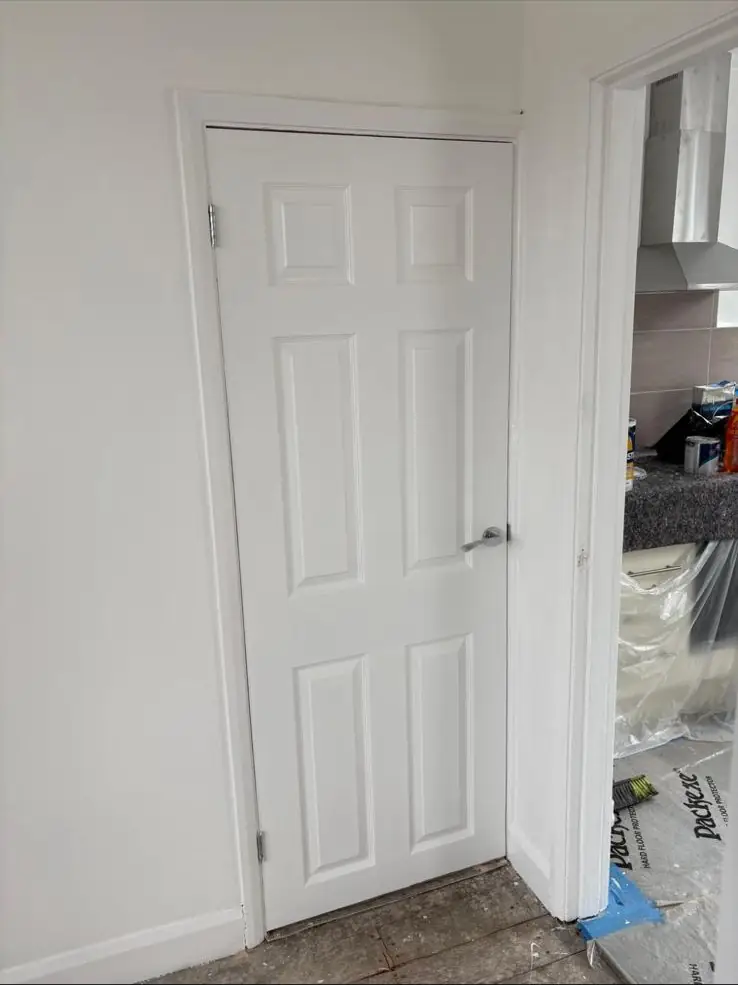
Dean paints and sprays kitchen cabinet doors, drawer fronts and frames in Northampton and nearby towns, a job often called a kitchen respray, giving sound units a new colour without replacing them. Each door is degreased, keyed and primed for what it is made of. Every kitchen gets a visit and a free written quote.
Kitchen cabinet painting and kitchen respray in Northampton
If the doors still hang straight and the carcasses are solid, a new colour is often all a dated kitchen needs. Painting the units leaves the worktops, sink, appliances and tiling where they are, so the work stays with one trade. We are painters and decorators in Northampton, and kitchen cabinet painting is part of our interior painting work, so the walls, ceiling and woodwork can be done at the same visit.
A kitchen respray and kitchen cabinet painting are the same job with a different way of putting the paint on. Spray finishes are available as well as brush and roller, and Dean will tell you at the visit which suits your doors, your colour and the way you use the room.
What the work covers
The job takes in every painted face you see when you stand in the kitchen:
- Door fronts and backs, and drawer fronts
- Visible carcass edges, end panels, plinths, cornice and pelmet
- Islands and breakfast bars, where the panels are paintable
- Kitchen walls, ceiling and woodwork, if you want the room finished in one go
Cupboard interiors, usually white melamine, are left alone, as paint inside would only scuff. Worktops, tiles and appliance fronts with their own factory finish are not part of this service.
How we paint kitchen cabinets, step by step
1. Survey and written quote
We open the doors, check the hinges and look at the backs, edges and hinge holes to see what the units are made of. Your written quote lists the doors, drawer fronts and panels, the primer and finish we plan to use and the number of coats. Our article on what a decorating quote should include explains what to check.
2. Protecting the kitchen
Worktops, floor, hob and appliances are covered, and the walls and tiles next to the units are masked. A kitchen holds a lot in a small space, so emptying the cupboards beforehand helps; our checklist on getting ready for a decorator covers the rest.
3. Doors and hardware off
Each door and drawer front is numbered to its opening so it goes back exactly where it came from. Handles and hinges are taken off and bagged with their door. Hinges are never painted: paint in the cup or on the arm stops a soft-close hinge working and chips the first time it moves. If you are changing to handles with a different hole spacing, the old holes are filled and sanded flush before priming.
4. Degreasing
Every surface is cleaned with a degreaser and rinsed, including doors that look clean. Cooking grease builds up most round the handles, along the underside of the wall units and beside the cooker. Rust-Oleum’s cupboard guide warns that its water-based paint will not stick to an oil-covered door, and the same holds for any water-based finish.
5. Keying and dust control
Sound surfaces are sanded to an even, dull key so the primer has something to grip. Ronseal’s cupboard paint instructions give 240 grit for sound wood and 120 grit where old paint is flaking, and warn that wood painted before 1960 may contain lead paint. Dust is collected with a vacuum rather than swept up. HSE notes that wood dust can cause asthma and advises against sweeping it or blowing it off with compressed air.
6. Priming
The primer depends on the surface. Bare wood, filler and cut MDF edges are primed so they do not soak up the topcoat and show as dull patches. Glossy, laminate and melamine faces get a bonding primer. Zinsser Bulls Eye 1-2-3, for example, is a water-based primer-sealer sold for its adhesion to glossy surfaces, and it also seals tannin bleed from timber such as oak.
7. Finish coats
Two thin finish coats go on with a light sand between them, door backs before faces. Thin coats dry and harden all the way through, while one heavy coat stays soft underneath and marks easily.
8. Refitting and adjusting
Doors go back on their own hinges, the handles are refitted and the hinges adjusted so the gaps line up again. We then check every door and drawer in good light and touch in anything missed.
Which kitchen surfaces can be painted?
Most kitchen units can be painted if the surface is sound and the primer matches the material:
| Surface | Paintable? | What it needs |
|---|---|---|
| Solid timber (pine, oak) | Yes | Degrease and key, then seal knots and tannin-rich timber with a stain-blocking primer |
| Painted or primed MDF | Yes | Degrease and key, then prime any bare edges, which are thirstier than the face |
| Melamine and laminate | Yes, with care | Thorough degrease, a scuff sand and a bonding primer or a cupboard paint made for melamine |
| Foil or vinyl wrap, fully stuck | Sometimes | A test door first, then a key and a bonding primer |
| Foil or vinyl wrap, lifting or bubbled | No | New doors, or the wrap stripped where the board underneath is sound |
| Swollen or water-damaged MDF | No | A new door or panel, because paint will not hide a blown edge |
When painting is not the right answer
Vinyl wrap that has started to peel, usually on doors beside the oven or above the kettle, will carry on peeling under new paint. The glue under the wrap is failing from heat and steam, and a coat of paint only seals the bubble in for a while. The same goes for MDF swollen by a leaking sink or dishwasher, warped doors and carcasses that no longer hold a hinge screw. Where only a few doors are affected, replacement doors in a paintable finish can be painted with the rest. Where most of the kitchen is like that, we will tell you plainly that paint is not worth the money.
Brush and roller or spray finish?
Either lasts well on good preparation. The difference is in the look:
- Spray lays down a flat, even film with no brush or roller texture, which suits smooth slab doors and handleless kitchens. It needs more masking and tighter control of dust and overspray.
- Brush and roller leaves a very fine texture close to a traditional hand-painted kitchen, and suits shaker and in-frame doors with mouldings. It is also the usual way to paint fixed panels and carcass edges.
Many water-based trade finishes can go on either way. Dulux Trade Diamond Satinwood, for example, can be brushed or rolled, is listed as most suitable for HVLP spray, and is sold as non-yellowing.
Paint systems and finishes
A cabinet paint system has three parts chosen to work together: the cleaner, the primer and the topcoat. For the topcoat we use water-based trade satin or eggshell made for woodwork and hard wear, not wall emulsion. Dulux Trade Diamond Eggshell is one example: it is water-based, can be applied by brush, roller or spray, and is rated Class 1 for scrub resistance under ISO 11998. Eggshell gives a softer, flatter look, while satin reflects a little more light and wipes clean more easily. Our article on eggshell, satin or gloss compares the sheens, and our colour and finish advice looks at the worktop, floor and daylight before you choose a shade.
How long does kitchen cabinet painting take?
Most kitchens are out of normal use for several days, and large kitchens for longer. How long yours takes depends on:
- the number of doors, drawer fronts and panels
- how much degreasing and repair they need
- whether the surface needs a bonding or stain-blocking primer
- a big colour change, such as dark wood to white, which can need an extra coat
- room temperature and ventilation, which slow or speed drying
Drying is not the same as hardening. Trade finishes can be recoated within hours: Dulux lists 4 to 6 hours for Diamond Eggshell and 6 hours for Diamond Satinwood. Hardness takes far longer, and Zinsser gives Bulls Eye 1-2-3 a full cure time of 7 days. Your quote includes a realistic schedule.
How much does kitchen cabinet painting cost?
Published UK price guides put professional kitchen cabinet painting at about £600 to £1,600 for an average kitchen, or £60 to £100 a cabinet. The table gives their ranges, with new doors for comparison. They are national figures for sense-checking a quote, not DH Painter & Decorator’s prices.
| Job | Typical UK range (2026) | What the range covers |
|---|---|---|
| Kitchen cabinets painted or resprayed, average kitchen | £600 to £1,600 per kitchen | MyJobQuote gives £600 to £1,500 for the cabinets in an average kitchen, depending on the number of units. Ideal Home quotes a kitchen designer at £800 to £1,600 for a full spray respray. Sources: MyJobQuote, Ideal Home. |
| Kitchen cabinets, small 8m² kitchen | £480 to £920 per kitchen | MyJobQuote's materials-and-labour figure for painting the cabinets in a small 8m² kitchen. Its labour-only figure for the same job is £450 to £800. Typical time: 3 to 4 days. Source: MyJobQuote. |
| Kitchen cabinet painting, per cabinet | £60 to £100 per cabinet | MyJobQuote gives £60 to £80 a cabinet. Ideal Home quotes a kitchen designer at £80 to £100 a cabinet for professional brush or roller painting. Sources: MyJobQuote, Ideal Home. |
| Full kitchen respray, spray finish | £800 to £1,600 per kitchen | Ideal Home's expert range for a full spray respray, with premium services at £1,500 to £7,000. Homebuilding & Renovating's experts say around £800 for a small kitchen, and that a respray can start from around £1,400 depending on size. Sources: Ideal Home, Homebuilding & Renovating. |
| New doors instead: 11 to 15 cupboard doors replaced | £500 to £1,400 supplied and fitted | MyJobQuote's range for supplying and fitting 11 to 15 standard, off-the-shelf doors on the existing carcasses, for comparison with painting them (6 to 10 doors: £300 to £900). Made-to-measure or solid wood doors cost considerably more. Typical time: half a day to 1 day. Source: MyJobQuote. |
Your price depends on the number of doors and drawer fronts, their condition and what they are made of. Laminate and wrap need more preparation than painted wood. The primer, a spray or brushed finish, a big colour change and whether the walls and ceiling are being painted at the same time all count too. Our painter and decorator cost guide sets out typical UK rates. Dean prices your kitchen after seeing it, and his free written quote is the figure that counts.
Looking after painted cabinets
- Treat the doors gently for the first week or two while the paint hardens, and open and close them by the handle
- Clean with warm soapy water and a soft cloth; Ronseal advises avoiding abrasive cleaners
- Wipe off splashes and steam marks instead of leaving them to dry on
- Keep the kettle and toaster out from under the wall units, where heat and steam collect
- Keep the leftover paint, labelled with the colour, for touching in chips later
Kitchen painting around Northampton
We paint kitchens across Northampton, and from our Northampton base we also cover nearby towns including Kettering and Wellingborough, as well as Corby, Milton Keynes and Bedford. If the doors are only part of the job, our woodwork and door painting covers internal doors, frames and skirtings in the same finish. Wardrobes, dressers and other pieces are on our furniture painting page, and plastic windows and doors on uPVC spraying.
Book kitchen cabinet painting
For a free quote, call Dean on 07539 779 036, email office.dhpainter@gmail.com or ask for a quote online. Photos of the doors and a close-up of one edge help us see what they are made of.
Sources
- How to paint your kitchen cupboards, Rust-Oleum (accessed 2026-11-26)
- One Coat Cupboard Paint (water-based), Ronseal (accessed 2026-11-26)
- Wood dust, Health and Safety Executive (accessed 2026-11-26)
- Bulls Eye 1-2-3, Zinsser UK (accessed 2026-11-26)
- Dulux Trade Diamond Satinwood, Dulux Trade (AkzoNobel) (accessed 2026-11-26)
- Dulux Trade Diamond Eggshell, Dulux Trade (AkzoNobel) (accessed 2026-11-26)
- Kitchen Painting Cost: How Much Does It Cost in the UK?, MyJobQuote (accessed 2026-11-26)
- How much it costs to paint a kitchen: the breakdown, Ideal Home (accessed 2026-11-26)
- Kitchen respray cost: how much you can expect to pay and what's involved, Homebuilding & Renovating (accessed 2026-11-26)
- Kitchen Door Replacement Cost Guide (UK 2026 Prices), MyJobQuote (accessed 2026-11-26)
Last updated by Dean, DH Painter & Decorator.


