
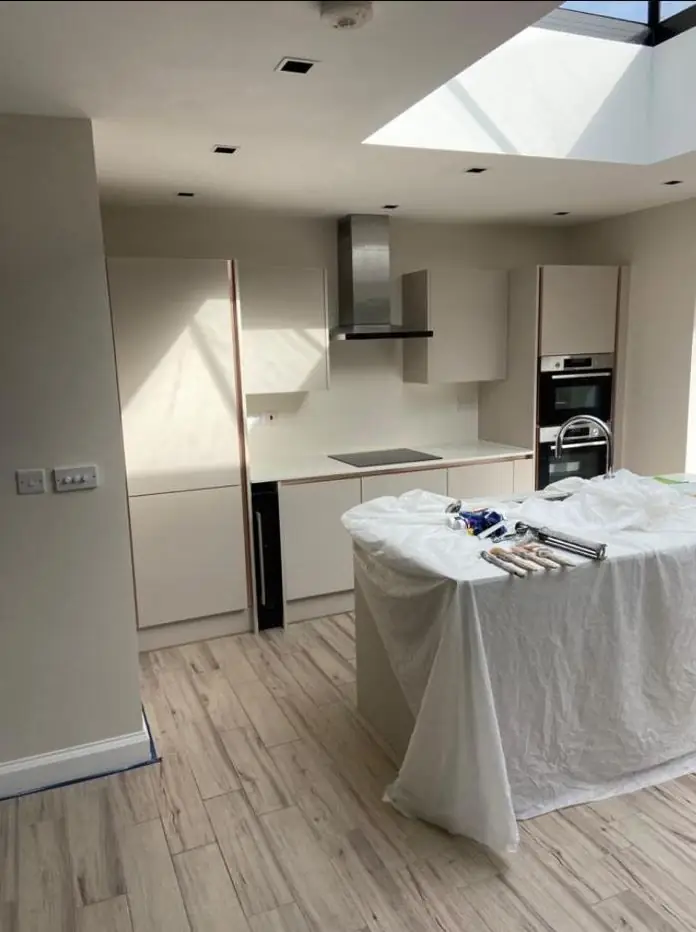
Nearly a quarter of Harlestone households rent privately, mostly whole houses and cottages, so Dean plans larger voids room by room and uses breathable paints on older stone homes. We decorate for landlords and letting agents.
| Fact | Detail | Source |
|---|---|---|
| Privately rented households | 22.6% (West Northamptonshire 19.1%) | Nomis (ONS) |
| Social rented households | 5.4% (West Northamptonshire 14.4%) | Nomis (ONS) |
| Shared or converted houses (HMOs) | 0 households; 6 purpose-built flats | Nomis (ONS) |
| Althorp Estate | Sold many village properties to private owners in 1990 | Wikipedia |
| Homes with four or more bedrooms | 41.3% | Nomis (ONS) |
Who rents in Harlestone, and what do they rent?
A larger share of Harlestone is privately rented than you might expect in a small village. The Census 2021 figures for the two output areas that make up the parish show 22.6% of households renting privately, 20.8% through a landlord or letting agent. That is above the West Northamptonshire figure of 19.1% and England’s 20.5%. Social renting is the other way round: 5.4% in Harlestone against 14.4% across the council area.
| Tenure (Census 2021) | Harlestone | West Northamptonshire | England |
|---|---|---|---|
| Owned | 69.2% | 64.8% | 61.3% |
| Private rented | 22.6% | 19.1% | 20.5% |
| Social rented | 5.4% | 14.4% | 17.1% |
The split is fairly even between the two halves. In the Upper Harlestone output area, 27 of 110 households rent privately; in Lower Harlestone, 23 of 111.
Whole houses and cottages, not bedsits
The Census found no households in converted or shared houses, so there are no HMOs or bedsits in the parish, and only six purpose-built flats, all in Upper Harlestone. Lets here are whole houses and cottages, and many of them are large: 41% of homes have four or more bedrooms. For a landlord that changes what a turnaround looks like. Rather than a quick repaint of a one-bedroom flat, a void in Harlestone is more likely to mean a family house with several bedrooms, a hall, stairs and landing, and often a garden with fencing. We plan it as a sequence: the rooms that need most work first, the hall and stairs last, so new marks from moving furniture are not left behind.
Turning round a stone or listed cottage between tenants
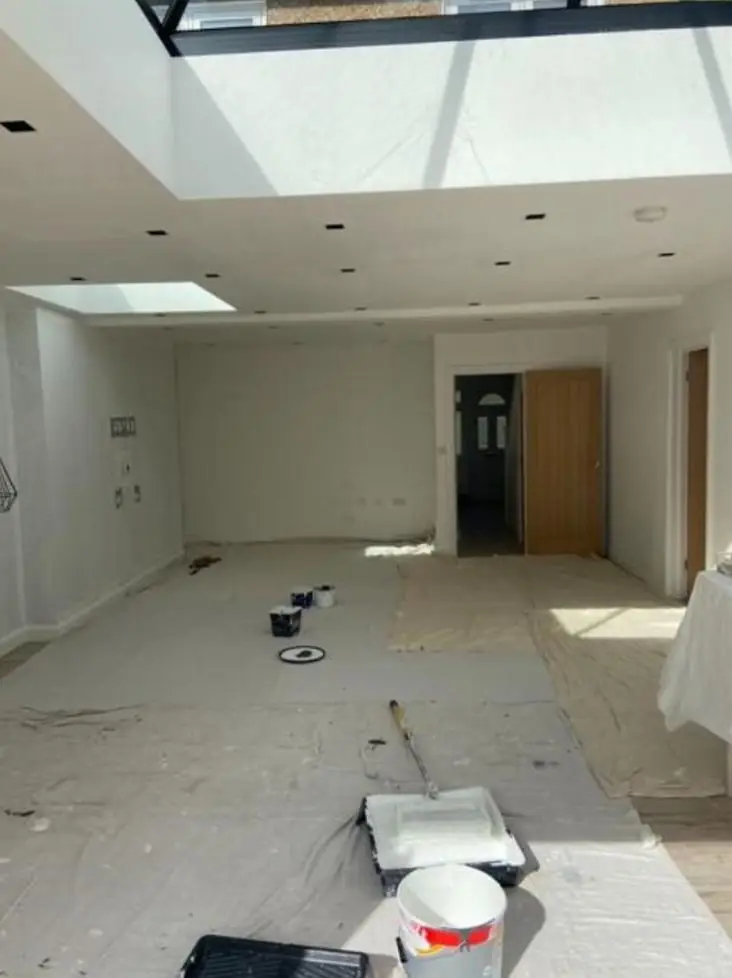
Some of the parish’s rented homes may be older stone cottages in the conservation area, and some may be listed. That limits what can go on the walls. A hard-wearing vinyl emulsion, the usual choice for a rental, is the wrong product on solid stone walls with lime plaster, because it traps moisture and leads to the very damp and mould complaints a landlord wants to avoid. So between tenancies in those cottages we:
- use breathable paints on the solid walls, in a neutral colour that is easy to touch up at the next change;
- keep joinery colours like-for-like, especially on windows and doors facing the road, where the conservation area guidance and, on scheduled houses, the Article 4 Direction apply;
- note any damp, mould or cracking in the photo record we give you at the end, so it can be dealt with before it becomes a dispute;
- avoid replacing original doors or windows, which on listed and Article 4 houses needs consent.
Homes in Upper Harlestone that are off the gas grid often rely on oil or electric heating. Some tenants heat only part of the house to save fuel, which leaves cold rooms where condensation collects. A note in the move-in pack about keeping rooms ventilated and evenly heated helps the decoration last.
Outside, the timber windows and doors on the older cottages need repainting on a regular cycle whoever lives there. Booking that work during a void, or agreeing access with a sitting tenant in good weather, keeps the joinery from reaching the point where it needs a joiner, which is a far bigger job than a repaint. Where a let has a garden, see fence and gate staining in Harlestone.
| Tenure | Share |
|---|---|
| Owned | 69.2% |
| Social rented | 5.4% |
| Private rented | 22.6% |
| Type | Share |
|---|---|
| Detached | 46.4% |
| Semi-detached | 34.1% |
| Terraced | 16.8% |
| Flat or maisonette | 2.7% |
Source: Census 2021 (ONS), tenure (TS054) and accommodation type (TS044) tables via Nomis. The figures are for the census area that best fits Harlestone, so its edges are not exactly Harlestone’s. Smaller groups are not shown, so the shares do not add up to 100%.
The Althorp Estate’s part in the village
For a long time much of Harlestone was let by one landlord. Earl Spencer of Althorp bought the estate in 1829, built many of the village’s workers’ cottages, and the Althorp Estate sold many village properties to private owners in 1990. The appraisal notes that it remains the major landowner. Where a let is one of those cottages with shared estate details, such as projecting gables and the same chimney design, matching colours across a row matters.
Our main landlord and letting agent decorating page covers how we work with agents, keys and inventories. For the stone cottages, see also interior painting in Harlestone. To budget for a void, use our cost guide, and for the stone and estate cottages, the Harlestone overview.
Sources
- Census 2021 TS054 Tenure, Harlestone output areas, Nomis (ONS) (accessed 2026-11-16)
- Census 2021 tenure, West Northamptonshire and England, Nomis (ONS) (accessed 2026-11-16)
- Census 2021 TS044 Accommodation type, Harlestone output areas, Nomis (ONS) (accessed 2026-11-16)
- Census 2021 TS050 Number of bedrooms, Harlestone output areas, Nomis (ONS) (accessed 2026-11-16)
- Census 2021 TS046 Central heating, Harlestone output areas, Nomis (ONS) (accessed 2026-11-16)
- Harlestone, Wikipedia (accessed 2026-11-16)
- Harlestone Conservation Area Appraisal and Management Plan (July 2017), West Northamptonshire Council (accessed 2026-11-16)
- Article 4(1) Direction, Harlestone Conservation Area, West Northamptonshire Council (accessed 2026-11-16)
Last updated .


