
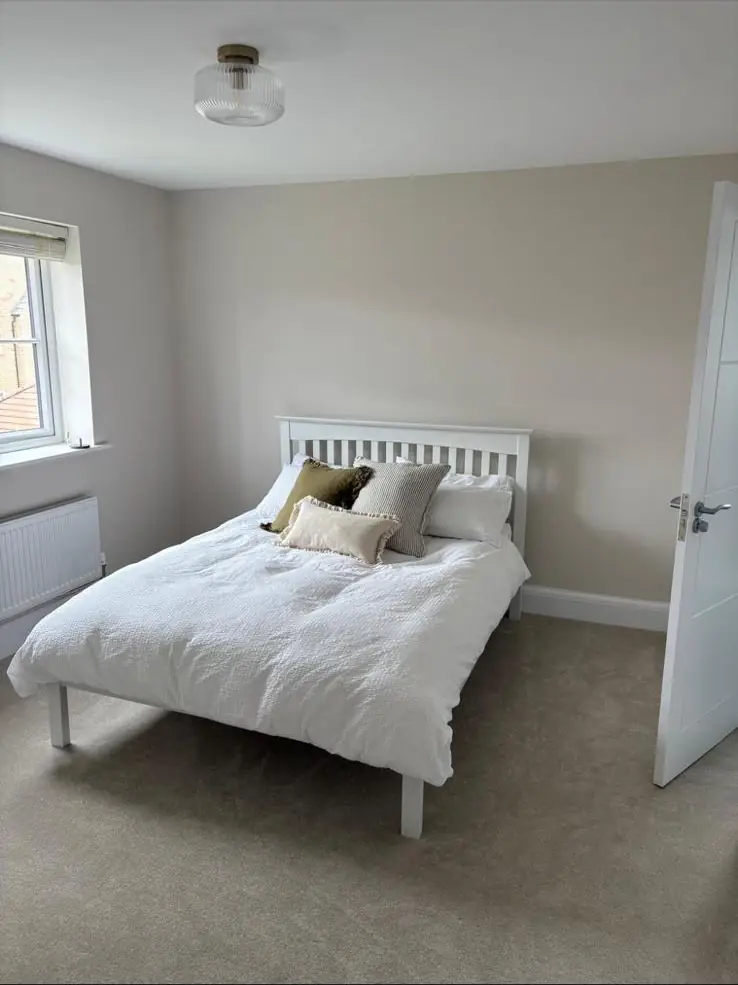
DH Painter & Decorator paints interiors across Lings, the NN3 neighbourhood about 3.3 miles north-east of Northampton town centre. Most homes here are three-bed court houses built between 1973 and 1982, so Dean quotes room by room after looking at the house, for owners, landlords and shared-ownership households.
| Fact | Detail | Source |
|---|---|---|
| Three-bedroom homes | 54.0% of Lings homes (Census 2021); West Northamptonshire 39.1% | Nomis (ONS) |
| Built 1973-1982 | About 1,090 of 1,300 homes in LSOAs 014A and 014C (VOA, March 2026) | GOV.UK |
| Wall construction (EPC sample) | 48 cavity, 38 system built, 36 timber frame of 145 certificates | EPC register |
| Owner-occupied | 44.1% of households; West Northamptonshire 64.8% | Nomis (ONS) |
The typical Lings interior: three bedrooms, built 1973-82
In the 2021 Census, 54.0% of Lings homes had three bedrooms, against 39.1% across West Northamptonshire, and 53.2% were terraced, more than double the district share. Valuation Office records put about 1,090 of the roughly 1,300 homes in the two Lings statistical areas in the 1973-1982 build period, which is the main phase of the New Town estate. So the typical Lings interior is a three-bed court house of that age, with modest, regular rooms, a straight stair and very little in the way of cornices, picture rails or deep mouldings to cut in around.
That regularity helps. Ceilings are a normal height, walls are mostly flat and square, and a whole-house repaint can be planned room by room so you keep the use of most of the house while we work. The variable is not the layout. It is what the walls are made of, and that changes from one court to the next.
Three wall types behind the same emulsion
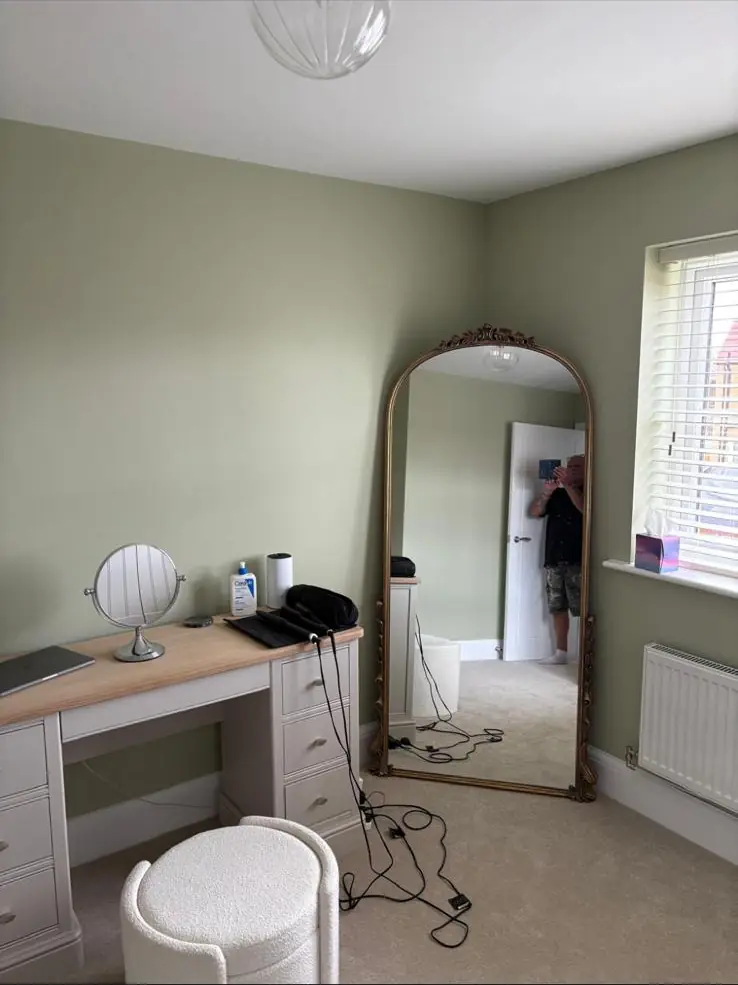
Energy certificates for 145 Lings homes across 22 postcodes record 48 cavity walls, 38 “system built” walls (the assessor’s term for non-traditional construction) and 36 timber-frame walls, with the rest new builds or unstated. Inside, a timber-frame house, and many non-traditional ones, has plasterboard on the outside walls rather than wet plaster. Board behaves differently under a brush and a scraper: screw heads pop, the paper face tears if a filling knife digs in, and over-sanding raises the fibres. On board we use a lightweight filler, seal any torn face before the emulsion goes on, and sand by hand with a fine paper.
| Wall type | Where the Lings EPCs record it | What it changes indoors |
|---|---|---|
| Timber frame | Rillwood Court, Wade Meadow, Ellfield Court, and 6 of 7 flats sampled at NN3 8NE | Plasterboard on outside walls: gentle filling, sealed repairs, no aggressive sanding |
| System built | Hangerfield Court (4 of 7), Nethermead Court (5 of 7), Poppyfield Court (4 of 7) | Lining varies by system, so we check it before raking out any crack |
| Filled cavity | Lingswood Park and North Priors Court (13 of 14), West Priors Court (6 of 7) | Plastered masonry that takes firmer preparation |
| 2019-22 new build | Emmanuel Court and Emmanuel Gardens, 1-7 Hayeswood Road | Contract matt over new board; see new plaster and new-build painting in Lings |
| Type | Share |
|---|---|
| Detached | 16.3% |
| Semi-detached | 18.6% |
| Terraced | 53.2% |
| Flat or maisonette | 11.9% |
Source: Census 2021 (ONS), accommodation type (TS044) tables via Nomis. The figures are for the census area that best fits Lings, so its edges are not exactly Lings’s.
Do you paint the smaller flats around Nethermead Court?
Yes. Not every Lings interior is a three-bed. In the output area around Nethermead Court, 66 of 149 households live in purpose-built flats and 59 homes there have one bedroom. A one-bed flat is a short job of small rooms, and the main planning point is carrying sheets, steps and tins up from wherever the van can stop. VOA also records about 100 homes in Lings statistical area 014C built in 1965-72, before the main estate. The sources do not say which courts those are, so we look at each house as we find it rather than assume its walls match its neighbours.
Who books interior work in Lings, and what they tend to ask for
Owner-occupiers are a minority here: 44.1% of households own their home, against 64.8% across West Northamptonshire. A further 23.5% rent privately and 29.2% rent from the council or a housing association. That mix changes what each household needs:
- Owners selling usually want a neutral, clean whole-house repaint, with scuffed woodwork brought back at the same time.
- Private landlords want a hard-wearing emulsion that can be touched up between tenants; our landlord decorating page for Lings covers re-lets.
- Council and housing association tenants should read their tenancy agreement on decorating before booking anything beyond a straightforward repaint.
- Shared-ownership households, 37 of them in Lings, mostly in the output area around Billing Brook Road and Emmanuel Court, should check the lease for any conditions.
Our main interior painting service page sets out how we prepare walls, ceilings and woodwork in any house. The price depends on the number of rooms and their condition rather than the postcode; the painter and decorator cost guide explains how a quote is put together. For outside work and the other services we cover in this part of NN3, see the Lings area page.
Sources
- Census 2021 TS050 number of bedrooms, Lings output areas and LSOAs 014A/014C, Nomis (ONS) (accessed 2026-11-16)
- Census 2021 TS044 accommodation type, Lings output areas and LSOAs 014A/014C, Nomis (ONS) (accessed 2026-11-16)
- Census 2021 TS054 tenure, Lings output areas and LSOAs 014A/014C, Nomis (ONS) (accessed 2026-11-16)
- Council Tax stock of properties 2026, table CTSOP4.1 (build period and band), Valuation Office Agency (accessed 2026-11-16)
- Energy Performance Certificate register, search by postcode (145 Lings certificates), GOV.UK (accessed 2026-11-16)
Last updated .


