
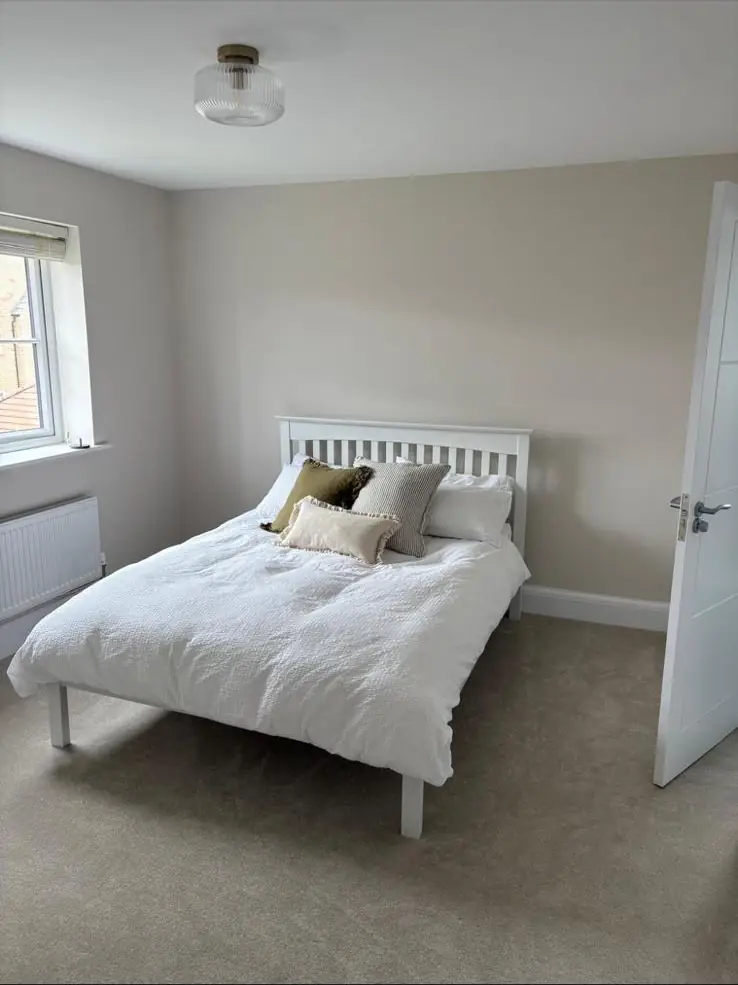
Interior painting in Weston Favell runs from dated stone cottages on High Street, where old lime plaster needs a paint that lets the wall breathe, to 1930s semis and 1980s-90s detached houses with ordinary plaster. Dean tests the walls where it matters and quotes free.
What do the dates on High Street tell you about the walls inside?
Several houses on High Street say when they were built. The Grange at no. 105 is dated 1812, no. 95 is 1820, nos 36-38 carry 1832 and no. 30 is 1839. Further on, Devonshire Cottages at 97-103 are dated 1879 and no. 40 is 1884. Behind each of those fronts is a solid wall of coursed limestone rubble, somewhere between about 140 and 215 years old, with no cavity and, in most cases, a lime plaster face on the room side.
Lime plaster on solid stone lets moisture pass both ways. Seal it under a vinyl emulsion and damp that used to leave through the room face gets trapped in the plaster. The first sign is nearly always the same: paint blistering or peeling in a band just above the skirting on an outside wall, sometimes with a musty corner behind furniture. For walls like these Dean uses breathable mineral or clay-based emulsions. Where earlier modern paint has already started to lift, it is scraped back first, because a new coat laid over failing paint fails along with it.
Before choosing a paint he scratches and wets a hidden patch to see whether the wall carries distemper, limewash or layers of modern emulsion, and takes moisture readings low on the outside walls. Cracks in lime are filled with a soft, compatible filler, and rooms that are out of square are cut in to the line of the room rather than to a spirit level.
| Fact | Detail | Source |
|---|---|---|
| Dated fronts on High Street | The Grange 1812, no. 95 1820, nos 36-38 1832, no. 30 1839, Devonshire Cottages 1879, no. 40 1884 | West Northamptonshire Council |
| The Rectory, 48 Church Way | About 1758, additions 1777; red brick with a coursed-rubble west wing | West Northamptonshire Council |
| Detached homes | 57.0% of the 547 homes in the village output areas (West Northamptonshire 31.7%) | Nomis (ONS) |
| Owned outright | 53.4% of households (Census 2021) | Nomis (ONS) |
| Listed entries | 14 in or at the edge of the conservation area | British Listed Buildings |
Listed interiors: when a repaint needs consent
Fourteen list entries sit in and at the edge of the conservation area. Among the houses are The Grange, 10 High Street, The Priory at 113, 21, 21A, 22, 23 and 26 High Street, the Rectory at 48 Church Way and Hervey’s Cottage at 56. Listing covers the inside of a building, not only its front. Repainting a room in the same kind of paint is maintenance. Stripping historic finishes, hacking off old plaster or changing the character of a room is where listed building consent comes in, and the conservation officer at West Northamptonshire Council is the one to ask before the job is booked.
The Rectory shows why a survey matters in these houses. The Rev. James Hervey built it in about 1758, with additions in 1777, in red brick, but its west wing is coursed rubble. Two rooms in one house can need different paint.
Mostly detached, mostly long-owned
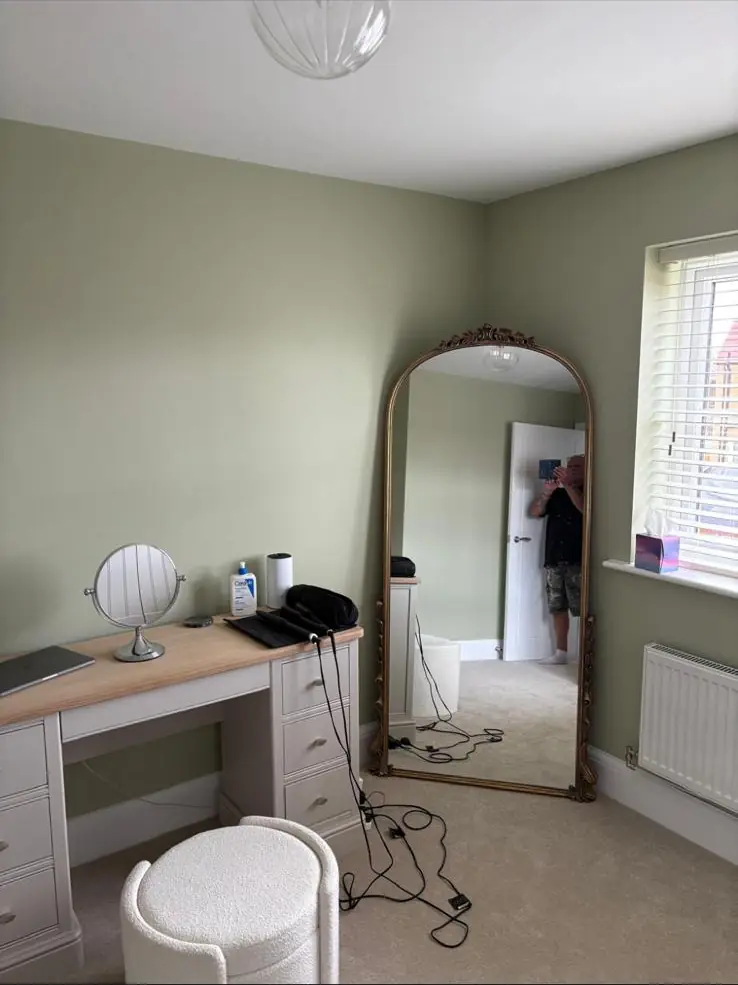
Census 2021 counts 547 homes in the four output areas that take in the village and its edges. 57% are detached and only 8.4% terraced. 88.2% of households own their home, well above the 64.8% across West Northamptonshire, and 53.4% own it outright. These are mostly larger houses that stay lived in while they are decorated, so Dean clears, sheets and finishes one room before moving to the next, and the rest of the house carries on as normal.
The same NN3 postcode also takes in streets built across seventy years, and each era brings its own preparation:
| Built | Examples | What the walls usually need |
|---|---|---|
| 1812 to 1884 | Dated cottages on High Street | Test the old finish, soft filler, breathable mineral or clay emulsion |
| 1930 to 1949 | Weston Way, Park Way, Meadway | Older plaster with patched repairs; fill, spot-prime, then two coats |
| 1967 to 1975 | Thorburn Road, Favell Way, Neale Close bungalows | Sound plaster in most rooms; wipeable finishes in kitchens and halls |
| 1983 to 1995 | Clumber Drive, Rufford Avenue, Nesbitt Close | Straight repaint; fill the usual hairline cracks where walls meet ceilings |
| Type | Share |
|---|---|
| Detached | 57% |
| Semi-detached | 25% |
| Terraced | 8.4% |
| Flat or maisonette | 9.5% |
Source: Census 2021 (ONS), accommodation type (TS044) tables via Nomis. The figures are for the census area that best fits Weston Favell, so its edges are not exactly Weston Favell’s.
Shade, trees and north-facing rooms
Mature trees round the church and churchyard, many of them under Tree Preservation Orders, shade a good number of the older houses. Rooms on that side are darker and their outside walls slower to dry, so they are where moisture readings matter most and where a warmer, lighter colour does the most work. If the room also needs papering, our wallpaper hanging page for Weston Favell covers lining uneven stone walls.
For the full preparation and paint systems we use on all kinds of house, see our interior painting service. For what a room or a whole house tends to cost, read the decorating cost guide, and for everything else we do in the area, go back to the Weston Favell overview.
Sources
- Weston Favell Conservation Area Appraisal and Management Plan (March 2010), West Northamptonshire Council (accessed 2026-11-16)
- Listed buildings in Park Ward, Northampton, British Listed Buildings (accessed 2026-11-16)
- The Grange, Northampton, British Listed Buildings (accessed 2026-11-16)
- Census 2021 TS044 accommodation type, output areas E00138658, E00138659, E00138661, E00138662, Nomis (ONS) (accessed 2026-11-16)
- Census 2021 TS054 tenure, output areas E00138658, E00138659, E00138661, E00138662, Nomis (ONS) (accessed 2026-11-16)
- Census 2021 TS044 accommodation type, MSOA West Northamptonshire 029 and West Northamptonshire, Nomis (ONS) (accessed 2026-11-16)
- NN3 3BN postcode profile, checkmypostcode.uk (accessed 2026-11-16)
Last updated .


