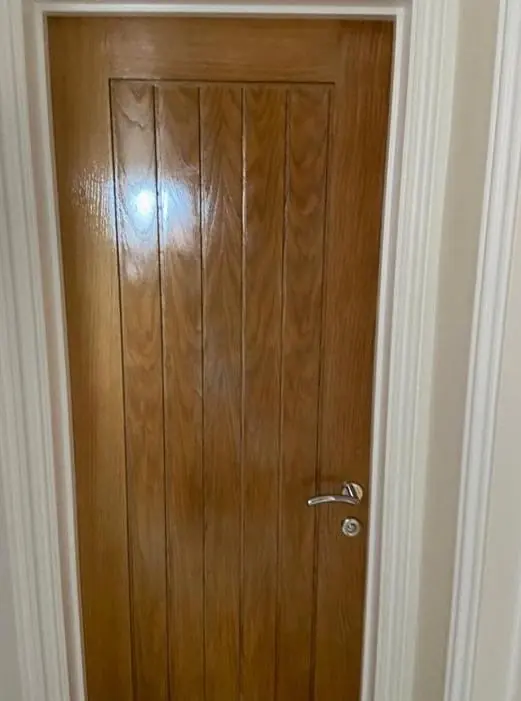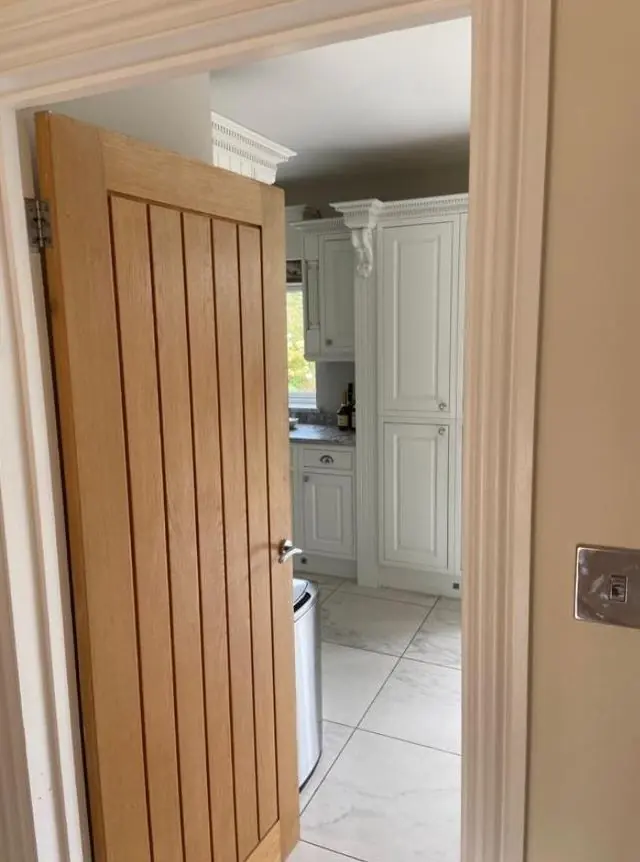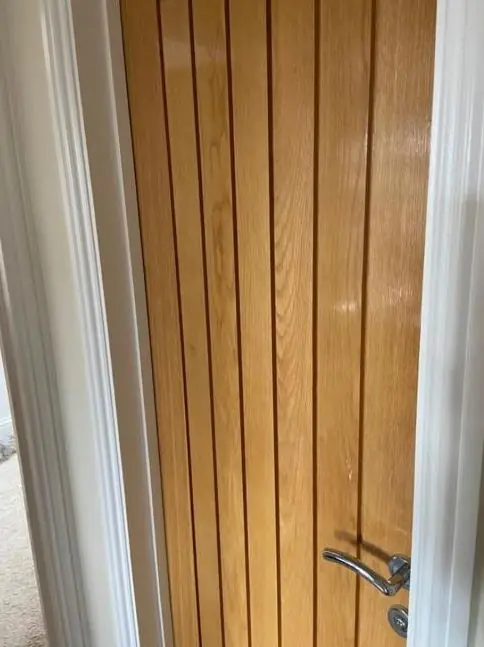
Dean repaints internal doors, frames, skirtings, architraves and front doors across Ecton Brook, NN3 5, about 4.1 miles east of Northampton town centre. The estate's woodwork is mostly plain 1970s and 1980s joinery, so the work is usually a hard-wearing satin refresh rather than period restoration.
What the joinery looks like on a Development Corporation estate
Ecton Brook was laid out by the Northampton Development Corporation from the late 1970s, with a 1979 image of its first phase held in the RIBA library. Homes from that era were fitted with practical joinery: flush or simple panel internal doors, plain or lightly moulded softwood skirtings and modest architraves. There are no Georgian six-panel doors or deep Victorian torus skirtings to strip back. What you often find after forty-odd years is layer upon layer of gloss, yellowed in hallways and landings, chipped along the bottom rail of every door and cracked where the skirting meets the wall.
That shapes the job. On a terrace in Foxendale Square or Normead Square we would normally key and repaint the existing coatings rather than burn them off, then pick a water-based satin that will not yellow the way the old oil gloss has. The step-by-step method of degreasing, sanding, filling and knotting is on our main door, skirting and woodwork painting page; here we focus on what changes in Ecton Brook.
Front doors that are seen as a row
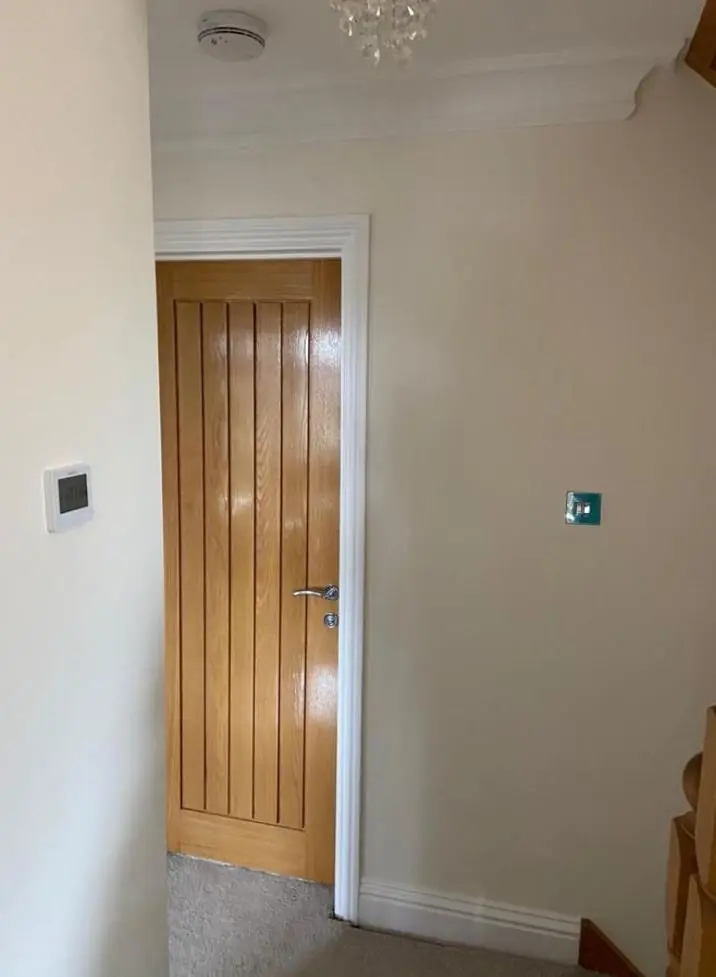
Many addresses in the estate are pedestrian squares and places, such as Snowbell Square, Lockcroft Square and Windflower Place, where front doors face a shared footpath or green instead of a road. Neighbouring doors are read together from the path, so a single bright door can look out of step even though nothing forbids it. Ecton Brook has no conservation area and no listed buildings, which leaves owners free to choose any colour, unlike the Great Billing Conservation Area just across Great Billing Way. We are happy to talk through how a shade will sit beside the doors either side before the tin is opened.
Timber front doors and frames on the squares also need to be painted on a dry day with the door wedged open for drying, which means planning around whoever is home. We sheet the footpath outside so walkers are not stepping through wet paint or dust, and a door painted in the morning is usually dry enough to close by late afternoon.
Carrying the job in from shared parking
Because the squares are pedestrian, the van usually stays in a shared parking bay and everything comes in by hand. For a woodwork job that matters more than you might think: doors are often taken off their hinges and laid on trestles to paint the faces flat, and trestles, sheets, sanders and extraction all have to be walked in. We plan the day to keep trips down and leave nothing standing on the path. On the detached roads, such as Riverwell, Parkside, Raisins Field Close and Ecton Park Road, driveways make this easier, and there is often more timber to deal with, including garage doors and side gates.
Satin, gloss or eggshell for estate woodwork
| Surface in Ecton Brook | Usual condition | Finish we tend to suggest |
|---|---|---|
| Flush internal doors | Scuffed edges, old gloss, hand marks around handles | Water-based satin, tough and easy to wipe |
| Plain softwood skirtings | Knocks from hoovers and furniture, gaps at the wall | Satin or gloss after caulking the top edge |
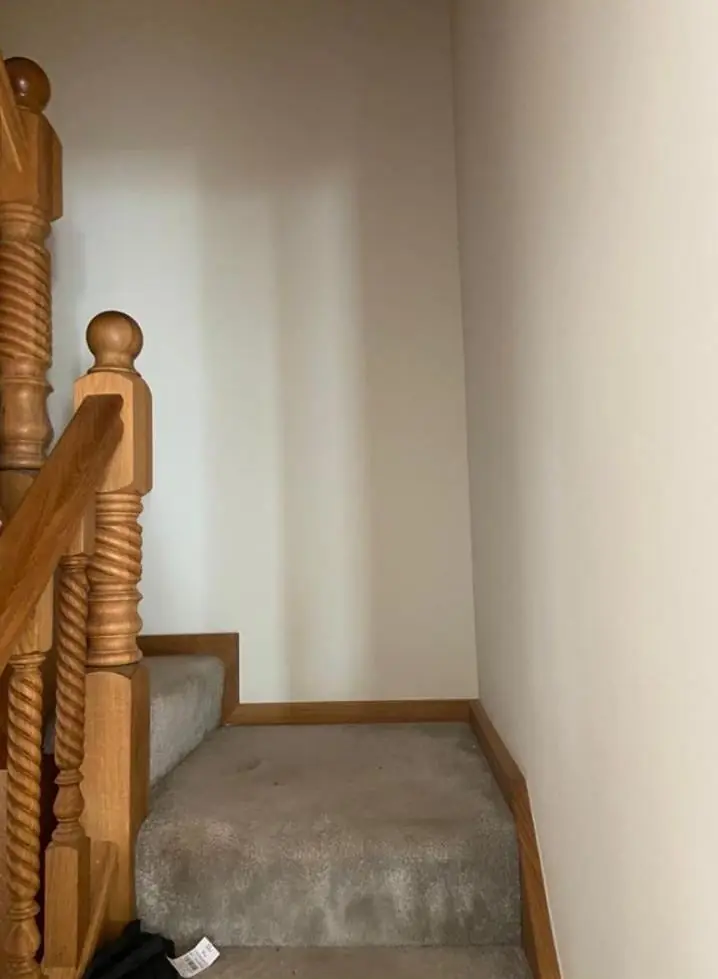
| Staircase strings and spindles | Heavy wear in narrow hallways | Hard-wearing satin, worked in stages so the stairs stay usable |
| Timber front door and frame | Weathered bottom rail, faded paint | Exterior gloss or satin, chosen with the row in mind |
Satin suits the estate’s rented homes because it hides small marks and can be wiped between tenancies. If you are reworking the whole house, the place page for Ecton Brook shows how woodwork fits in with the other work we do there.
Last updated by Dean, DH Painter & Decorator.