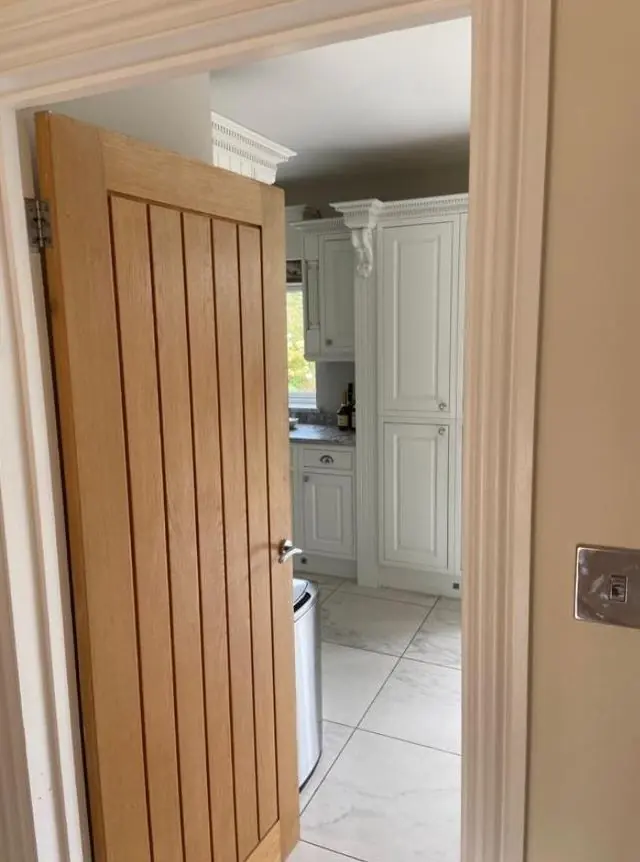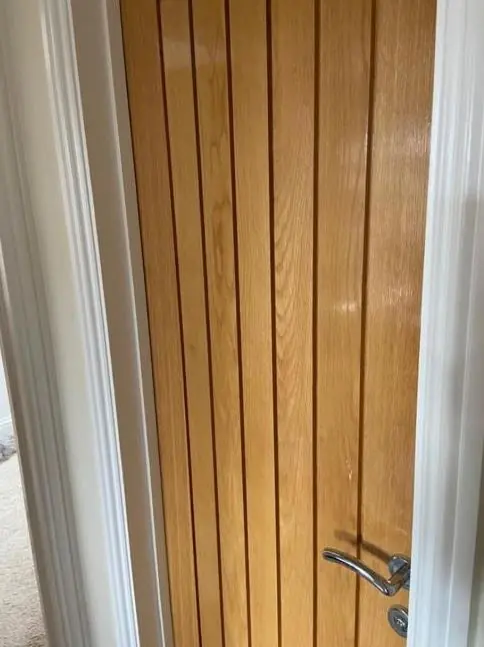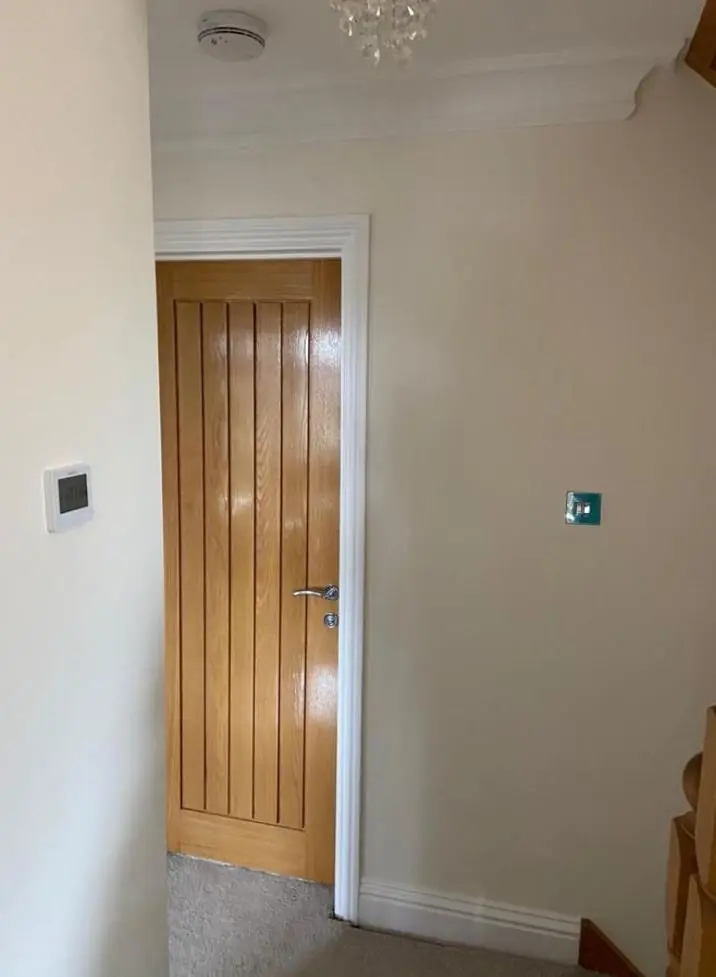
Dean paints internal and external doors, skirtings, architraves and window joinery in Great Billing, NN3, about 3.9 miles east of Northampton town centre. The village has two very different kinds of woodwork: period joinery in the stone conservation core around High Street and Elwes Way, and standard modern doors and boards in the estates that surround it.
Two villages’ worth of woodwork in one postcode
Great Billing’s old core is small, a High Street with Elwes Way, Church Walk, Pound Lane and Cattle Hill running off it, but the joinery inside it spans three centuries. Vernacular cottages and farmhouses of the 16th to 18th centuries tend to have ledged-and-braced plank doors. The Georgian houses, some of them three storeys, have panelled doors, and several front doors carry fanlights above. The paired estate workers’ houses that E.F. Law designed for the Cary-Elwes family in 1866 add another layer of Victorian joinery. Step outside the conservation area to the newer closes north and east of the old village, and the doors are moulded or flush modern doors with MDF or softwood skirtings.
The preparation and paint differ between those two groups, so we look at what is actually there before writing a quote. The general method of degreasing, keying, filling and knotting is set out on our main door, skirting and woodwork painting page. This page is about what changes in Great Billing.
Plank doors and panelled doors need different handling
A ledged-and-braced door is boards held together by horizontal ledges and a diagonal brace. On a cottage that has been painted many times, the gaps between boards fill with old paint, then crack as the timber moves with the seasons. Filling those joints solid with a rigid filler only makes the cracking worse, because the boards are meant to move. We clean out the loose material, leave the joints open and use a flexible oil or alkyd finish that can tolerate the movement.
Georgian panelled doors are the opposite problem. The detail lives in the mouldings around each panel, and decades of gloss soften those edges. On a door of that age the lower layers may contain lead, so we test before any sanding and use wet abrading or low-heat stripping if it is present. A fanlight brings its own work: thin glazing bars that need cutting in by hand and putty that may want attention before paint goes over it.
- Cottage plank doors: joints left open, flexible finish, colour that suits stone.
- Georgian panelled doors: lead check, moulding profiles kept crisp, fanlight bars hand-painted.
- Estate-house doors: light key, quality primer where needed, durable satin or eggshell.
Front doors in the conservation area
Designated in 1976, the conservation area still has no Article 4 direction, which leaves a like-for-like front door repaint on an unlisted house free of any permission. The appraisal does single out uPVC replacements as harmful to the village’s character, which is a good reason to keep an old timber door painted rather than let it decay to the point of replacement. The listed houses include the Old Post Office at 20 High Street, Manor Lodge, 27 Church Walk and 18 Pound Lane. If you own one of those and want a noticeably different colour, or want old paint stripped off a historic door, check with the council’s conservation officer first. We will raise it when we look at the job.
Colour against limestone and ironstone
Most of the old village is coursed Pendle limestone, with deeper golden ironstone on buildings such as the Old Post Office and Home Farm. Bright brilliant-white gloss on a cottage door can look harsh against that stone. Muted greens, greys, off-whites and deep traditional colours usually sit better. On the modern estates the brickwork is lighter and the choice is wider. If you want help choosing, see our colour advice service.
Getting to the door
Many cottages on Pound Lane and Cattle Hill face straight onto a narrow lane with no front garden, and Elwes Way is tightly walled in stone. For external door work we bring what fits in one trip, keep the lane clear and plan for a door that needs to stay open while the paint goes off. More about the village as a whole is on our Great Billing area page.
Last updated by Dean, DH Painter & Decorator.