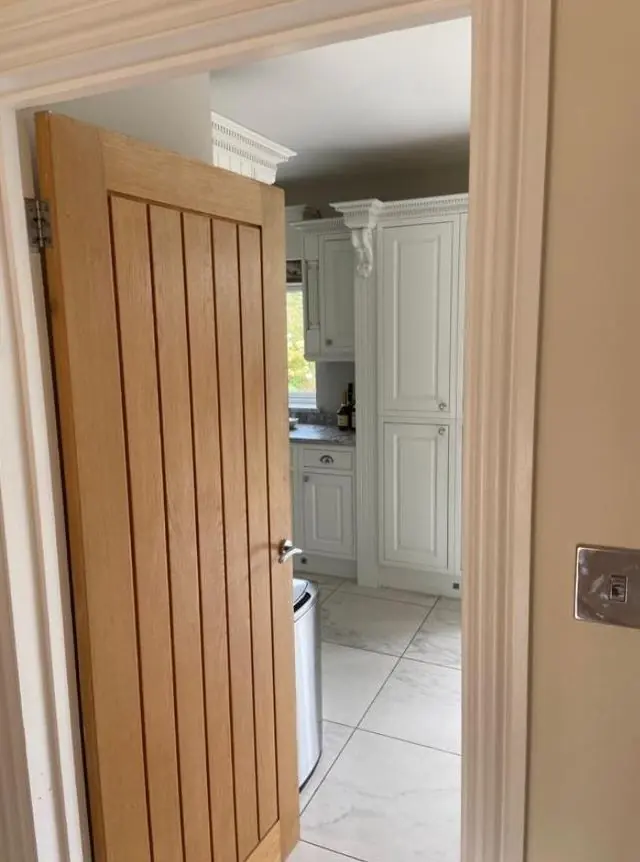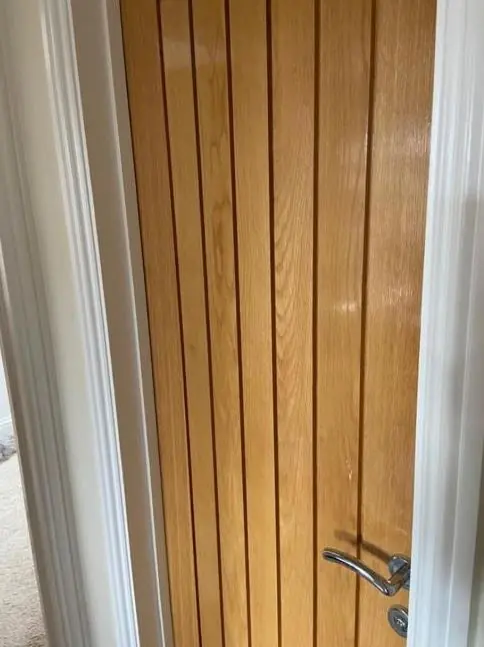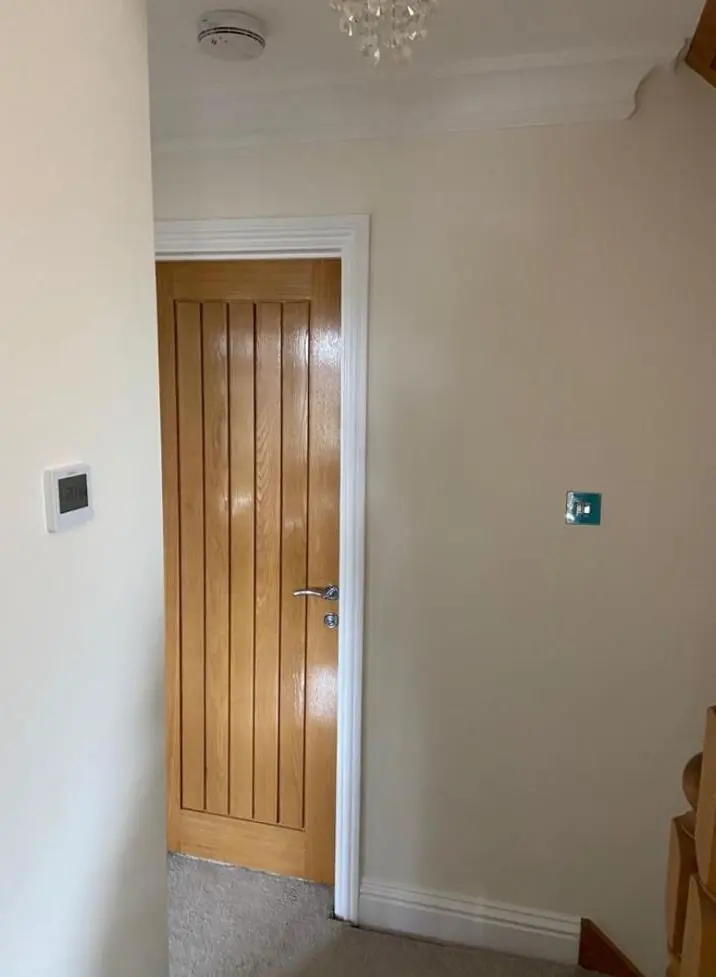
Dean repaints internal doors, skirtings, architraves and frames in Rectory Farm, the NN3 estate 4.2 miles out on the north-east side of Northampton. Most homes here were built between 1973 and 1992, so the usual job is reviving original softwood that has had decades of oil gloss.
Softwood that has been glossed for forty years or more
Almost every house on Rectory Farm went up between 1973 and 1992. Council tax records put around 570 of the 790 homes in the Olden Road, Crowthorp Road and Collyweston Road area in the 1973 to 1982 band, and around 420 of the 520 homes in the Deansway closes between 1983 and 1992. Builders of that period fitted plain softwood skirtings, architraves and door linings, and owners have been adding oil gloss over them ever since.
After that many coats, two problems show up. Oil gloss yellows as it ages, most of all where daylight is weak, such as a hall or a landing with no window. The layers also build up until panel mouldings fill in, door edges rub on the frame and the line where skirting meets wall turns lumpy. On this estate, then, a woodwork job is rarely just a fresh top coat. The first question is how much of the old build-up has to come off.
Northern terraces against the Deansway closes
The estate has two halves, and the woodwork in each tends to need different handling.
| Part of Rectory Farm | Typical joinery | What it usually needs |
|---|---|---|
| Olden Road, Ermine Road, Mortar Pit Road, Pilton Close (mainly 1970s terraces) | Flush or simple panel doors, short skirting runs, boxed stair stringers | Heavy sanding and filling where years of tenancies or DIY have left chips, drips and dents |
| Morgan, Riley, Bentley, Healey and Allard Closes (1983 to 1992) | More doors per house and longer skirting runs in the detached layouts | Keying back thick gloss, clearing filled-in mouldings, changing the sheen |
| Fellmead Court bungalows and the 2009 and 2019-2021 infill | Primed MDF or factory-finished doors | Light preparation and a first proper finish |
Some 1970s terraces on Mortar Pit Road and Collyweston Road have cavity walls recorded with little or no insulation. Skirtings on those cold outside walls, mainly in bedroom corners and bathrooms, can collect condensation, which leaves mould spotting and soft, flaking paint along the bottom edge. We clean and treat those lengths before any primer goes on, or the new coat lifts the same way.
Changing from oil gloss to water-based satin
Moving from yellowed oil gloss to a lower sheen that stays white is the most common upgrade for joinery of this age. Water-based satin does not yellow like oil, and it dries fast enough that doors can be hung and used the same day. It will not stick to old oil gloss on its own, though. Each surface needs degreasing and sanding to a dull key, followed by an adhesion primer. Bare knots that turn up in the softwood are sealed first so the resin does not bleed through as brown rings.
The full preparation sequence, including filling and caulking, is set out on our main door, skirting and woodwork painting page. Here we stick to what the age of Rectory Farm’s houses adds to it. On the oldest terraces, paint applied before the 1980s could contain lead, so any heavy sanding there is done wet, with dust kept to a minimum.
Working round people in compact houses
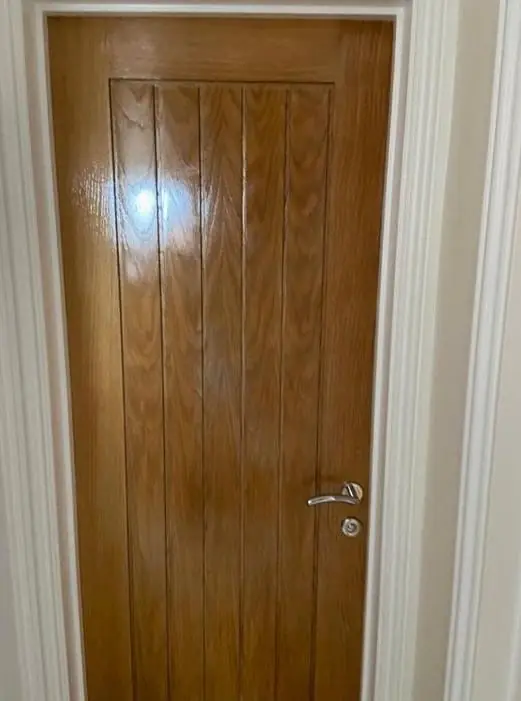
Many of these houses are small. An energy certificate for one semi on Morgan Close records a floor area of 66 square metres. That means fewer doors than a large house, but also that doors cannot be left off their hinges for long when a family is living in every room. We usually work one floor at a time. Doors come off, are prepared and coated flat, then go back on before the evening, while skirtings and frames are done room by room so a bedroom is always usable.
For more about the estate’s housing and the other work we cover there, see our Rectory Farm area page.
Last updated by Dean, DH Painter & Decorator.