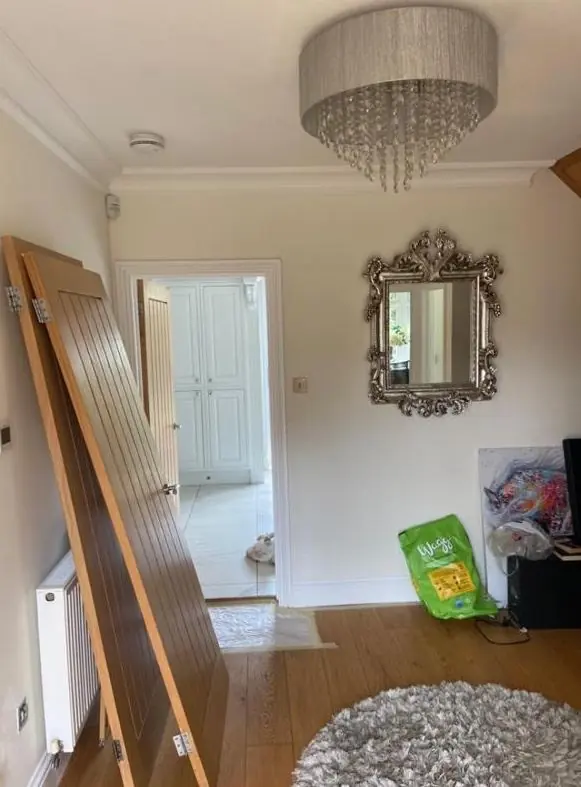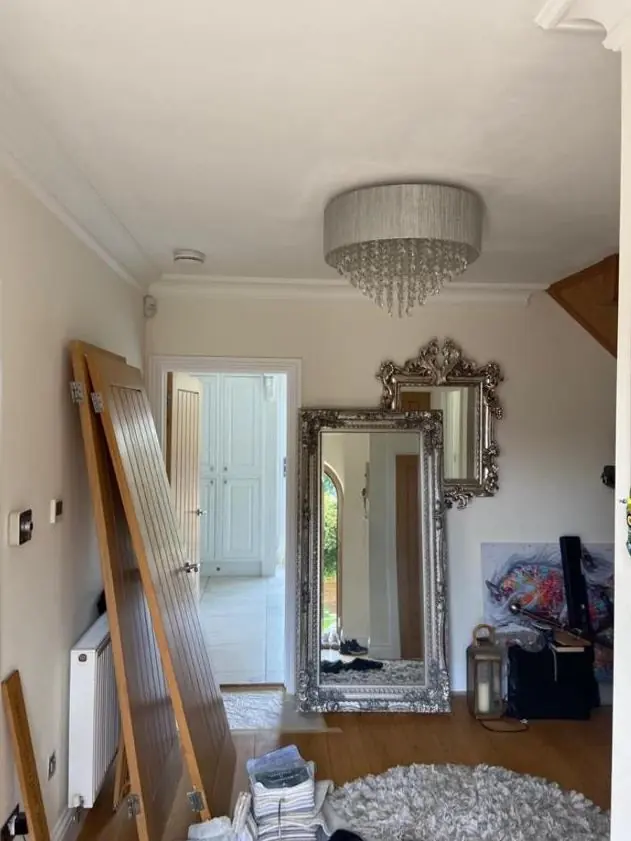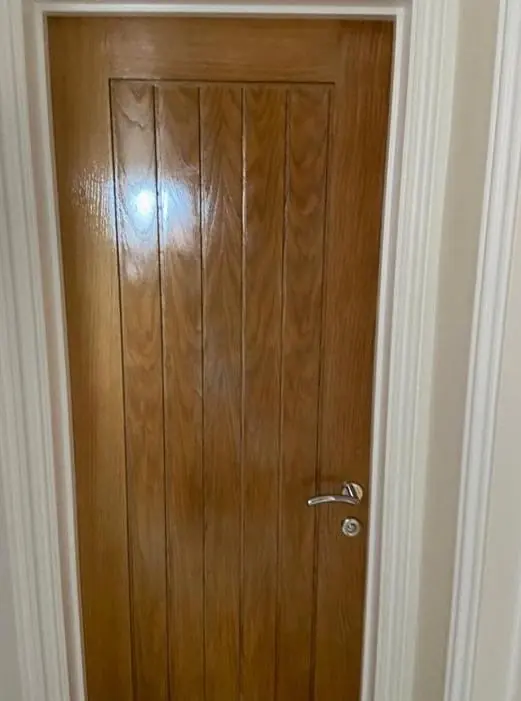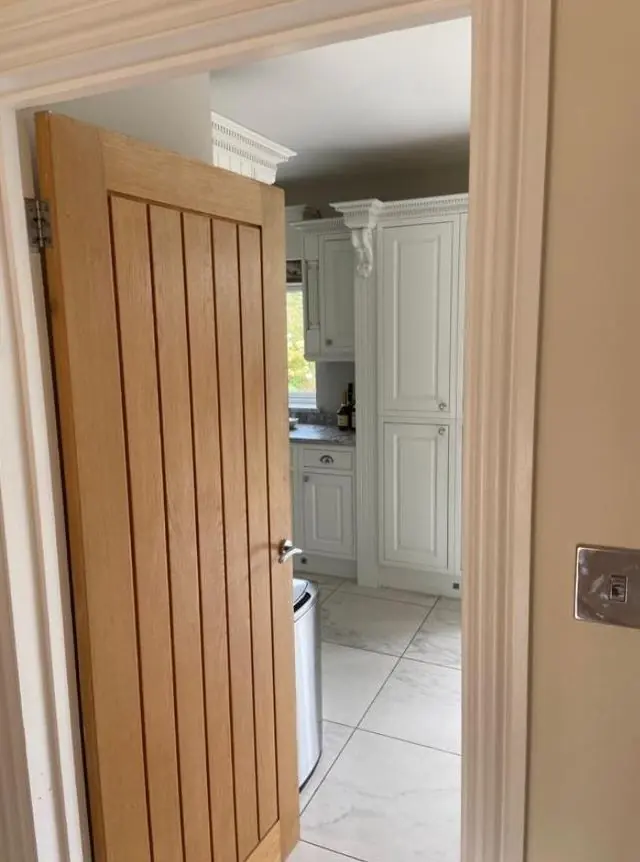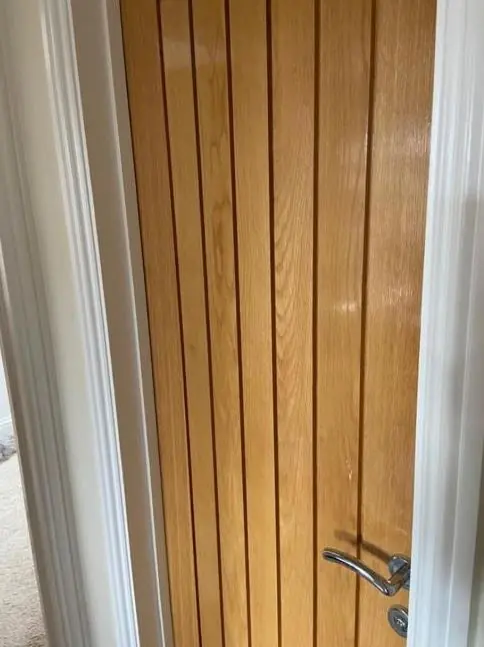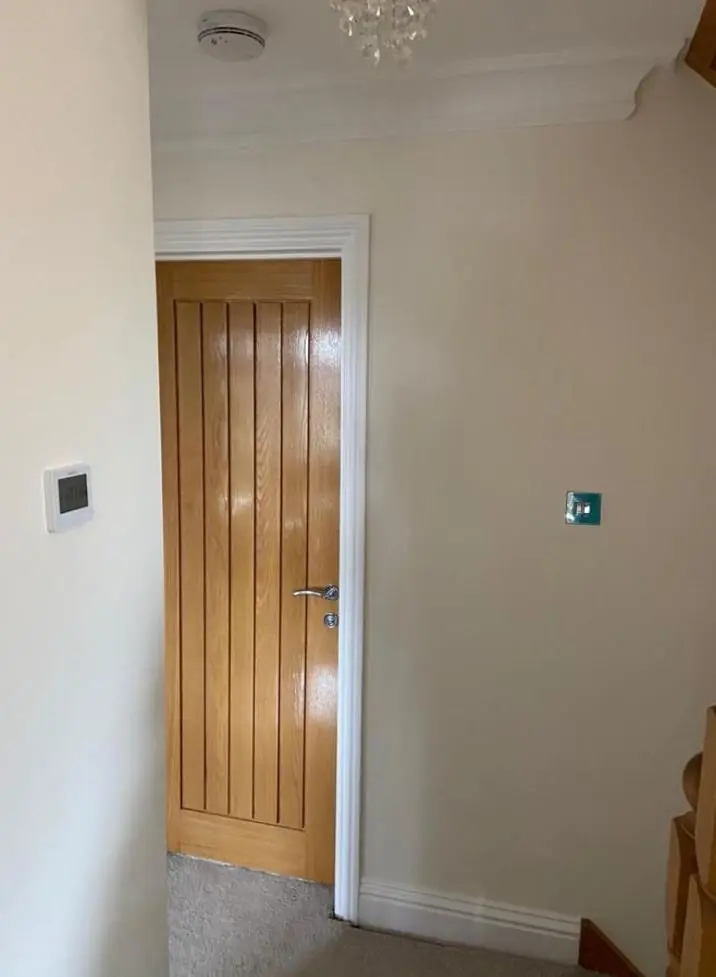
Dean paints internal and external doors, frames, skirtings and architraves in Hartwell, about 6.5 miles south of Northampton town centre. The joinery here runs from rough-sawn plank doors in 17th and 18th-century limestone cottages to standard machined profiles on the estates built between the 1930s and the 1970s, and each needs a different approach.
Plank doors and wooden lintels in the stone cottages
The oldest houses on Hartwell Green are coursed limestone rubble from the 17th and early 18th century, several still under thatch on Park Road, with wooden lintels over the openings and brick end stacks. Their internal doors are often ledged plank doors rather than panelled ones, hung in frames that have moved with the walls for three centuries. Nothing is square. A skirting in one of these rooms may follow a wall that bows by a couple of centimetres along its length, and the gap at the top of the board changes all the way along.
That shapes the job. We fill and caulk the gaps that will hold, but we don’t try to force a straight line onto a wall that isn’t straight, because rigid filler in a wide moving joint cracks within a season. Plank doors are washed down, the old finish keyed, and any open joints between boards left open so the door can still breathe and move. Where a cottage has wooden lintels inside, we treat them as joinery: clean, key and paint or leave bare to match what is there, rather than painting over them with wall emulsion.
Four-panel doors on the Grafton estate cottages
The pair of Grade II cottages at 4 and 6 Forest Road date from about 1840 and were built by the Grafton estate, as were the cottage ornee row on Ashton Road described as new in 1875. Houses of that type usually have four-panel doors with moulded edges, and the mouldings are what suffer most from repeated coats of gloss. On doors of this age we check the lower layers before any sanding, since paint applied before the 1960s may contain lead. Where it does, we wet-abrade rather than dry sand, and keep dust out of the rest of the house.
Repainting inside a listed building like for like is normally treated as maintenance, but stripping or replacing original doors can need consent. On any listed property in the parish we keep to cleaning, repairing and repainting what is already there.
Moulded joinery in the 1930s to 1970s houses
Most homes in Hartwell are newer than their setting suggests. Council houses went up in 1932, 1934-5 and 1939, the rural district council added 74 houses and flats on Salcey Avenue and Salcey Close after 1945, and the private estates on the south-east side of the main street and at Lower End followed from the early 1960s, including 153 houses from a 1973 consent. Their doors, frames and skirtings are standard moulded profiles, and the usual problems are yellowed oil gloss, chipped edges where vacuum cleaners and pushchairs hit, and doors that have been painted shut on their hinge side.
For these houses the work is closer to what is set out on our main door and skirting painting page: degrease, key, fill, prime bare patches, then two finish coats. Many owners switch from yellowing solvent gloss to a water-based satin at this point, which needs a proper adhesion primer over the old oil coat.
Front doors, porches and projecting eaves
The c.1840 estate cottages were built with timber porches and projecting wooden eaves, and plenty of later houses have added porches of their own. In a village beside Salcey Forest, this external joinery spends much of the year in shade and damp. Bottom rails of front doors and the feet of porch posts go first, usually with soft timber under flaking paint. We probe these areas, cut out and splice or fill what has rotted, and use a microporous exterior system that lets the wood dry outwards. Forest-side joinery gets a fungicidal wash before priming, and we book exterior door painting for the drier months.
Arranging the work
Woodwork-only jobs are often fitted around a room being decorated, but they can be booked on their own. Because Hartwell is a drive out from Northampton by the Hanslope road or through Roade, we plan the work as a continuous run of days with materials on site. You can read more about the village’s houses on our Hartwell area page.
Last updated by Dean, DH Painter & Decorator.