DH Painter & Decorator covers Hartwell, the NN7 village on the Buckinghamshire border beside Salcey Forest, about 6.5 miles south of Northampton town centre. Dean, with over 30 years in the trade, decorates inside and out, from breathable finishes on the old limestone cottages to repaints on the 1930s to 1970s housing.
A forest-edge village on the county border
Hartwell is a village and civil parish in West Northamptonshire, on the Buckinghamshire border next to Salcey Forest and the M1. It lies about 6.5 miles south of Northampton town centre in a straight line, reached through the forest on the Hanslope road or by way of Roade, and roughly 13 miles north of Milton Keynes. At the 2011 census it had 1,875 residents, up from 588 in 1961, and that growth explains the mix of buildings a decorator meets here.
The village grew on Hartwell Green, an area of common land on the forest edge, with farmhouses and cottages on both sides of the main road and more building at Lower End to the north-west. By 1727 almost every house belonged to the Grafton estate, which was sold off in 1913 and 1919. Council housing followed from 1932, and private estates from the early 1960s. So a single walk from Park Road to Salcey Close passes 17th-century limestone, Victorian estate cottages, post-war council houses and 1970s homes, and each needs a different approach to paint.
The limestone and thatch of Park Road and Forest Road
The oldest surviving houses date from the 17th or early 18th century and are coursed limestone rubble, some painted, with thatched or slate roofs, brick end stacks and wooden lintels. 38 Forest Road is a lobby-entrance house built by John Mould in 1681. On Park Road, the thatched cottages at numbers 1, 22, 41 and 52 include Old Forge Cottage at No. 41, which is painted limestone with leaded casements in eyebrow dormers.
Soft limestone laid in lime mortar has to breathe. Acrylic masonry paint traps moisture in it and can lead to spalling and failing paint, so where these walls are painted we use limewash, mineral or silicate-type systems. Inside, lime plaster takes breathable emulsions. Because piped water only arrived shortly before the First World War, these cottages had bathrooms and services added later, and their walls are usually patched and uneven, so filling and lining paper often come before any interior painting. Outside, woodwork under thatch eaves needs careful ladder work that keeps clear of the thatch edge.
Grafton estate cottages, the chapel and the old school
The Grafton estate rebuilt parts of the village in the 19th century. 4 and 6 Forest Road are a pair of estate cottages from about 1840 in coursed squared limestone with Gothick iron casements, which need rust removal and metal primer rather than a timber-window treatment. Eight cottages on Ashton Road, built in a restrained cottage ornee style, were described as new in 1875, and the estate cottages of this period have timber porches and projecting wood eaves that weather faster than the stone around them.
Two public buildings have their own surfaces. The Wesleyan Methodist chapel on Hartwell Green was rebuilt in 1889 in brick with stone quoins, so one elevation can need two different primers and systems. The 1861 National school on Forest Road, a single-storey stone building with a slate roof, has been a house since the new primary school opened in 1962. Converted buildings like this, and the barn conversions in the parish, have high walls and exposed timbers that call for tall access and careful masking. Hartwell End House, early 17th century with later additions, is largely pebbledashed over stone and brick, which takes a lot of paint and needs cracks and hollow patches checked first. Our render and masonry painting page covers that kind of wall.
Council and estate homes from 1932 to the 1970s
Eight council houses were finished in 1932, four more in 1934-5 and another group in 1939. After 1945 the rural district council built 74 houses and flats at Salcey Avenue and Salcey Close. Private building started in the early 1960s, mostly on the south-east side of the main street and at Lower End, and outline consent in 1973 for 13 acres beyond the old boundary led to 153 houses.
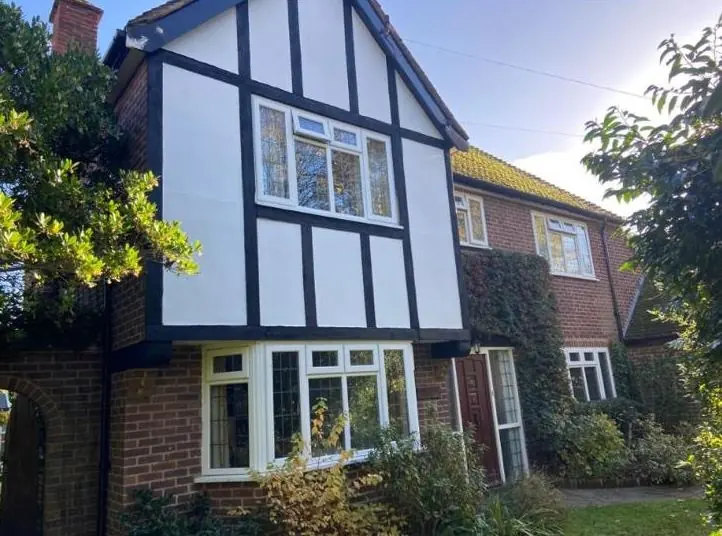
These homes are now 50 to 90 years old, and the work they need is predictable: timber fascias and soffits that collect debris from nearby trees, front doors and window frames, fences, and tired interiors. Walls are flatter and rooms more regular than in the cottages, so wallpaper, feature walls and whole-house repaints go faster.
Salcey Forest, shade and timber
Salcey Forest, managed by the Forestry Commission since the early 1920s, runs along the north-east side of the parish. Homes near it get heavy tree cover, leaf litter, shade and damp. Render, fences and north-facing timber pick up algae and mould, which have to be treated with a fungicidal wash before any paint or stain, or the new coat lifts. Shade also slows drying, so exterior work here is booked for the drier, warmer months.
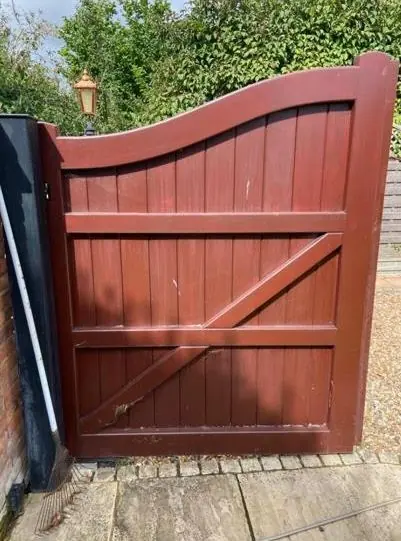
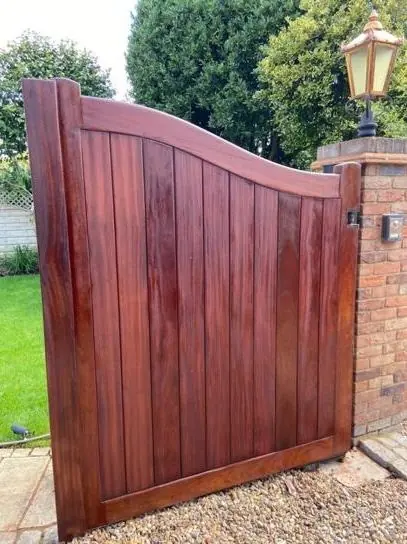
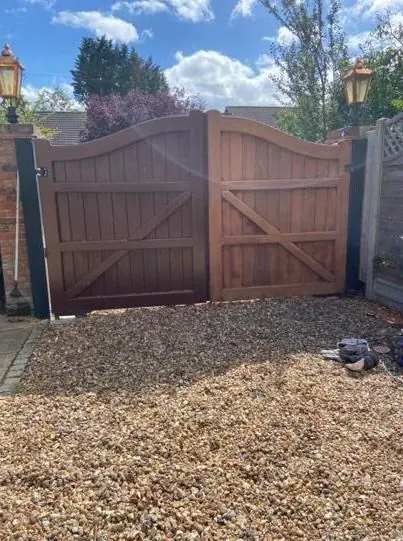
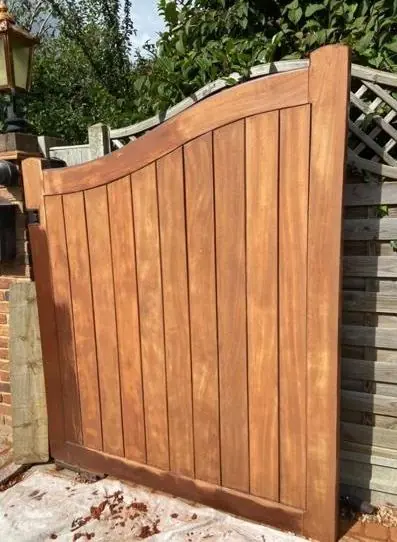
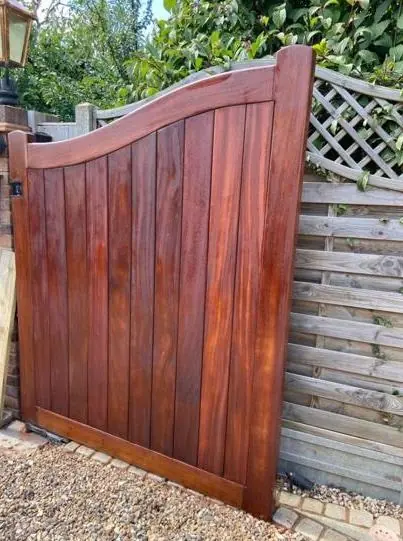
Timber has long been part of village life: two sawmills ran here for much of the 20th century, and an RAF maintenance unit in the forest closed in 1957. Today that shows in the amount of outdoor woodwork, from fences and gates to porches and sheds. In the forest’s damp and shade, fence and gate staining needs redoing more often than on open, sunny plots.
Listed buildings and consent
No conservation area is recorded for Hartwell, but the parish has 12 listed buildings. They include the Grade II* Church of St John the Baptist, rebuilt in 1851 by Charles Vickers, plus Grade II Hartwell End House, Hartwell Park Farmhouse, 52 Park Road, Old Forge Cottage, 4 and 6 Forest Road, The Old Manor, The Croft, Ivydene, Salcey Lawn and two war memorials. Repainting a listed building like for like is the safe default. A change of colour or paint system may need listed building consent from West Northamptonshire Council, and Dean will point that out when he quotes.
How we cover Hartwell
We cover Hartwell from our Northampton base. With no rail link, everything comes by van, and jobs are planned in continuous blocks of days rather than short visits. Cottages on Park Road and Forest Road sit right on the main road through the village, so exterior work there needs ladders footed properly and an eye on passing traffic. Commercial work in the village is small in scale: the village shop, the Rose and Crown, the Hartwell Club, the community centre and the primary school. We also cover nearby Roade, Hanslope, Stoke Bruerne, Hackleton, Grange Park, Yardley Gobion and Collingtree. For a rough idea of costs before you call, see our painter and decorator cost guide, or ring Dean on 07539 779 036 for a free quote.
Last updated by Dean, DH Painter & Decorator.