
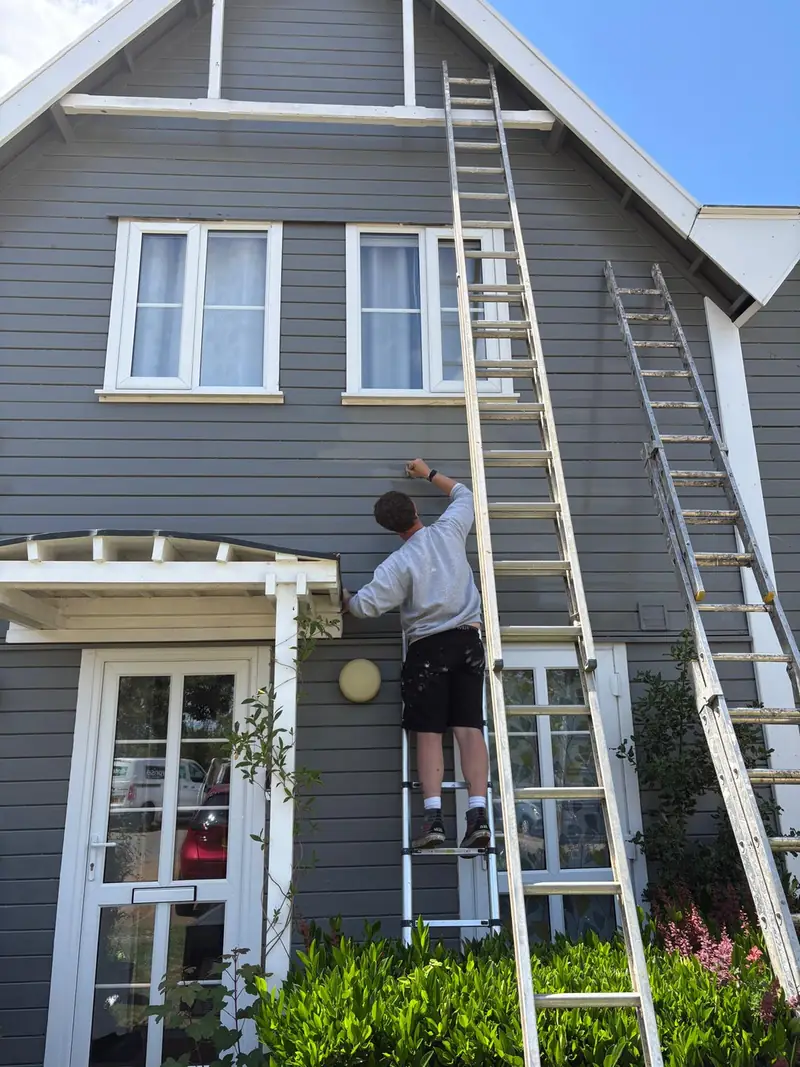


Parklands stands at about 120-122 m, some 40 m higher than Northampton town centre 2.5 miles to the south-west, with 60 hectares of open grassland on one side and the A5123 on the other. Exterior painting here is mostly fascias, soffits, doors, gates and any painted masonry, timed for the weather and prepared for wind and road grime.
Working 120 metres up on the town’s north-east edge
Elevation data puts the Parklands estate at about 120 to 122 m above sea level, roughly 40 m above the town centre at about 79 m. The ground falls away to about 108 m on the Bradlaugh Fields side, and Bradlaugh Fields itself is 60 hectares of grassland and hedgerow. For outside painting that has two effects. Rain is driven against the walls and joinery rather than falling straight down, so the exposed sides of a house take more water than the sheltered ones. And a breezy day dries paint fast, sometimes too fast: a coat that skins over in a stiff wind can trap brush marks and lose adhesion at the edges.
So on the open elevations we lean towards higher-build, flexible exterior systems that cope with timber moving between wet and dry, and we watch the forecast for wind as closely as for rain. Still, dry days with light wind are the ones to book. Our guide to the right time of year for exterior painting sets out the temperature limits.
| Type | Share |
|---|---|
| Detached | 20.4% |
| Semi-detached | 63.7% |
| Terraced | 11.9% |
| Flat or maisonette | 4% |
Source: Census 2021 (ONS), accommodation type (TS044) tables via Nomis. The figures are for the census area that best fits Parklands, so its edges are not exactly Parklands’s.
What actually gets painted on a Parklands house
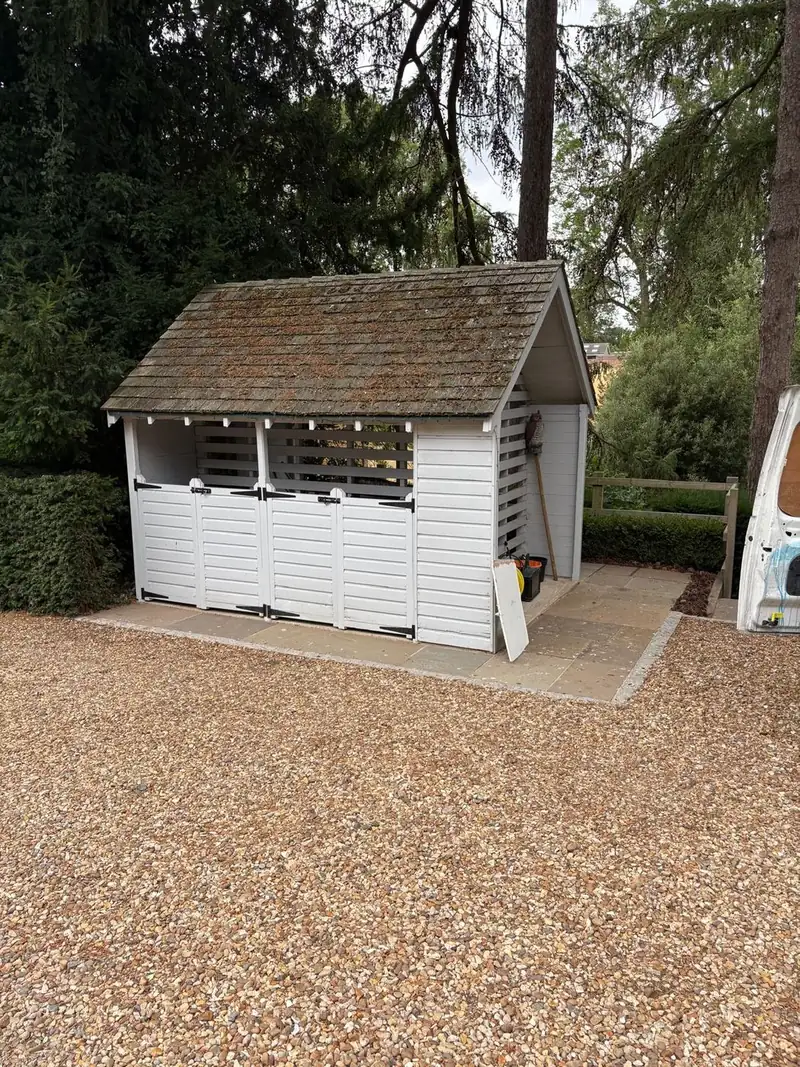
Energy certificates for Parklands Avenue, Parklands Crescent and Coppice Drive record full double glazing, and they record cavity brick walls. That shortens the list. The frame material is not given, so if your windows are timber they are painted; if not, they are cleaned and left. A typical exterior job here covers:
- fascias, soffits, bargeboards and any timber gable cladding, high on the roof-room semis and low on the bungalows (more on our Parklands fascia and soffit page);
- front and back doors, door frames and any timber porch;
- side gates, garage doors and the timber or metal around them;
- masonry that has already been painted, such as a plinth, a rendered panel or a garden wall;
- window sills and frames where they are still timber.
Census 2021 counts 63.7% of households in the two areas covering Parklands as semi-detached and 20.4% as detached, with only 11.9% terraced. So we can nearly always get round the side of the house with ladders and a tower, and the whole outside is yours to decide on. The one thing to think about on a semi is the shared front: your fascia and gutter line runs straight into next door’s, and a colour change stops halfway along the roof. It is worth a word with your neighbour before choosing. During the school run we keep the van off Spinney Hill Road and park on the estate roads.
Which side of the house takes the weather
| Where | Exposure | What it means for the paint |
|---|---|---|
| Fronts facing Kettering Road (A5123) | Traffic film from a four-lane primary road | A full wash-down and degrease before any coat, and a finish that can be wiped clean |
| Rear elevations towards Bradlaugh Fields | Open grassland and lower ground beyond | Wind-driven rain on gables and fascias; sound flexible coatings, extra attention to end grain |
| Gables of the roof-room semis | Full two-storey height plus the roof | Tower or long ladder, and a check of the bargeboards from close up |
| Bungalow eaves | Single storey | Reached from steps or a short ladder, so a quicker and simpler job |
| Fact | Detail | Source |
|---|---|---|
| Height of the estate | About 120-122 m above sea level; town centre about 79 m | api.opentopodata.org |
| Flood risk | Flood Zone 1 throughout: no Zone 2 or 3 land mapped | Environment Agency |
| Open space on the south-west edge | Bradlaugh Fields, about 60 ha of grassland and hedgerow | Wikipedia |
| Glazing | Full double glazing recorded on Parklands Crescent certificates | EPC register |
Kettering Road frontages and road grime
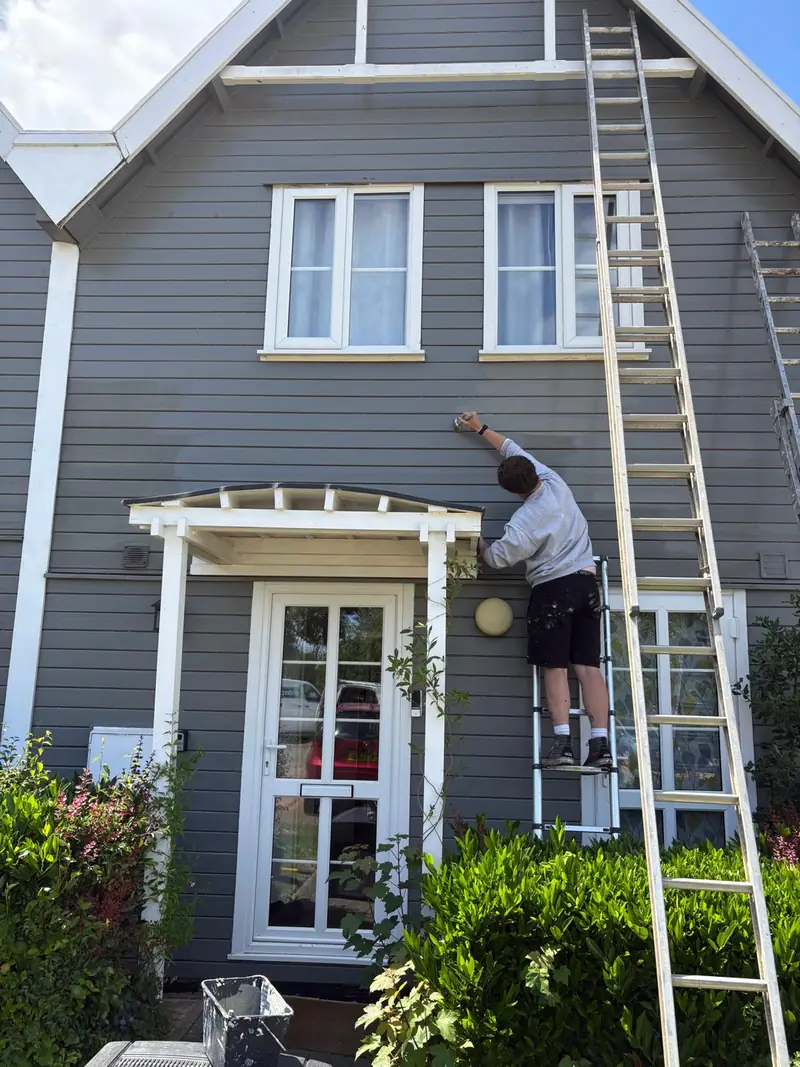
Houses near Kettering Road live beside heavy traffic, and the film it leaves on sills, doors and painted masonry is greasy enough to stop new paint bonding. We wash those faces with a degreasing cleaner and rinse them, let them dry fully, and only then sand and prime any bare spots. On the finish coat, a washable exterior product means the next layer of grime can be wiped off with water instead of being painted over in three years.
The Environment Agency maps no Flood Zone 2 or 3 land anywhere across the estate, so the whole of Parklands is Flood Zone 1. You will not find flood tide marks on the lower courses here; the low-level problems we look for are splashback on plinths and damp at the foot of timber gates and door frames. The full exterior method, from filling to topcoat, is on our main exterior painting page, and the Parklands area page covers the rest of the estate.
Your questions about exterior painting in Parklands
Something not covered here? Call Dean on 07539 779 036.
Does the height of Parklands affect exterior paint?
It does. At about 120 m the estate stands some 40 m above the town centre, with open grassland to the south-west, so walls and joinery on the exposed sides take wind-driven rain and dry quickly in a breeze. We use flexible exterior coatings on those faces and avoid painting in a strong wind, when paint skins over too fast.
Do Parklands houses need their windows painted?
Usually not. Energy certificates for Parklands Avenue, Crescent and Coppice Drive record full double glazing, so most exterior jobs are fascias, soffits, doors, gates and painted masonry. If your frames are still timber we prepare and paint them like any other joinery; otherwise we clean them and mask them off.
My house faces Kettering Road. Will new paint stay clean?
It will get dirty again, but it can be made easy to clean. We wash and degrease the road-facing side before painting, because traffic film stops paint bonding, and finish in a washable exterior paint. A rinse with water each spring then removes most of the grime instead of leaving it ground in.
Is there any flood risk to think about on a Parklands exterior?
Not from rivers. The Environment Agency maps the whole estate as Flood Zone 1, the lowest category, and no brook runs through it. The damp we look for at low level is ordinary splashback and water sitting at the foot of gates and door frames, which we deal with by sealing end grain and keeping paint off the ground.
Sources
- EU-DEM 25 m elevation, Parklands and Northampton town centre, Open Topo Data (accessed 2026-11-16)
- Flood Zones 2 and 3 (rivers and sea), Parklands area, Environment Agency (accessed 2026-11-16)
- Bradlaugh Fields, Wikipedia (accessed 2026-11-16)
- Energy certificates, Parklands Crescent NN3 6DT, EPC register (accessed 2026-11-16)
- Energy certificates, Parklands Avenue NN3 6DS, EPC register (accessed 2026-11-16)
- Energy certificates, Coppice Drive NN3 6ND, EPC register (accessed 2026-11-16)
- OpenStreetMap data within 900 m of Parklands (Overpass query, 16 November 2026), OpenStreetMap (accessed 2026-11-16)
Last updated .