Dean paints interiors across Towcester (NN12), about 8 miles south-west of Northampton town centre. The town mixes old timber-framed and stone buildings hidden behind Georgian fronts, Victorian brick terraces and newer estates to the south and west, and the walls in each need different paint and preparation.
One town, three very different kinds of wall
Inside a Towcester house, the age of the plaster matters more than the age of the front door. Georgian owners on Watling Street often refaced earlier buildings, so a timber frame from a much older house can still be standing behind the brick or stone. So a room that looks Georgian from the pavement can have exposed beams, lime plaster and walls that lean. A short walk west, the Victorian terraces on Richmond Road, Queens Road and Pomfret Road have more uniform rooms. The housing to the south and west of the centre, built in the 20th and 21st centuries, mostly has flat modern plaster and plasterboard.
Each of these needs its own paint and preparation, so the first thing we do on a quote visit is work out which kind of wall we are dealing with. Our main interior painting page covers the general process. This page deals with what is particular to Towcester.
Beams, lime plaster and walls that need to breathe
Lime plaster takes in moisture and lets it out again. Cover it with a heavy vinyl emulsion and that moisture can get trapped, which later shows up as blistering, flaking or damp patches. In the older buildings of the centre, especially those with a timber frame behind a refaced front, we generally use breathable, vapour-permeable paints. Where earlier coats are already failing, we scrape back to a sound surface before we put anything new on.
Timber frames also move with the seasons, so hairline cracks along beams and at the junctions between frame and plaster tend to come back. Rigid filler pushed into those joints usually cracks again within a year. A flexible filler, sanded flush and painted, copes far better. Where beams are left on show, we cut in by hand along their uneven edges rather than relying on masking tape, which won’t seal properly against rough or old timber.
- Breathable emulsions on lime plaster and older lime-based finishes
- Flexible fillers where the frame meets the plaster
- Hand cutting-in against beams, panelling and irregular reveals
- Conventional washable emulsions where walls are modern plaster or plasterboard
About 95 buildings in the town are listed. If your home is one of them, you need listed building consent for any change to its character, and that can include changing a paint type inside. Straight like-for-like redecoration is a different matter, but it’s worth asking the council before you change the finish on a historic surface.
Damp near the Tove and condensation in newer homes
Towcester’s eastern boundary is the River Tove, with low water meadows beyond it. Houses on the lower ground nearby can get damp-related staining in cool rooms, on north-facing walls and behind furniture. We treat any mould with a fungicidal wash and seal water marks with a stain-blocking primer before applying a mould-resistant finish. If a damp patch is still growing, it needs fixing at the source first, and we’ll say so and hold off painting.
The newer homes have the opposite problem: walls are flat but bathrooms and kitchens collect condensation. Moisture-resistant kitchen and bathroom paints help there. If your house is recent and the plaster has never been painted properly, our mist coat guide explains why that first sealing coat matters.
Getting ladders and dust sheets into a Watling Street house
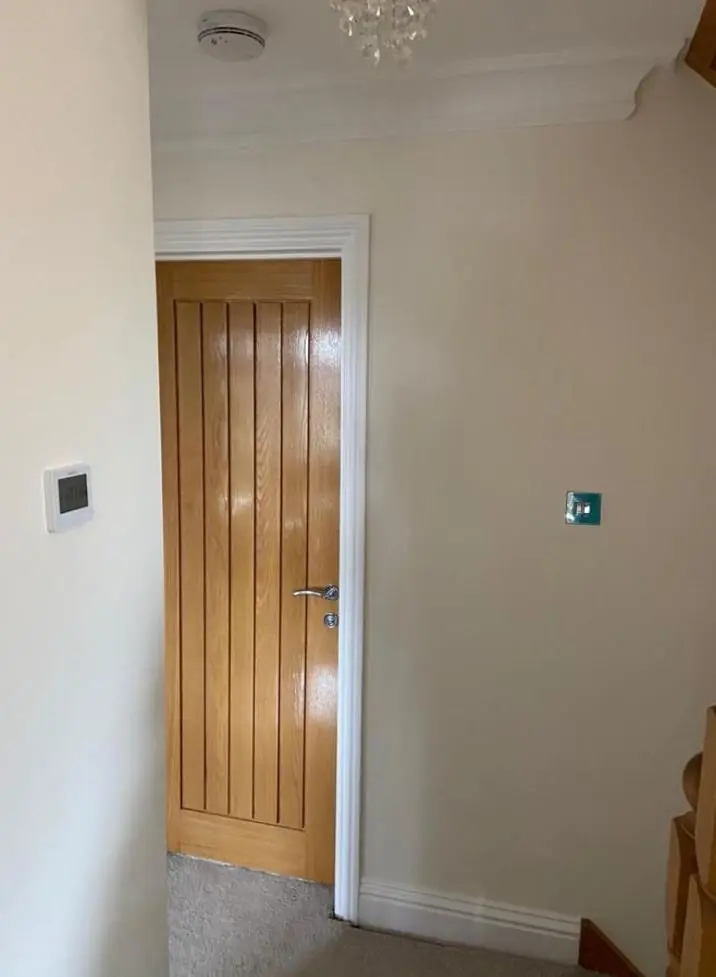
Watling Street and Park Street frontages sit right on the pavement, with heavy A5 traffic going past and little room to stop a van. Many of the long, narrow burgage plots behind them can only be reached on foot through alleyways such as The Ruins. On these jobs we agree in advance where to unload, bring steps and boards through in one trip, and set up a working area inside so nothing is left on the pavement. The taller Georgian houses on Watling Street rise to three storeys with high rooms and stairwells, so we bring the right platforms rather than stretching from a short ladder.
The Victorian roads are easier. Houses there stand back from the road behind their garden walls, so loading is simpler, and most interiors are a run of similar rooms that can be planned in a sensible order. For more about the town as a whole, see our Towcester area page.
Last updated by Dean, DH Painter & Decorator.