Dean gives colour and finish advice in Towcester, the NN12 market town on Watling Street, 8.2 miles south-west of our Northampton base. Inside the conservation area, painted fronts are expected to stay within a white and cream palette, and Article 4 or listed status can limit what you change, while homes elsewhere in the town have much more freedom.
Start by finding out which rules apply to your house
In Towcester, the first colour question is a planning question. The Towcester Conservation Area covers the historic core along Watling Street, and since 2012 it has also taken in Richmond Road, Pomfret Road, Queens Road and part of Brackley Road. Some properties also have an Article 4 Direction, which means work on elevations facing a road, open space or waterway needs planning permission. The council’s own guidance lists exterior painting, windows, doors and gates among the things these directions can reach. Around 95 buildings in the town are also listed, and any change to the character of a listed building needs listed building consent.
So before we hold up a single sample card, we suggest confirming your property’s status with the council. If none of these applies, you have far more freedom. If one does, we work within it rather than around it.
The white and cream fronts of Watling Street
The 2012 appraisal names white- and cream-painted brick and rendered stone as part of the character of the town centre. That gives a clear starting palette for fronts in the conservation area, but white is not a single colour. A brilliant white can look harsh and slightly blue against ironstone dressings and old clay tile. A softer off-white or a warm cream usually sits better beside the stonework and the painted fronts next door. We test samples on the actual wall, in morning and afternoon light, before you decide.
Some fronts should not be painted at all. Bare ironstone and limestone ashlar, such as the Grade II* house at 157 Watling Street West, should stay as bare stone. Where stone or brick has already been painted, the paint needs to be breathable mineral or limewash-compatible so the wall can dry out. That narrows down which ranges and which sheens we can recommend. Our colour and finish advice page explains how we test samples and match sheens.
Doors and joinery: the colour that does the work
When a front has to stay white or cream, the front door, sash bars and any carriage-arch doors are where character comes from. Deep traditional shades on panelled doors are common on period streets. On a street with heavy A5 traffic, a mid-depth colour in a hard gloss or satin also hides road grime better than a pale one, and it can be washed down without losing its sheen. If your building has an Article 4 direction that covers doors, check the colour with the council before ordering paint.
Inside: long, narrow plots and darker back rooms
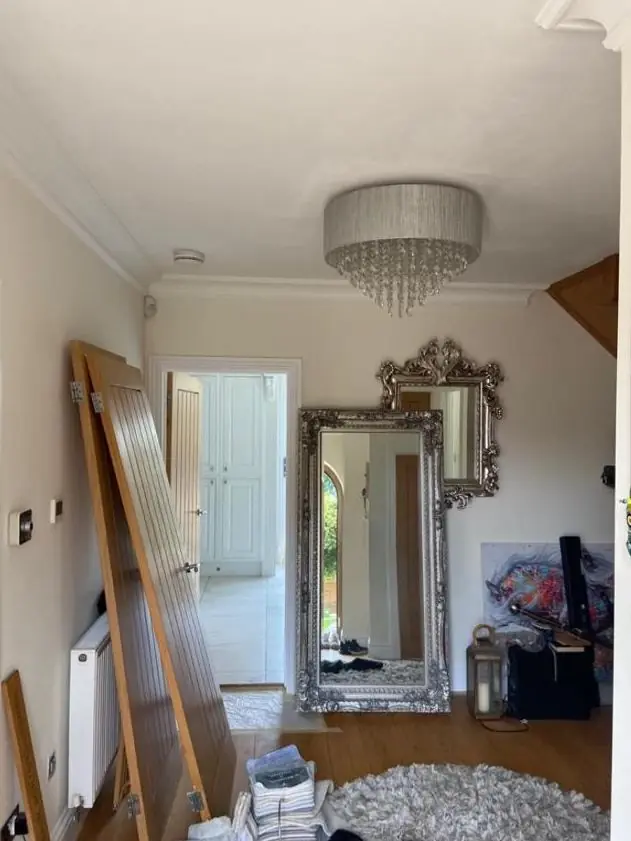
Behind Watling Street, buildings sit on long, narrow burgage plots, close together with little open space. Rear rooms and back wings can get limited direct light. In those rooms we usually avoid cold greys, which can turn dull and flat. Warmer neutrals, or a mid-tone with a little yellow or red in it, look calmer and lighter. Ceilings painted a shade off from the walls rather than stark white also soften the contrast in a dim room.
Lime plaster changes the choice too. Breathable paints come in more limited, chalkier colour ranges than standard vinyl emulsions, and a deep colour can look different on an absorbent wall. We sample on the wall in question rather than on a board.
Victorian terraces and the newer estates
The Victorian roads on the western side are now inside the conservation area, and many of their brick fronts are painted white or cream, so the same caution applies outside. Inside, a terrace’s narrow hall, stair and landing read as one space, so a single scheme usually carries through all three. The twentieth-century and newer estates on the town’s southern and western edge generally sit outside these controls, so colour there is down to taste and the light in each room. For more about the town, see our Towcester page.
Last updated by Dean, DH Painter & Decorator.