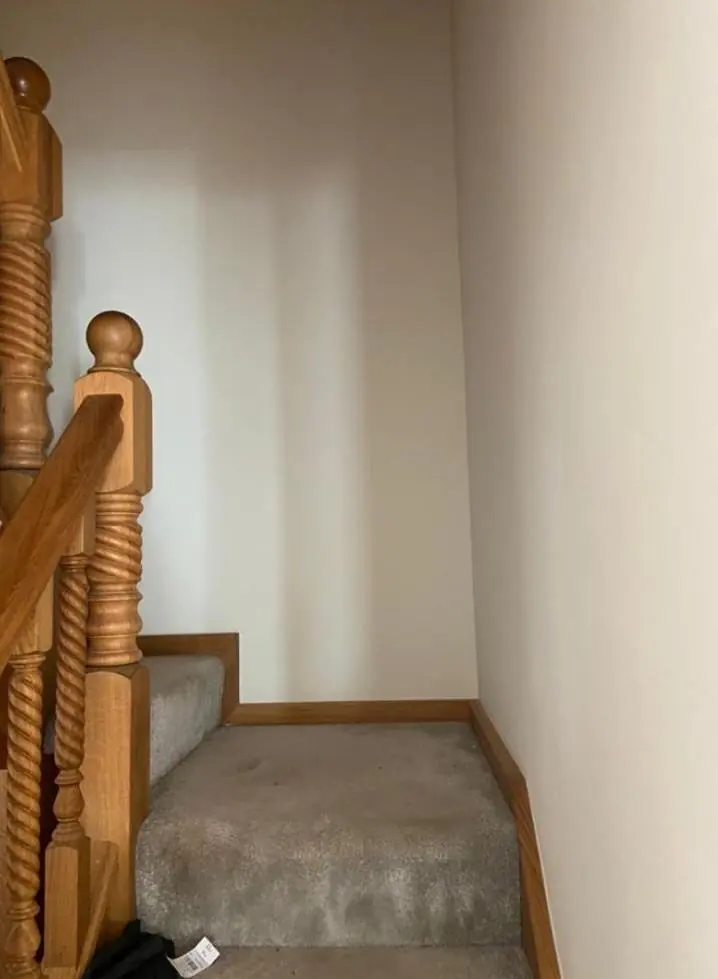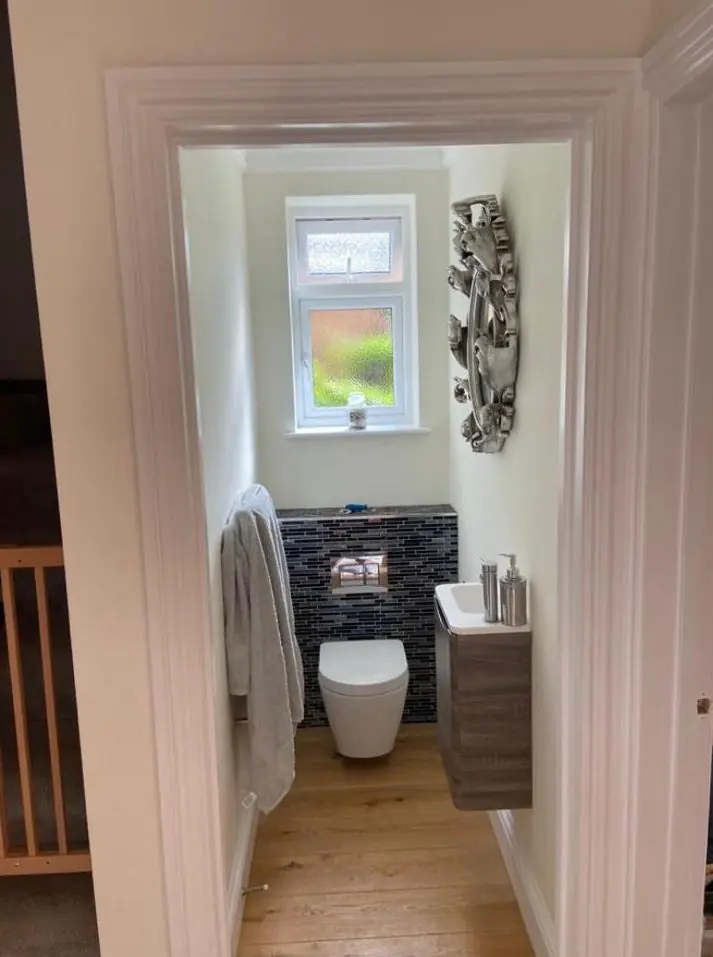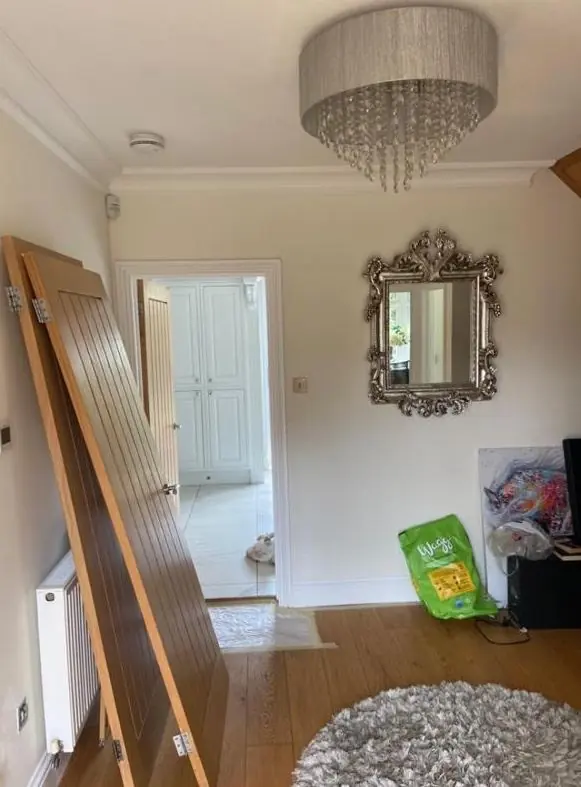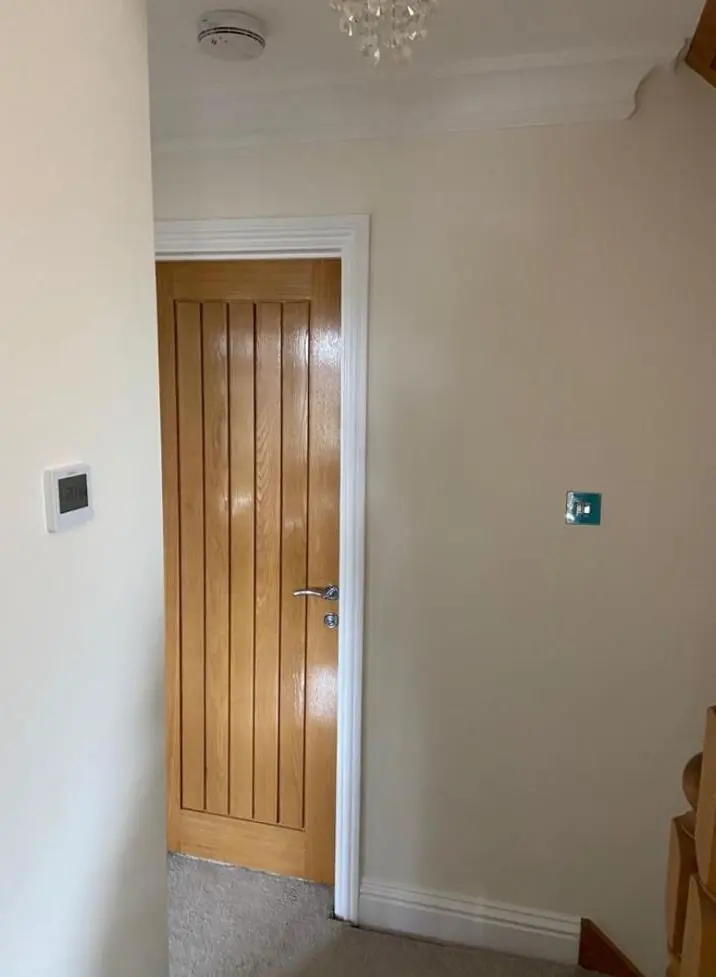
We decorate hallways, staircases and landings in Bozeat, a North Northamptonshire village about 9.4 miles east of Northampton town centre. Dean adapts the access and finishes to the house: tight, steep stairs in the old limestone cottages, and full-height stairwells in the estate and newer homes that need staging to reach the landing wall.
Two kinds of staircase in one village
Bozeat’s housing falls into clear groups, and the stairs follow them. In the 17th and 18th-century limestone cottages and farmhouses around Dychurch Lane, Mile Street and Easton Lane, staircases are often tight and steep, sometimes boxed in between walls, with low headroom at the turn. In the three private estates built in the 1960s and 1970s, and in the houses on the former Gola factory site, the stairs are typically straight or quarter-turn flights rising through a full-height hall, with a long wall above them that cannot be reached from a stepladder.
Those two layouts need different equipment and different amounts of time, which is why Dean looks at the stairs before quoting rather than pricing by the number of rooms.
Working in a narrow cottage stairwell
A cottage staircase has little room for a platform, so we use compact stair ladders and short boards that can be set on the treads without blocking them, keeping a route up and down for the household. The walls are a bigger question than the access. Solid limestone, plastered by hand, is rarely flat or square, and older plaster on these walls may have been finished with distemper or lime-based paints that a modern vinyl emulsion will not bond to well. We test the surface first. Where it is powdery we wash it back and use a breathable paint, so moisture in the stone can still escape.
Gas only reached Bozeat in 1990, so older houses may have been heated by open fires or solid-fuel stoves until then. Smoke staining on stairwell ceilings and landing walls is a common result of that kind of heating. It bleeds through ordinary emulsion, so it gets a stain-blocking primer first.
Tall stairwells in the estates and newer housing
In the estate houses and the post-1999 homes, the landing wall is the hard part. We set up an adjustable stair platform or a small tower with boards across the drop, never a ladder resting on a tread. With the access fixed, the walls are usually sound plasterboard or plaster, and the work is about finish:
- washing down hand marks along the stair wall and around light switches
- filling cracks at the ceiling line and where the stairwell meets the landing
- a scrubbable or durable matt on walls that take knocks from bags and furniture
- satin or eggshell on spindles, handrail, strings and skirtings, cut in neatly at the treads
Houses built after 1999 may still have their original builder’s emulsion in the hall, now more than 20 years old. That thin coat often patches badly, so a full repaint wall to wall tends to look better than spot repairs.
Keeping the stairs usable
Stairs are the one room you cannot close off. We decorate in a sequence that keeps a safe route open: ceilings and the high landing wall first, then walls, then the woodwork, with the treads covered and the handrail painted last so it can dry while the household works around it. Carpets are protected with dust sheets taped at the nosings, not loose sheets that slide.
For the general method, including how we price hallway work, see our main hallway, stairs and landing decorating page. If you are comparing quotes, the guide to choosing a painter and decorator lists the questions worth asking. Other services we offer in the village are on our Bozeat area page.
Last updated by Dean, DH Painter & Decorator.