
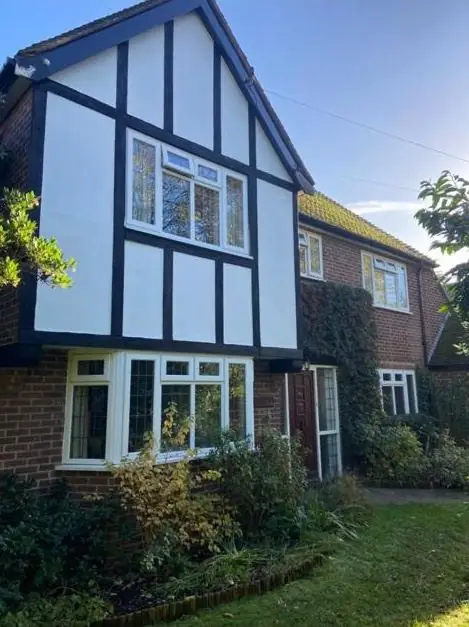
In Dallington's old village the walls are local ironstone under slate, so exterior painting is mostly windows, doors and other joinery, and the listed buildings need consent for any change of colour or finish. Beyond the conservation area, houses off Poyntz Lane and Dallington Park Road are ordinary repaints. Dallington lies 1.3 miles north-west of Northampton town centre, in NN5.
| Fact | Detail | Source |
|---|---|---|
| Conservation area | Designated January 1970; extended to the whole of Dallington Park in February 2011 | Northamptonshire HER |
| Historic building materials | Predominantly Northamptonshire ironstone, with slate the main roof covering | West Northamptonshire Council |
| Listed buildings | 14 inside the conservation area (2011 appraisal); 16 Historic England list entries across Dallington | services-eu1.arcgis.com |
| Flood warning area | Environment Agency area 055FWFPNNE06 names Dallington Green among its streets | Environment Agency |
| Height above sea level | About 74 m by the brook on Brook Lane; 84-90 m along Harlestone Road | api.opentopodata.org |
Ironstone and slate: what actually takes paint
The 2011 conservation area appraisal describes the historic buildings as predominantly Northamptonshire ironstone, probably quarried close by, with slate the main roof covering. The listing texts describe the same walls as sandstone coursed rubble and ashlar. Either way, the walls of the old village were never meant to be painted, and they should stay bare. On these houses the exterior painting is the timber and metal set into the stone:
- sash windows with glazing bars, some in moulded surrounds;
- leaded-light metal casements and stone-mullioned lattice casements;
- panelled front doors, fanlights and bracketed door hoods;
- box dormers sitting in steep slate or tile roofs;
- gates, railings and the odd painted boundary detail.
Paint is kept off the stone around every one of these. Where earlier painters have splashed or overpainted stone sills and reveals, we leave that as found unless you want it cleaned off, which is a separate conversation about method.
| Type | Share |
|---|---|
| Detached | 28.5% |
| Semi-detached | 35.3% |
| Terraced | 24.9% |
| Flat or maisonette | 11.2% |
Source: Census 2021 (ONS), accommodation type (TS044) tables via Nomis. The figures are for the census area that best fits Dallington, so its edges are not exactly Dallington’s.
Is my house listed, or just in the conservation area?
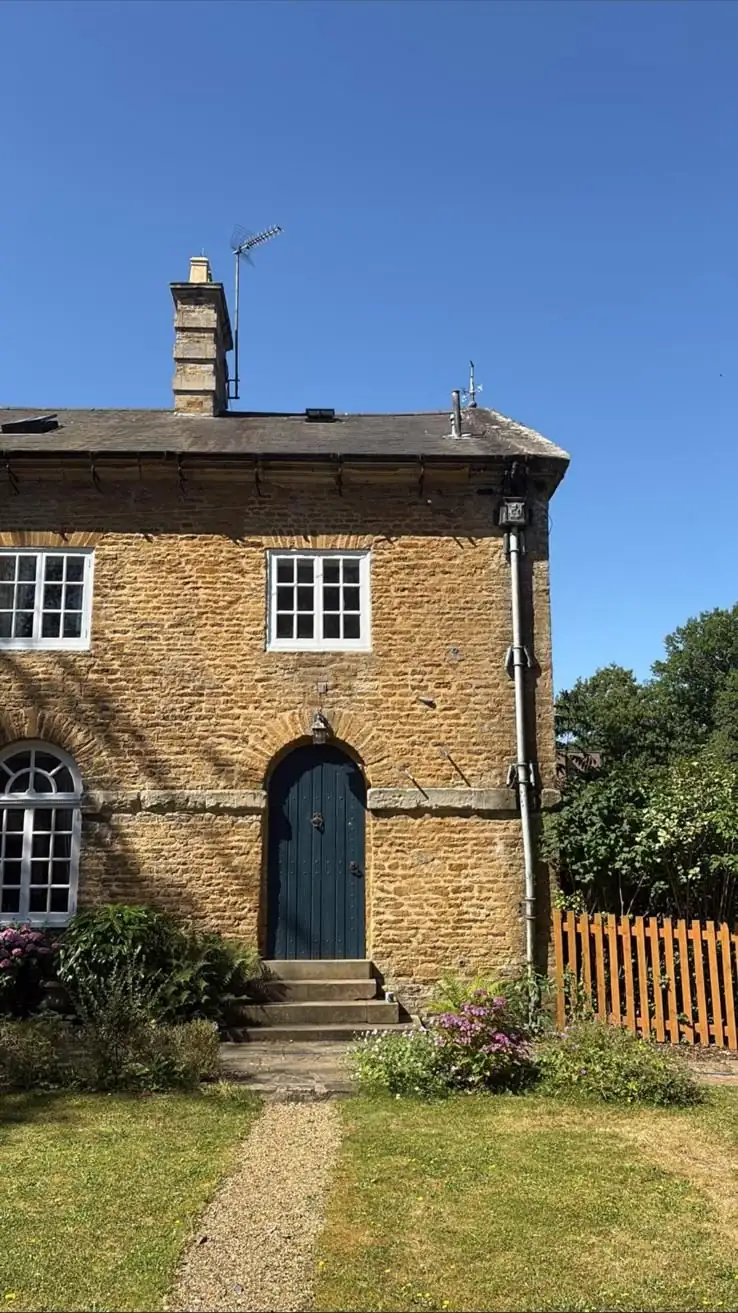
It matters, because the rules differ. The Dallington conservation area was designated in 1970 and extended in 2011 to take in the whole of Dallington Park. The appraisal counts 14 listed buildings inside it, and Historic England’s list has 16 entries across Dallington including Elmleigh on Harlestone Road and the war memorial. On a listed building, any change to the colour or finish of the outside needs listed building consent, so the safe course is a like-for-like repaint. On an unlisted house in the conservation area, there is no Article 4 direction for Dallington on the council’s list, so repainting is normally permitted development; the planning department can confirm that for a particular address.
| Listed building | Grade | Painted parts named in the listing |
|---|---|---|
| Dallington Hall (1-5 Dallington Court) | II* | Sashes with glazing bars in eared architraves, eight-panel door, gabled dormers |
| The Wheatsheaf Inn, 126 Dallington Road | II | Leaded metal casements and a sash, under a thatched roof |
| House known as Dallington Weir, Raynsford Road | II | Box dormers and a bracketed door hood |
| The Bartons, 2 Raynsford Road | II | Sashes, a first-floor oriel and flush casements in the wing |
| Raynsford Almshouses, Dallington Green | II | Stone-mullioned lattice casements |
Near the thatch on the Wheatsheaf, no heat gun or blowlamp is used to remove paint. Scraping and chemical strippers only.
Doors and frames a few metres from the brook
A strip of Flood Zone 2 and 3 follows the Dallington Brook through the village, and the postcode centres along Brook Lane, Dallington Green and Dallington Road sit only metres outside it. The Environment Agency’s flood warning area for the Dallington Brook names Dallington Green among the streets it covers. Timber close to the ground here gets wet often. Before repainting a front or back door on these streets, Dean checks the bottom rail, the sill and the foot of the frame with a probe. Soft wood is cut out and repaired with a resin filler or a spliced-in piece before any primer goes on, because paint over wet rot fails within a season.
Damp mornings in the valley
The old village sits in a small east-west valley. By the brook on Brook Lane the ground is about 74 metres above sea level; Harlestone Road by the park is about 84 metres and rises to around 90 at the Poyntz Lane end. Cold, damp air settles in the bottom, and the trees round the green and along the brook keep many fronts in shade. Paintwork there dries more slowly and holds dew later into the morning. Exterior work in the valley is booked for settled spells, started once surfaces are dry and stopped early enough for the last coat to firm up before evening. Our guide to timing exterior painting explains the timing.
Detached houses outside the boundary
Off Poyntz Lane and along Dallington Park Road most homes are detached and privately owned, with no conservation colour controls. These are standard repaints: wash down, scrape and sand, spot-prime, fill, then two finish coats on windows, doors, fascias and any rendered panels. Front doors and woodwork are covered in more depth on our Dallington doors and woodwork page, and the general method is on the main exterior painting service. Everything else we cover in the area is on the Dallington page.
Sources
- Dallington Village Conservation Area Appraisal & Management Plan (February 2011), West Northamptonshire Council (accessed 2026-11-16)
- Dallington conservation area, Northamptonshire Historic Environment Record (accessed 2026-11-16)
- Dallington Conservation Area map, West Northamptonshire Council (accessed 2026-11-16)
- National Heritage List for England, list entries in the Dallington area, Historic England (accessed 2026-11-16)
- Dallington Hall, Northampton, British Listed Buildings (accessed 2026-11-16)
- The Wheatsheaf Inn, Northampton, British Listed Buildings (accessed 2026-11-16)
- House Known As Dallington Weir, Northampton, British Listed Buildings (accessed 2026-11-16)
- The Bartons, Northampton, British Listed Buildings (accessed 2026-11-16)
- Heritage and non-heritage Article 4s and Local Development Orders (LDOs), West Northamptonshire Council (accessed 2026-11-16)
- Flood risk zones (Environment Agency Flood Map for Planning), planning.data.gov.uk (accessed 2026-11-16)
- Flood warning area 055FWFPNNE06: areas near the Dallington Brook and Brampton Branch in Northampton, Environment Agency (accessed 2026-11-16)
- EU-DEM 25 m elevation data, Open Topo Data (accessed 2026-11-16)
Last updated .


