
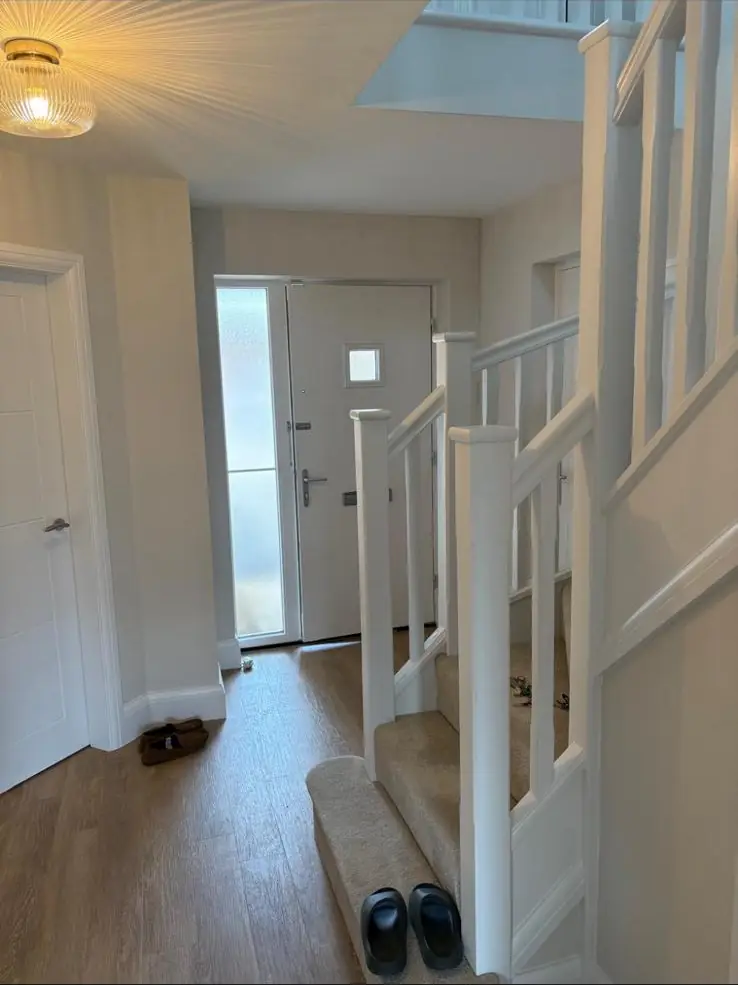
Dean paints walls, ceilings and woodwork inside Dallington homes, from solid-stone 17th and 18th century houses round the green to detached houses off Dallington Park Road and flats near Cardigan Close. Dallington is 1.3 miles north-west of Northampton town centre in NN5, and every quote follows a visit.
Three kinds of home inside a few hundred metres
The 2021 Census splits Dallington into small output areas, and the four that cover the village and its edges could hardly be more different. Round Dallington Park Road and Poyntz Lane, 82.8% of homes are detached and 90.6% are owner-occupied, most of them owned outright. A short walk east, the Brookside Meadows and Candace Court area is 85.5% social rented. Between them, the Dallington Road and Cardigan Close area is one-third purpose-built flats. So an interior job here can mean a whole detached house, a three-bed semi between tenants or a one-bedroom flat in a sheltered scheme, and the preparation, the access and who pays all change with it.
| Census output area | What the homes are | What that usually means inside |
|---|---|---|
| Dallington Park Road, Poyntz Lane, Dallington Green (128 homes) | 82.8% detached; 56.2% owned outright | Whole-house repaints of settled homes, often lived in while the work goes on, room by room |
| Raynsford Road, Brook Lane, The Croft (122) | Mostly semis and terraces; 31.4% council homes | A mix of stone houses in the conservation area, 1970s-80s infill and council bungalows |
| Dallington Road, Brook Lane, Cardigan Close (131) | 34.4% purpose-built flats; 54.2% council homes | Small rooms, often decorated by the tenant or arranged through the landlord |
| Brookside Meadows, Candace Court (117) | Semis and terraces; 78.6% housing association | Homes let by a housing association, whose own rules on tenants decorating apply |
The figures come from Nomis (ONS) tables for the four output areas, 497 households in all.
| Fact | Detail | Source |
|---|---|---|
| Dallington Park Road / Poyntz Lane output area | 82.8% detached, 90.6% owner-occupied (Census 2021) | Nomis (ONS) |
| Brookside Meadows / Candace Court output area | 85.5% social rented, 78.6% housing association (Census 2021) | Nomis (ONS) |
| Dallington Road / Cardigan Close output area | 34.4% of homes are purpose-built flats (Census 2021) | Nomis (ONS) |
| Converted farm buildings | The Granary, The Stables and 6-16 Old Dairy Farm named as positive buildings in the 2011 appraisal | West Northamptonshire Council |
| Type | Share |
|---|---|
| Detached | 28.5% |
| Semi-detached | 35.3% |
| Terraced | 24.9% |
| Flat or maisonette | 11.2% |
Source: Census 2021 (ONS), accommodation type (TS044) tables via Nomis. The figures are for the census area that best fits Dallington, so its edges are not exactly Dallington’s.
What is different about painting inside a stone house by the green?
The houses round Dallington Green and up Raynsford Road are 17th and 18th century, built of local stone that the 2011 conservation area appraisal calls Northamptonshire ironstone. Inside, walls are thick, solid and rarely flat. They lose heat to the outside, so the inner face can be cold, and on the lower floors close to the Dallington Brook it can also be damp. That changes the job in three ways.
- Old plaster first. Walls are tapped over for hollow patches and soft areas before anything is filled. Where the original plaster is lime, repairs are made in a compatible filler, not a hard gypsum skim that would crack away from it.
- A paint that lets the wall dry. A breathable emulsion or mineral paint on solid walls lets moisture pass out instead of blistering behind an acrylic film.
- Cutting in on curves. Window reveals and corners wander, so straight lines at ceilings and skirtings are made by hand and eye, not by following the plaster.
The job can look quite different on the same street. The houses at 17-29 (odd numbers) Brook Lane are late-20th-century infill, named as modern properties in the appraisal, so they are likely to have modern plastered walls and joinery; Dean checks at the visit. Same street, different method.
Barns, stables and the old dairy
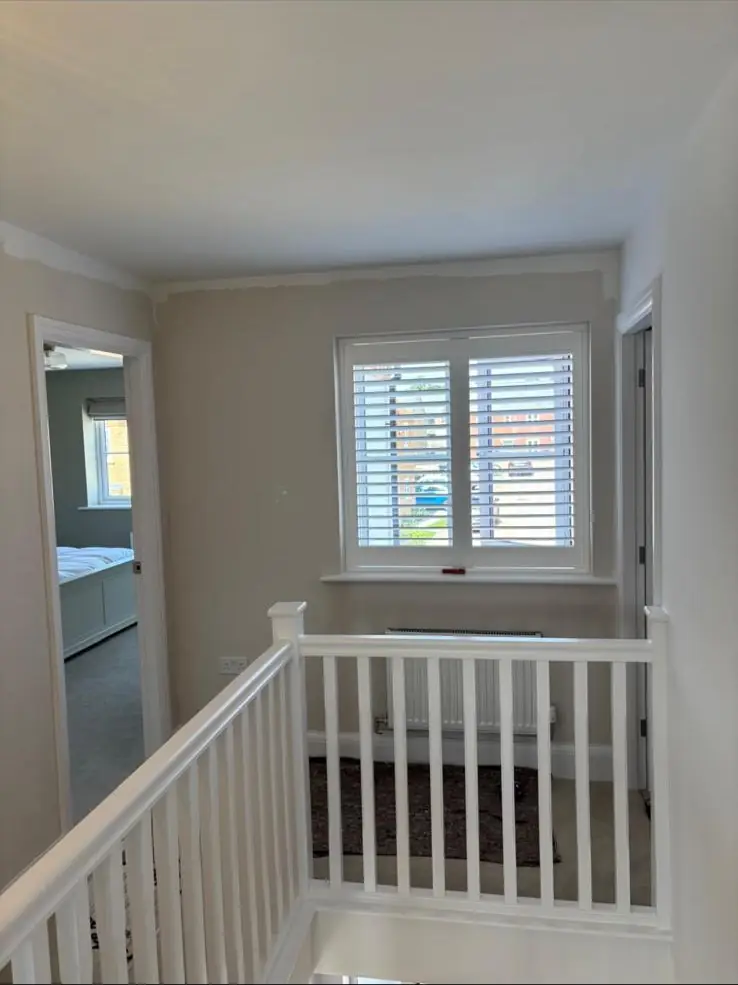
Several of the homes inside the conservation area started as farm buildings. The appraisal lists The Granary at 6 Raynsford Road, The Stables and 6-16 Old Dairy Farm on Brook Lane among its positive buildings, and Old Dairy Farm is brownstone rubble under red tiles. Conversions like these tend to have tall rooms open to the roof, long walls with few breaks and areas of stone left exposed on purpose. Painting them means a tower or low platform for the high work, careful masking where plaster meets bare stone so no emulsion creeps into the joints, and dust sheets laid well wide because spatter carries further from a height. If you want paper on that long gable wall instead, our wallpaper hanging page for Dallington covers the extra steps.
Repainting a whole detached house off Dallington Park Road
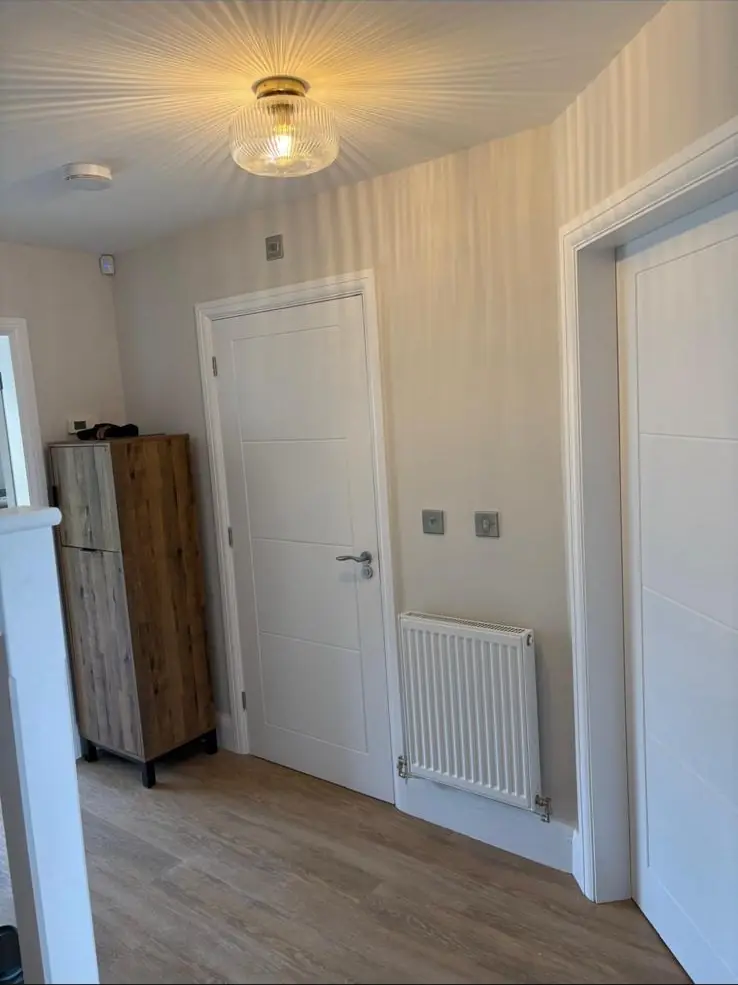
Most of the detached homes in the Dallington Park Road and Poyntz Lane area are owned outright, which usually means people who have lived there a while. The job tends to be a full repaint, top to bottom, while the house stays in use. Dean plans it so you lose as few rooms at once as possible: furniture moved to the middle and covered, ceilings before walls, woodwork last, each room cleared and back in use before the next is started. Hairline cracks over doors and at ceiling joints are raked out and filled, and a ceiling that has yellowed over the years gets a stain-blocking coat before the finish.
For what a full-house job involves in general, from protecting floors to the order of coats, see our main interior painting service. For how the cost is worked out, read the painter and decorator cost guide. Other Dallington services are on the Dallington area page.
Questions about painting inside Dallington homes
Something not covered here? Call Dean on 07539 779 036.
Can you paint the stone-walled rooms in an old Dallington cottage without trapping damp?
Yes. On solid stone walls we use a breathable emulsion or a mineral paint so moisture in the wall can still escape through the surface. Any lime plaster repairs are made with a compatible material first. If a wall near the brook is actively wet, the cause needs sorting before decorating, and Dean will tell you that at the visit rather than paint over it.
I rent a flat near Cardigan Close. Can I have it decorated?
Usually you need your landlord's agreement first, and in the Dallington Road and Cardigan Close area most homes are council-owned, managed by Northamptonshire Partnership Homes. Check your tenancy terms or ask the landlord. Once you have the go-ahead, Dean can quote for the rooms you want doing and suggest colours that are easy to live with in a small flat.
Do you paint converted barns with exposed stone walls inside?
Yes. Converted barns and stables such as those on Raynsford Road and at Old Dairy Farm on Brook Lane often have tall rooms and stone left bare on purpose. We use a tower for high ceilings and gable walls, mask the edge where plaster meets stone, and keep paint out of the stone joints.
Can I stay in my house on Poyntz Lane while it is painted?
Most people do. Dean works through the house a room or two at a time, so the kitchen, a bathroom and somewhere to sit stay usable. Furniture is moved and covered, floors are protected, and each room is cleaned up and handed back before the next one starts. The order is agreed with you at the quote.
Sources
- Census 2021 accommodation type (TS044), output areas E00138569, E00138583, E00138584 and E00138585, Nomis (ONS) (accessed 2026-11-16)
- Census 2021 tenure (TS054), output areas E00138569, E00138583, E00138584 and E00138585, Nomis (ONS) (accessed 2026-11-16)
- Dallington Village Conservation Area Appraisal & Management Plan (February 2011), West Northamptonshire Council (accessed 2026-11-16)
- Dallington conservation area, Northamptonshire Historic Environment Record (accessed 2026-11-16)
Last updated .


