Dean gives colour and finish advice to homeowners and landlords in Delapre, about 0.9 miles south of Northampton town centre, as part of a decorating job. The houses west of London Road are outside the conservation area, so exterior colours are your choice, but a few local factors are worth weighing first.
Where the planning line falls
Delapre Park Conservation Area was designated in July 2007 and covers the abbey, its outbuildings, the gardens and the parkland. Its western edge is London Road, and the 1930s houses on the far side were deliberately left out. We found no Article 4 direction that controls decoration on those streets. In practice that means owners on Delapre Crescent Road, Forest Road, Eastfield Road, Queen Eleanor Road and Ransome Road can repaint a front door, porch or rendered wall any colour they like without asking the council.
The Article 4 directions that do exist in Delapre deal with converting houses into small HMOs. They control use, not paint. Work on the abbey estate itself is a different matter: the abbey carries a Grade II* listing, with the stable block, orangery and game larder at Grade II, so a colour change on any of them is a listed building consent matter.
Rendered fronts on a brick terrace
The most interesting colour question in Delapre comes from external wall insulation. Several houses on Forest Road, Eastfield Road and Queen Eleanor Road now have a thin render finish over insulation, while the neighbours either side are still bare red brick. Because terraces are read as one continuous frontage, a stark white or a strong colour on one insulated house can look like a missing tooth in the row.
Shades that tend to sit comfortably next to interwar brick include warm off-whites, stone and putty tones, and soft greens with a grey undertone. Very cool brilliant whites show traffic dirt and tree staining quickly here. It also helps to look along the whole row before deciding: if one neighbour has already rendered and painted, matching or toning with that house usually looks more deliberate than introducing a third colour. Whatever the colour, the paint itself must be a flexible, breathable masonry coating made for insulated render, which limits the product range more than the colour range. Our guide to painting render covers why.
Facing the park
The semis on London Road look straight across to the tree-lined boundary of Delapre Park. Greens, muted blues and heritage-style front door colours sit well against that backdrop. The same mature trees also drop sap and leaf litter, and the road carries trunk traffic, so a satin finish on doors, gates and roofline timber keeps its colour longer than a flat finish on these frontages.
Colour and sheen inside interwar rooms
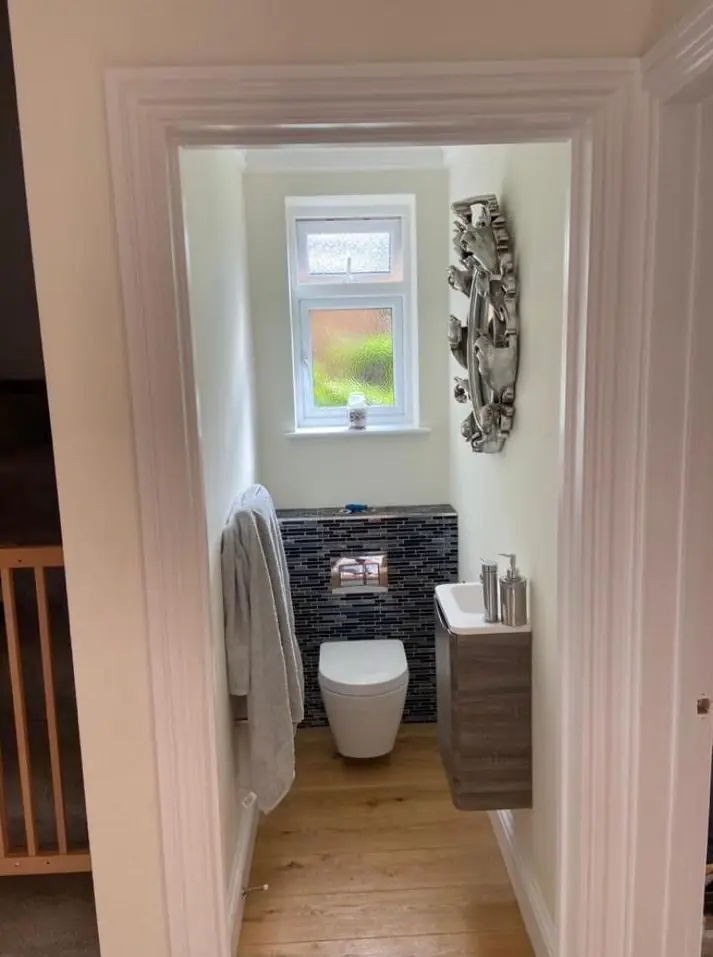
- Cold outer walls: in the solid-brick houses, a deep dark colour on a north-facing outside wall can make any condensation marks more obvious. Mid-tones with a warm undertone are more forgiving.
- Small rooms and narrow halls: lighter walls with a slightly deeper shade on the woodwork keep a 1930s hall from feeling boxed in, and a scrubbable matt or eggshell copes with wear.
- Picture rails: painting the frieze and ceiling the same pale shade lifts the ceiling height visually. Painting the frieze darker brings it down, which can suit the larger front rooms of the 100 to 120 square metre London Road semis.
- Shared lets: landlords near the Waterside Campus usually want one neutral wall colour and one woodwork colour across the house, so touch-ups between tenancies match.
Dean looks at colours on your actual walls, at the time of day you use the room, before anything is ordered. The advice comes alongside a decorating quote rather than as a separate design service. More on how it works is on our main colour and finish advice page, and you can see the other services we offer locally on the Delapre area page.
Last updated by Dean, DH Painter & Decorator.