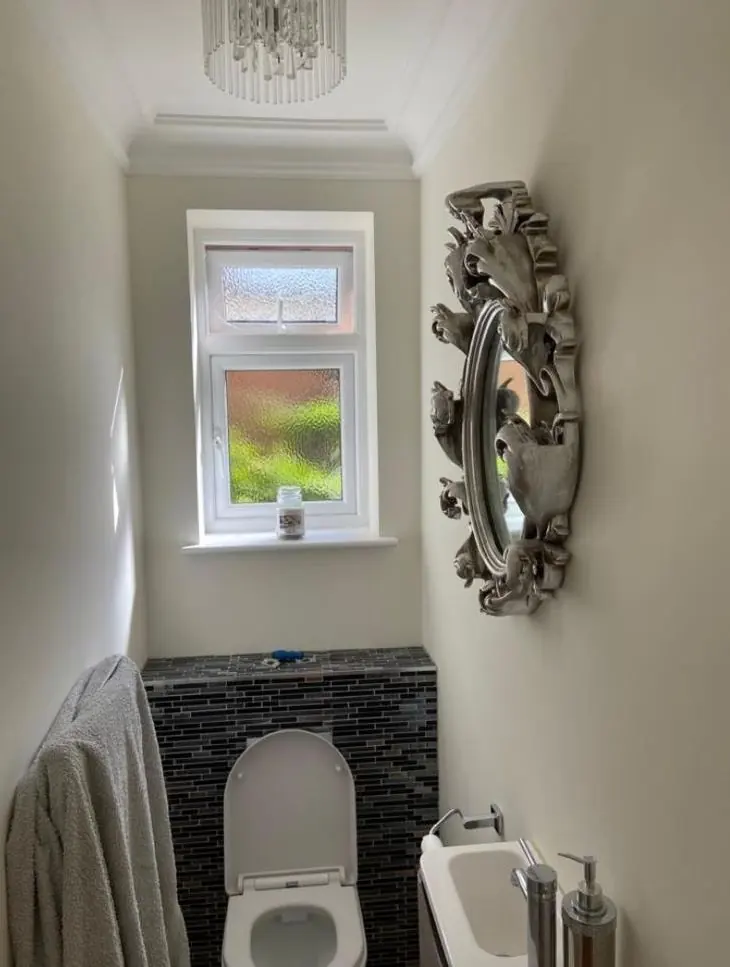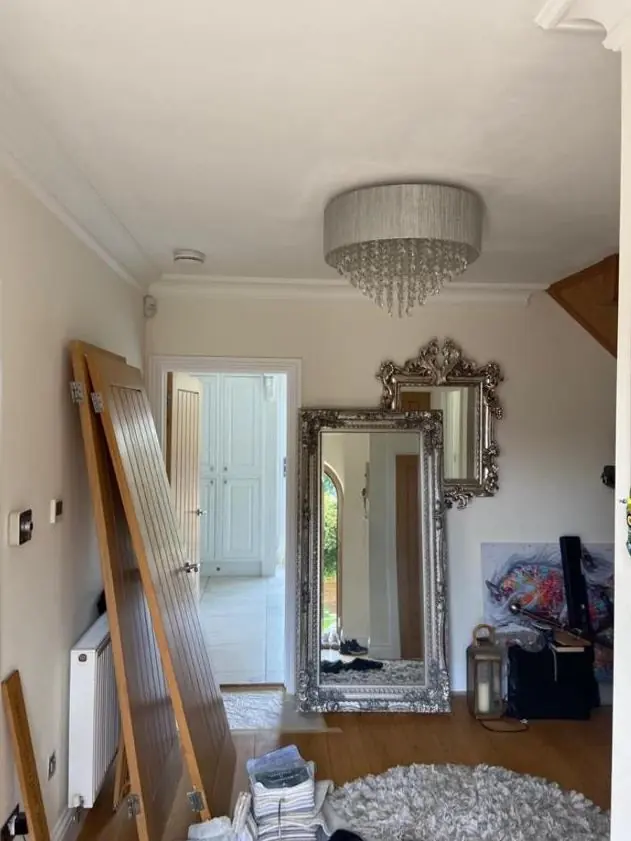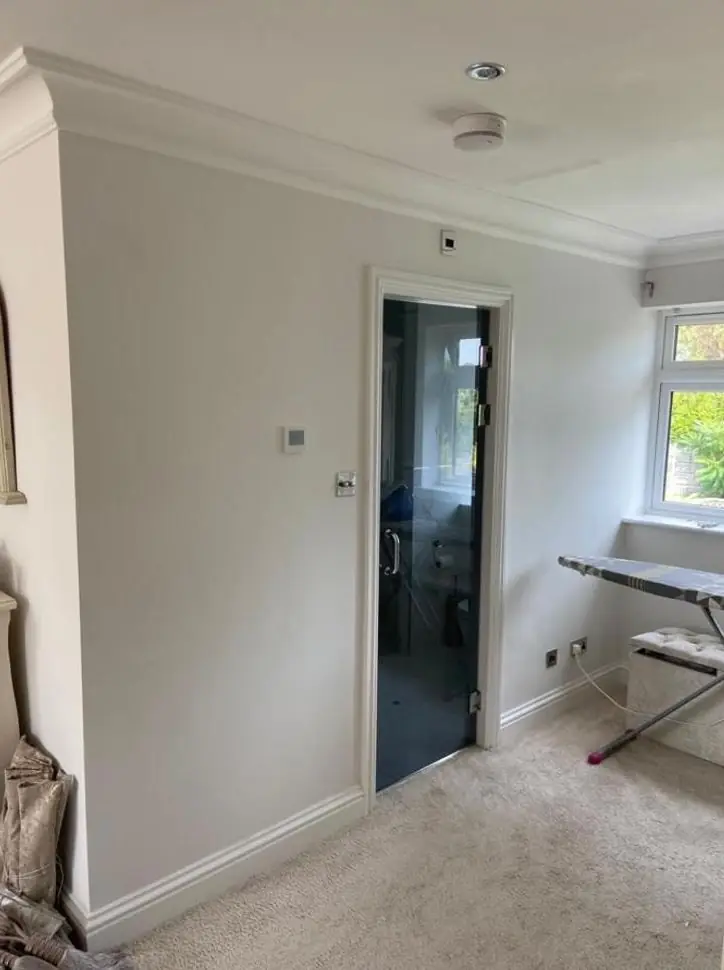
Dean applies decorative and traditional finishes in Denton, the NN7 village 5.4 miles east of Northampton. In the 17th to 19th century stone cottages and farmhouses that usually means limewash and other breathable traditional finishes. In the Leys estate and later homes, broken-colour effects, two-tone schemes and feature walls are the more likely requests.
Limewash suits the houses Denton was built with
The oldest houses in Denton, such as Church Farm (1675), the thatched house dated 1606 at the village’s western end, and the mid to late 17th century cottage at 5 Wareing Lane, were built of local limestone in the era of lime mortar and lime plaster. Limewash belongs to that kind of building. It is lime putty thinned with water, sometimes tinted with earth pigments, and applied in several thin coats. It soaks into a porous surface instead of forming a film, so the wall can still release moisture. In a village that sits in a valley and holds damp near the stream and the mature oaks around St Margaret’s, that matters.
It also looks different from modern paint. Limewash dries chalky and slightly uneven, deepens when it is damp and pales again as it dries, and gains a soft depth over several coats. Inside an old cottage, on a plastered wall, a chimney breast or a whitewashed beam ceiling, it gives a finish that a flat emulsion cannot copy.
What has to happen before limewash goes on
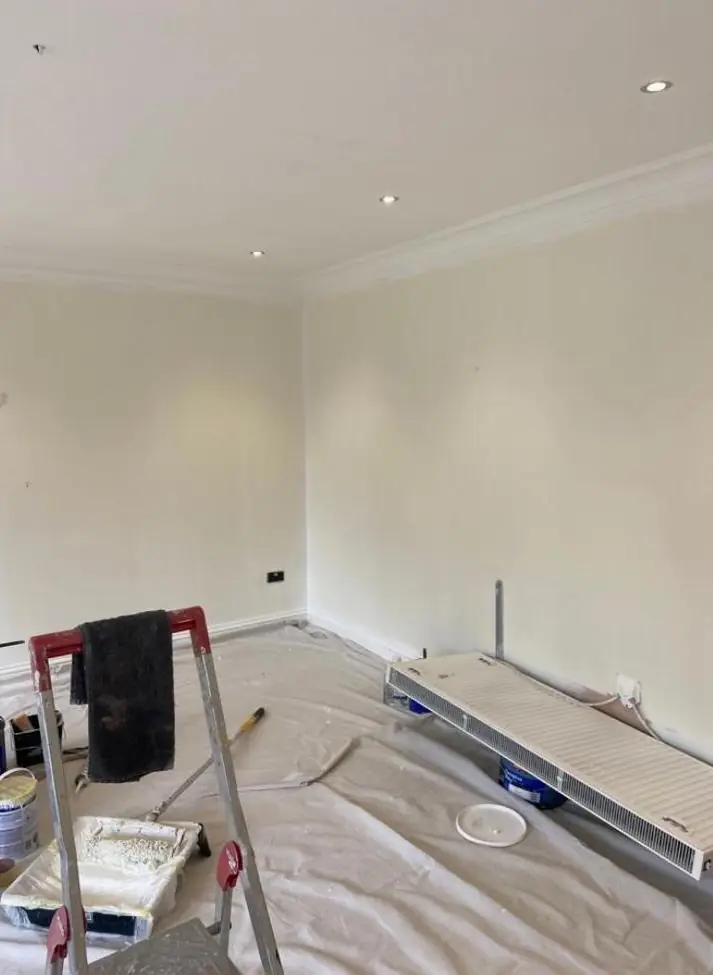
Limewash only bonds to a porous surface. Over acrylic or vinyl emulsion it powders and peels within months, so a wall painted in modern emulsion has to be taken back first. That can mean careful stripping across a whole room, which we include in the quote so it is not a surprise. It also brings practical requirements:
- Thin coats, applied to a dampened surface and protected from fast drying.
- Several coats, typically four or more, to reach an even finish.
- Gloves, eye protection and well-covered floors, since lime is caustic while wet.
- Patience, because the true colour is only clear once the last coat has fully cured.
On a listed building, and Denton has around a dozen, going back to a historic finish or stripping modern paint can count as a change of appearance. We will flag this before you commit so you can talk to the conservation officer first.
Broken colour and feature walls in the newer homes
The Leys estate of the late 1960s, and the bungalows and houses added since have gypsum plaster or plasterboard walls, where limewash is not the right choice. There, decorative work tends to mean colour washing or rag-rolled broken colour on a single wall, a two-tone split at dado height, a painted arch or geometric panel behind a bed, or picking out the panels of a modern door in a second shade. These finishes go over a sound emulsion base, so the preparation looks much like any interior job.
Hand-painted work has a local precedent
Hand-applied decoration has a visible place in the village. Inside St Margaret’s Church, Northampton artist Henry Bird painted biblical murals between 1975 and 1976, filling 16 panels with 31 life-size figures. Our work is domestic and far smaller in scale, but it starts from the same point: decoration painted directly onto the wall rather than printed or applied as a paper. In a house with a long history, a hand-finished surface also ages in a way that suits the building, softening rather than peeling. If you are thinking about a hand-finished panel or feature in a Denton home, Dean will talk through what the wall can take and how the finish will age.
Our main decorative finishes page describes faux effects and panelling in more depth. For other work in the village, see the Denton area page.
Last updated by Dean, DH Painter & Decorator.