Dean applies decorative and traditional finishes in Yardley Hastings, about 7.3 miles east of Northampton. Limewash suits the lime-plastered interiors of the old limestone cottages, while feature walls and two-tone effects fit better in The Leys, Highfield Way and other later homes.
Limewash for lime-plastered cottage rooms
The oldest homes in Yardley Hastings, the 17th and 18th century cottages and farmhouses on High Street, Little Street and Little Lane, were built of local limestone with lime plaster inside. Traditional finishes belong on that fabric, and limewash is the obvious one. It is lime and water, sometimes tinted with pigment, brushed on in several thin coats. It soaks into lime plaster instead of sitting on top as a film, so the wall keeps breathing, and it dries to a soft, chalky surface whose tone shifts slightly across the wall. That variation is the appeal; it suits hand-finished plaster that was never flat.
Limewash needs patience. Each coat goes on thin over a dampened surface and has to cure before the next. It will not take over modern acrylic paint, so walls already coated in vinyl emulsion need stripping first, or a different breathable finish chosen instead.
What to leave alone outside
The coursed limestone rubble walls that line the village are meant to stay bare. The conservation area appraisal lists painting among the incremental changes that harm unlisted buildings and recommends Article 4 directions to control it, so we would not limewash or paint stone that has never been coated. The brick fronts are similar: the Old Rectory’s 1701 facade, 20-22 Little Street and The Old School House should keep their exposed brick. Where stone has been limewashed or painted before, renewing it with limewash or a breathable mineral paint is the sympathetic option.
Picking out joinery and period detail
Some of the most rewarding decorative work here is on joinery rather than walls. The Old School House on Northampton Road, named in the appraisal as locally significant, has decorative bargeboards and an ornate wooden porch. Detail like that can be lifted by picking out mouldings and brackets in a second colour, done sparingly and within a traditional range. The work is slow: sanding into carved recesses, filling splits and cutting two colours in by hand without a wobble.
Inside, plank and panelled cottage doors and the window boards set into deep stone walls can be treated the same way. If the house is listed, and the village has 23 listed entries, any change of finish on original fabric should be checked with the council before work starts.
Feature walls in the later houses
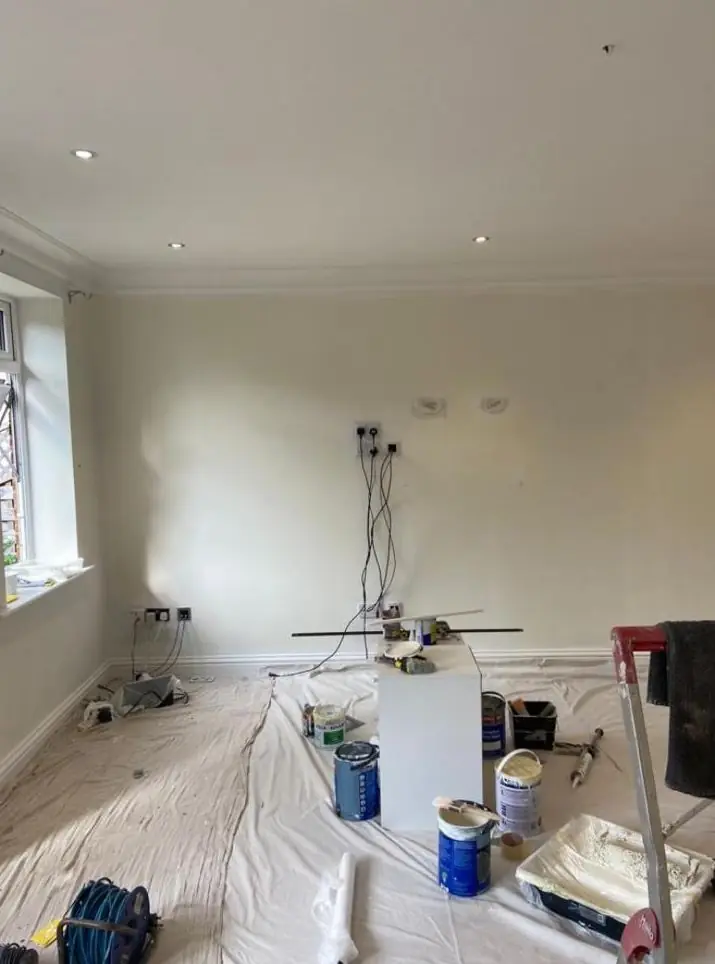
Feature walls, two-tone splits and broken-colour effects are more at home in the village’s later houses. The 1935 homes on The Leys, the Highfield Way houses and the Castle Ashby Road bungalows have flatter walls and squarer rooms, so a crisp horizontal line between two colours reads as level. A chimney breast or the wall behind a bed is the natural place for one. In the Greenyard barn conversions, any new plaster has to dry out and take a mist coat before an effect goes on top.
When we would talk you out of an effect
A paint effect is not right for every wall. On bowed lime plaster a two-tone line follows the bumps, and ragging or sponging can make the surface look grubby rather than rich. In a small cottage room with one casement, a heavy faux finish closes the space in. Dean will say so at the quote rather than leave you living with it. We cover Yardley Hastings from our Northampton base; the decorative finishes page explains the full range of effects, and the Yardley Hastings area page covers the village’s other painting work.
Last updated by Dean, DH Painter & Decorator.