DH Painter & Decorator applies decorative finishes in Overstone, an NN6 village about 5 miles north-east of Northampton. For the 18th-century farmhouses and the mid-19th-century estate cottages that usually means limewash, distemper-style or heritage flat paint; in the later houses it means feature walls, panelling and picked-out detail.
Finishes that belong to the building
Three periods of building sit side by side in Overstone: 18th-century lias cottages and farmhouses on Sywell Road, among them the thatched row and Holly Lodge Farmhouse, a mid-19th-century estate group of Whistlefield, Court House, The Dairy, Court Lodge and Court Cottages, and later homes off Woodland Avenue and by the lakes. In the older two, a decorative finish is often a practical choice before it is a look. Limewash and distemper suit lime-plastered walls because they let them breathe, and they give the soft, slightly uneven depth that modern emulsion cannot.
Limewash on lime plaster
Limewash is slaked lime thinned with water, sometimes tinted with pigment, and built up in several very thin coats. It hardens by taking in carbon dioxide from the air, stays breathable and dries to a chalky surface with gentle variation in tone. On lime plaster in a lias cottage it moves with the wall rather than sitting on top as a film. It does ask for patience:
- The wall is dampened before each coat so the limewash does not dry too fast and dust off
- Four or more thin coats, not two thick ones
- It dries several shades lighter than it looks wet, so samples must dry fully before you judge them
- It will not bond to modern emulsion, so any plastic paint has to come off first
That last point is where planning starts. Removing a modern coating to go back to limewash in a listed house is a change of finish, and in a building this old the old layers may contain lead. Dean tests before any sanding or scraping and keeps the preparation dust-free.
Distemper-style and heritage flat paints
Soft distemper was the standard Victorian finish for ceilings and plain walls, the era the estate cottages were built in. It gives a deep, powdery matt, but it rubs off and cannot simply be painted over with emulsion. Where you want the look in a room that gets wear, heritage flat and clay paints give a very similar chalky finish with more durability. Choosing between them depends on the room and the wall underneath.
| Finish | Where it suits in Overstone | What to watch |
|---|---|---|
| Limewash | Lime-plastered cottage walls; previously painted stone | Many coats, slow cure, will not go over modern paint |
| Soft distemper | Ceilings between beams in the oldest rooms | Marks easily; must be washed off before any change |
| Heritage flat or clay paint | Halls and kitchens in period houses | Narrower colour range than standard paint |
Feature walls and detail in the later homes
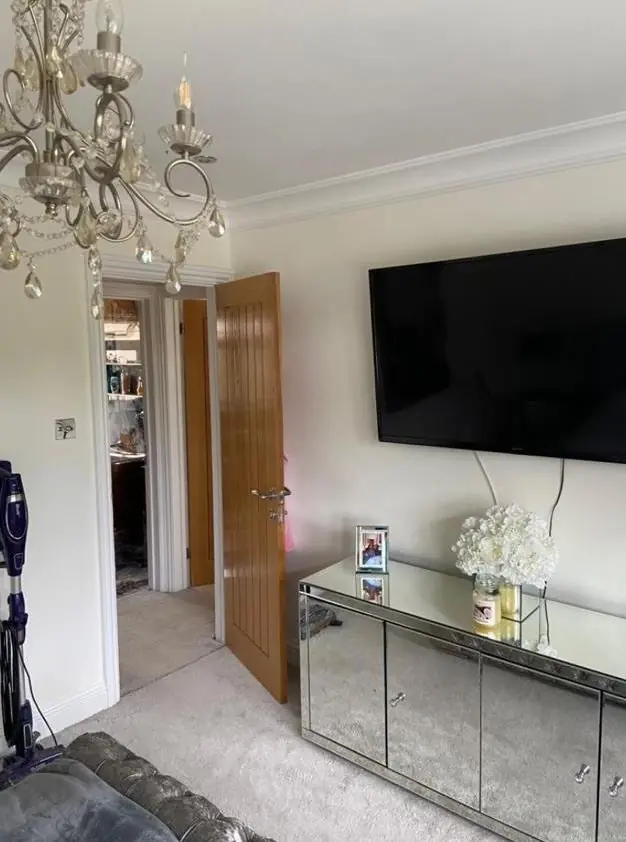
The newer houses off Woodland Avenue and in streets such as Ashdale Close, High Woods and Cherrytree Walk are not under any conservation controls, so decorative work there is about what you want in the room. That might be a single deep-toned feature wall, a two-tone split at dado height, new painted panelling where joints and pins need hiding, or picking out a fire surround in a contrasting sheen. Prep underneath is the same as for flat paintwork, because any effect shows up the wall beneath it.
Check listing before changing a finish
All of Overstone’s 18 listed buildings are Grade II, and there is no conservation area. Changing the type of finish, or stripping historic coatings, can need listed building consent from West Northamptonshire Council. Our main decorative finishes page explains how effects and panelling are done, our Overstone interior painting page covers ordinary repaints in the same cottages, and the Overstone area page covers the wider village.
Last updated by Dean, DH Painter & Decorator.