DH Painter & Decorator applies decorative paint finishes in Pineham (NN4), the 21st-century estate off Upton Valley Way North, on Northampton's south-western fringe 2.7 miles out. Dean adds depth to plain new-build rooms with limewash effects, painted panelling and two-tone schemes, fitted to each house's layout.
Adding depth to a house with no period features
In an older Northampton house, decorative painting often means picking out cornices, ceiling roses and dado rails that are already there. Pineham Village houses date from after 2007 and have none of that. Walls are flat plasterboard or plaster, ceilings are plain, and the trim is simple modern profiles. Decorative work here is about adding character rather than restoring it, which gives you more freedom but also means every effect has to be planned from scratch.
The finishes that suit these houses are the ones that give texture or structure to a flat wall:
- Limewash-effect paint, brushed in overlapping strokes for a soft, clouded wall that catches the light.
- Painted panelling, whether simple box mouldings or batten panels fixed to a plain wall and painted in one colour so the joints disappear.
- Colour-blocking and two-tone walls, such as a deeper lower band, a painted arch behind a bed or a contrasting ceiling.
Our main decorative finishes page describes the full range. Below is how they work in Pineham’s specific house types.
The three-storey stairwell as a showpiece
The townhouses on streets such as Mayfly Road have one feature older houses rarely match: a stairwell that runs through two flights over three floors. It is the tallest continuous wall in the house, and visitors see it every time they go upstairs. A limewash effect or tall painted panelling running up the stair line gives that height a purpose. Because brush-applied effects show every stop and start, the wall has to be worked in one go from top to bottom while the edge stays wet, so we set up stair platforms or a tower to reach the whole height at once.
Open-plan rooms: deciding where an effect stops
Many Pineham layouts join the kitchen, dining and living areas, with few doors or corners to mark a change. A decorative finish needs a clean place to end, or it looks unfinished. We usually anchor it to something real: a chimney-style wall, a stair return, the end of a run of kitchen units, or a single full wall rather than part of one. Panelling can define a dining zone within an open room without building a partition. Ceiling height matters as well: on a standard modern ceiling, a lower panelled band or a deeper colour below a painted line keeps the proportions right, whereas full-height panelling can make a smaller new-build room feel boxed in.
Working beside natural stone
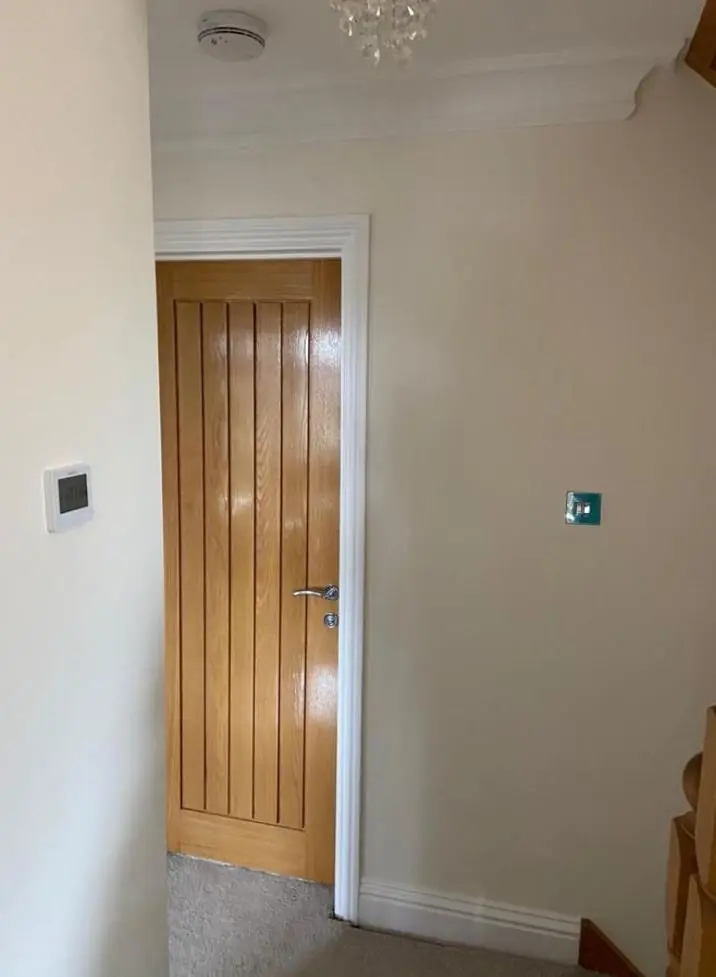
Some houses here already have a natural stone feature wall inside. That is your existing statement, and a second strong effect beside it usually competes. Better options are a quiet limewash tone that picks up the stone’s colour on the facing wall, or panelling in a room away from it. Wherever we work close to the stone, its edge is masked and cut in by hand, because stone is porous and paint or glaze that splashes onto it can stain permanently.
Preparing a young wall for an effect
Glazes and limewash-style paints show everything beneath them. On a new-build, that means filling settlement cracks at ceiling lines and corners first, sanding plasterboard joints flat, and replacing chalky builder’s emulsion with a sound base coat. On any recent plaster, the mist coat comes first; see our new plaster guide. For everything else on this estate, see the Pineham page.
Last updated by Dean, DH Painter & Decorator.