DH Painter & Decorator paints interiors in Spencer, the NN5 7 estate about a mile north-west of Northampton town centre between Harlestone Road and Spencer Bridge Road. Dean paints single rooms, whole houses and flats, adjusting the preparation to whether the home dates from the 1930s-50s, around 1970, the 2000s or the last few years.
Four building eras inside one NN5 7 estate
Spencer sits about a mile north-west of Northampton town centre, bounded by Harlestone Road (A428) to the south and Spencer Bridge Road (A4500) to the east, with Dallington beyond its western edge. Inside that boundary the houses were not all built at once, and the age of a Spencer home says a lot about its walls and ceilings before anyone opens a tin.
| Built | Streets | What we usually find inside |
|---|---|---|
| Late 1930s to 1950s | Pembroke, Tenby, Swansea, Monmouth, Streatfeild, Warren and Gladstone Roads | Family rooms with original chimney breasts, picture rails in some rooms, many layers of old paint |
| Around 1970 | Newport Road, Cardigan Close, Spencer Haven | Flats, maisonettes and bungalows with compact rooms and shared stairwells |
| 1986 to 2009 | Lyttleton Road | Flats and terraced houses with flatter, newer wall surfaces |
| Mostly recent, median build year 2019 | Countess Road | Managed blocks of flats, many of them privately let |
Because most estate homes are ordinary family houses rather than period restorations, an interior job here is usually about getting walls, ceilings and woodwork sound and evenly finished, with products that stand up to daily life. How we prepare and paint a room in general is on our main interior painting page. This page is about what changes when the room is in Spencer.
Inside the mid-century semis and terraces
The streets laid out between the late 1930s and the 1950s are the heart of Spencer. Their houses typically keep the original chimney breast in the front room, often with an alcove either side, and some rooms still have a picture rail. Windows have generally been replaced, so flaking sash boxes and putty are rarely part of an indoor job. What does come up is decades of build-up on ceilings and around the chimney breast: ridges of old paint, filler that has shrunk back, and the occasional ceiling that powders when rubbed and needs sealing before new emulsion will hold.
Those chimney breasts deserve a closer look. A disused flue can let damp or soot staining through the plaster, and that bleeds back through water-based paint. We spot-prime marked patches with a stain block before the finish coats, rather than hoping two coats of emulsion will bury them. Picture rails, where they survive, are worth deciding on early: kept and painted with the woodwork, or painted out in the wall colour so the room feels taller.
Many houses on Pembroke Road and the streets around it are housing association or council homes, and tenants there often decorate themselves. Private interior work in Spencer tends to come from owner-occupiers, a sizeable minority on streets such as Gladstone Road, and from landlords.
Newer plaster on Lyttleton Road and Countess Road
The homes on Lyttleton Road went up between the mid-1980s and 2009, and most of the Countess Road flats are only a few years old. Newer walls have their own snags. New-build homes keep drying out and settling for a while, so hairline cracks at ceiling junctions and around door frames are common early on. Anywhere a wall has been patched or made good, the bare plaster needs a diluted mist coat or the finish can peel; our mist coat guide explains why.
The Countess Road blocks are managed, so before we start we need the managing agent’s rules on working hours, lift and stair use, and where waste can go. For private landlords there, a between-tenancy turnaround calls for a scrubbable emulsion in one neutral that is easy to touch in when the next tenant leaves.
Getting materials and steps through the door
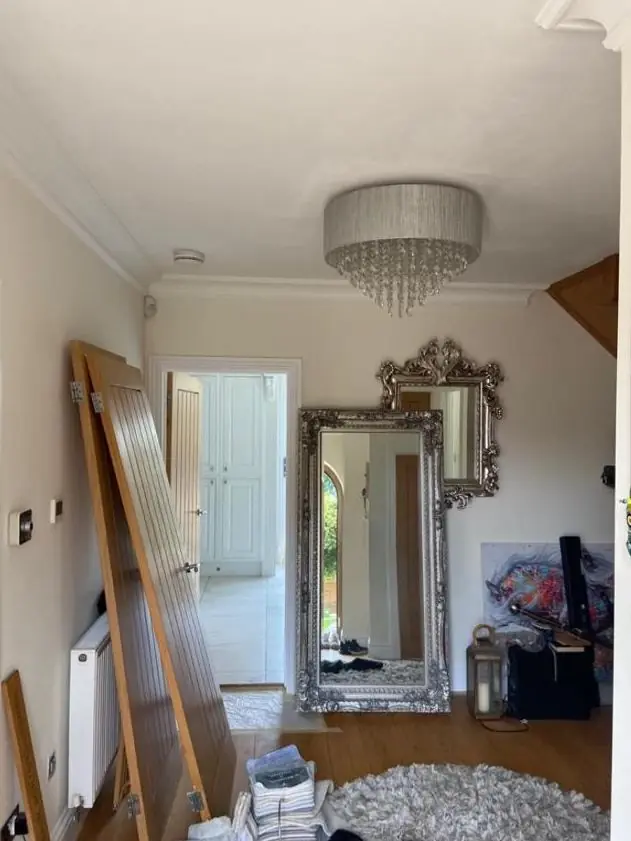
Many estate houses look to have off-street parking or side access, the usual pattern on 1930s-50s council layouts, though we check each one when quoting. The exceptions are homes fronting Spencer Bridge Road and Harlestone Road, both busy main roads where we plan parking and unloading in advance, and the flats and maisonettes around Cardigan Close, Spencer Haven and Newport Road, where everything goes up a shared stairwell and comes back down the same way. In those blocks we protect communal floors and handrails as carefully as the flat itself, because neighbours are using them all day.
Dean prices every job after seeing it, and the written quote is free. Our painter and decorator cost guide explains what drives the figure, and the Spencer area page covers the rest of our work in the district.
Last updated by Dean, DH Painter & Decorator.