
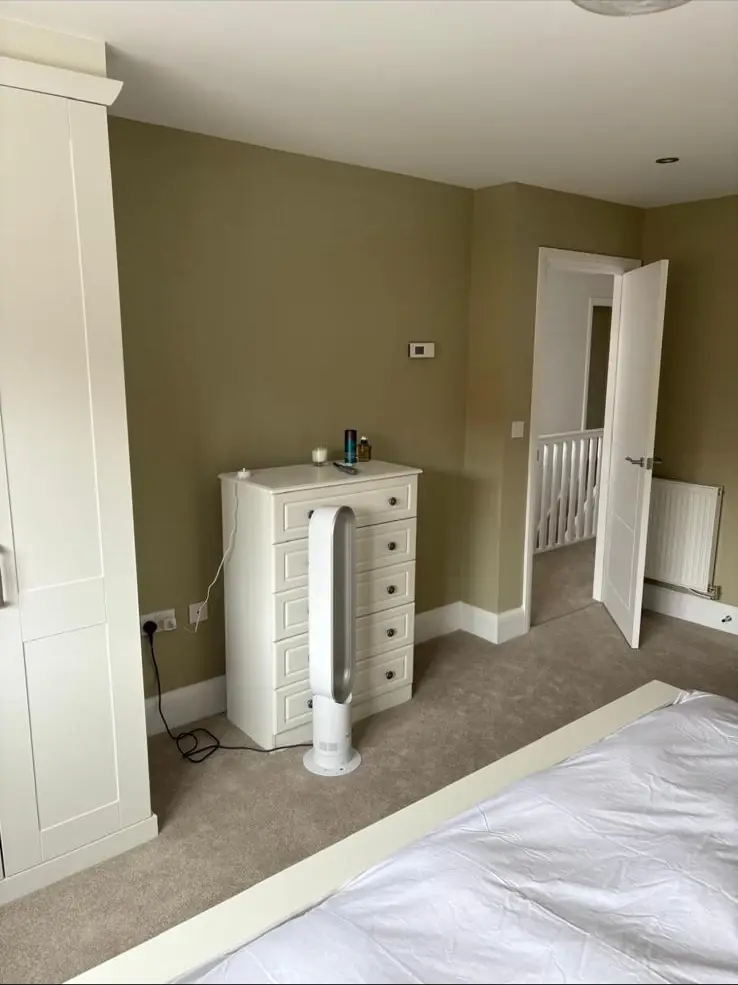
We paint interiors across St James, NN5, the terraced district 0.6 miles west of Northampton town centre on the far bank of the Nene. Most homes here are small solid-brick Victorian terraces, many on low ground inside the Environment Agency's flood zones, so Dean checks walls for damp, salts and condensation before a room is quoted.
Low ground, old walls: why a St James interior starts with a damp check
The streets between St James Road and the river are the lowest ground in St James, about 62 metres above sea level on Greenwood Road and St James Park Road. The Environment Agency maps much of that low-lying Victorian core into its flood zones. Of 72 postcode points checked across the two Census areas that hold the terraces, 47 fall in Flood Zone 2 or 3, and 31 of those in Zone 3. Flood zones ignore defences, and the banks were raised after the Good Friday flood of 10 April 1998, so none of this says anything about a particular house. It does tell us where to look harder before painting a ground floor.
On Stanley Road, Ambush Street, Spencer Street or Sharman Road, the walk-round before a quote looks for:
- tide marks and white salt bloom at the foot of walls, which emulsion will not hide for long;
- blown or crumbly plaster where an old damp-proof course was injected and the wall patched;
- skirtings that feel soft, or have been refitted with a gap behind them;
- brown staining on chimney breasts from old flue deposits, which bleeds through water-based paint unless it is sealed.
Salts are brushed off dry and the patch left to see whether they return. Live damp has to be put right by the right trade first, because paint over it only moves the problem along the wall. Where a wall is sound but still drying after replastering, a breathable emulsion goes on rather than a vinyl that seals the moisture in. In the same check, the streets on rising ground, such as Althorp Road, Wimbledon Street, Seymour Street and the Dundee, Fife and Forfar Street group, sat outside the flood zones, and their ground floors usually need less of this.
| Fact | Detail | Source |
|---|---|---|
| Flood zones in the Victorian core | 47 of 72 postcode points in Environment Agency Flood Zone 2 or 3, 31 of them in Zone 3 | planning.data.gov.uk |
| Terraced house walls | Solid brick in 49 of 53 sampled energy certificates | EPC register |
| Terraced houses by size | About 720 three-bedroom and 390 two-bedroom houses in the core | GOV.UK |
| Households over shops or commercial premises | 1.4% of core households (West Northamptonshire 0.5%), Census 2021 | Nomis (ONS) |
Solid brick and the mould in the back bedroom
Energy certificates tell a consistent story about these terraces. Of 53 terraced houses sampled across the core, 49 have solid brick main walls with no cavity, most recorded as uninsulated. A solid wall has nothing to break the cold, so the inside face of an outside wall runs colder than it would in a cavity-wall house, and that is where condensation settles: the corner of a back bedroom, behind a wardrobe on the gable wall, the bathroom ceiling above the bath.
Repainting mould only feeds it. We wash the area with a fungicidal solution, let it dry, seal any staining and finish kitchens, bathrooms and cold rooms in a mould-resistant paint. If the mould keeps coming back after that, the fix is ventilation and steady heating, and we will tell you so rather than keep painting over it.
How big is a typical job in a St James house?
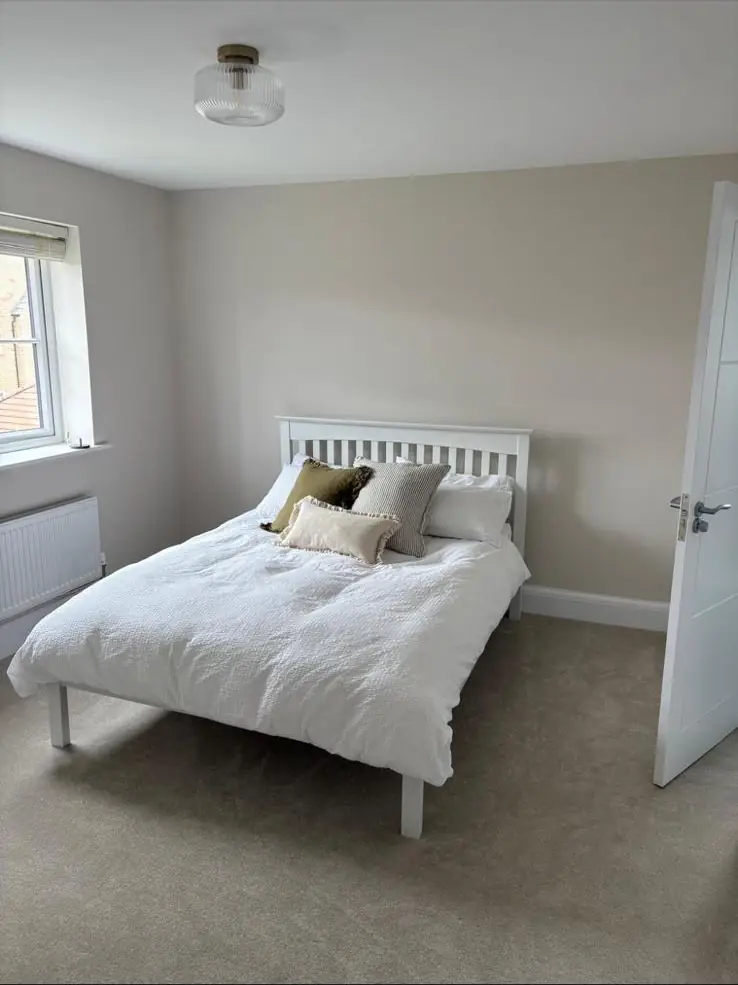
Smaller than people expect, and usually the whole house rather than one room. The Valuation Office Agency counts about 1,160 terraced houses in the core, 720 with three bedrooms and 390 with two, and the sampled certificates put most of them between 72 and 96 square metres. With a front room, a back room, a kitchen, a bathroom and two or three bedrooms off a short landing, it often makes sense to do the interior in one booking so the furniture only moves once.
| Home | What we usually find inside | What it changes |
|---|---|---|
| Victorian terrace, solid brick | Patched original plaster, cracked ceilings, chimney breasts in two rooms | More filling and making good; lining paper on the worst ceilings |
| Flat over a shop on St James Road | Side-door access and a narrow stair, with the shop trading below | Materials carried up by hand; sanding timed around the shop |
| Byfield Road and Greenwood Road blocks | System-built flats, ground floors of 40 to 73 square metres | Compact rooms; communal entrances and parking to plan |
| Former Express Lift site, 1999-2000 | Plasterboard on insulated cavity or timber-frame walls | Flatter walls; attention goes on nail pops and cracked board joints |
Flats over shops deserve a word of their own. The energy register lists addresses such as Flat Above, 121-123 St James Road, and the Census counts 1.4% of core households living over a shop or in a commercial building, nearly three times the West Northamptonshire rate of 0.5%. Those jobs depend on the business downstairs, so we agree with the owner when the noisy work happens, and carry everything up a staircase built for one person at a time.
| Type | Share |
|---|---|
| Detached | 3.4% |
| Semi-detached | 9.4% |
| Terraced | 52% |
| Flat or maisonette | 30% |
Source: Census 2021 (ONS), accommodation type (TS044) tables via Nomis. The figures are for the census area that best fits St James, so its edges are not exactly St James’s. Smaller groups are not shown, so the shares do not add up to 100%.
Planning the work in St James
The method, from filling and sanding to cutting in and the number of coats, is set out on our main interior painting service page. The St James side of planning is mostly about getting in and out: terraces here are parked on the street, so materials are unloaded at the kerb, and match days at Franklin’s Gardens make parking around Weedon Road harder, which we avoid when booking. If the hall and stairs are part of the job, our page on hallways and stairs in St James covers the staging a narrow terrace flight needs. For how decorating is priced, read the painter and decorator cost guide; other services in the district are on the St James area page.
Last updated .


