Dean hangs wallpaper and lining paper in Brixworth homes, from cottages in the old stone core to the newer estates, a short drive north of Northampton. The village's older stone cottages have walls that are rarely flat or square, so most jobs there start with lining paper, while the bigger period houses and newer estate homes bring stairwells, feature walls and full rooms.
Why paper behaves differently on Brixworth’s oldest walls
The cottages and farmhouses around Harborough Road, Church Street and Silver Street date from the 16th to the 18th century and are built in coursed lias, ironstone and limestone rubble. Inside, the walls follow the stone: they lean, bow and meet the ceiling at an angle that changes along the length of the room. A ceiling line can drop noticeably from one corner to the other. Hang a straight-repeat pattern against that and the motifs drift visibly away from the cornice within a few lengths.
The plaster on those walls is usually lime, and it can be soft or dusty. Paper pasted straight onto it can lift at the seams. So in most of these cottages the first job is preparation rather than paper:
- Consolidate loose or dusty patches and fill hollows so the paper has something firm to hold.
- Hang lining paper, usually cross-lined (horizontally) under the final paper, so the joints of the two layers never line up.
- Leave the lining to dry fully, then size or prime it to suit the adhesive.
If you only want a smooth, paintable surface, lining paper painted in a breathable emulsion works well on its own in these rooms.
Picking a paper that hides a crooked room
Pattern choice matters more in an old Brixworth cottage than in almost any modern house. Some papers forgive uneven walls; others expose them.
| Paper type | In an out-of-square cottage room |
|---|---|
| Small, random or free-match prints | Hide a sloping ceiling line well; the eye has no straight row to follow. |
| Textured or embossed papers | Disguise minor bumps in old lime plaster. |
| Bold stripes | Show every lean in the wall. Usually avoided unless the wall is close to plumb. |
| Large straight-repeat florals or geometrics | Possible, but we set out from the most visible point and accept that the pattern will lose its line somewhere less noticeable. |
Thick stone walls also mean deep window reveals. Papering into a reveal needs careful turning at the corners so the paper does not split on the edge of the stone.
Tall stairwells in the three-storey and Victorian houses
Brixworth also has larger older houses: three-storey stone houses on Newlands and High Street, and the late 19th-century red brick houses along Northampton Road. Their stairwells and halls have long drops, and papering them means working from staging over the stairs, with drops long enough that a heavy paper needs two people to handle without creasing. We plan those jobs so the stairs stay usable when the work stops each day. Matching a pattern up a full stair drop also uses more paper than a flat wall of the same width, so we work out quantities once we have measured.
Feature walls and full rooms in the newer housing
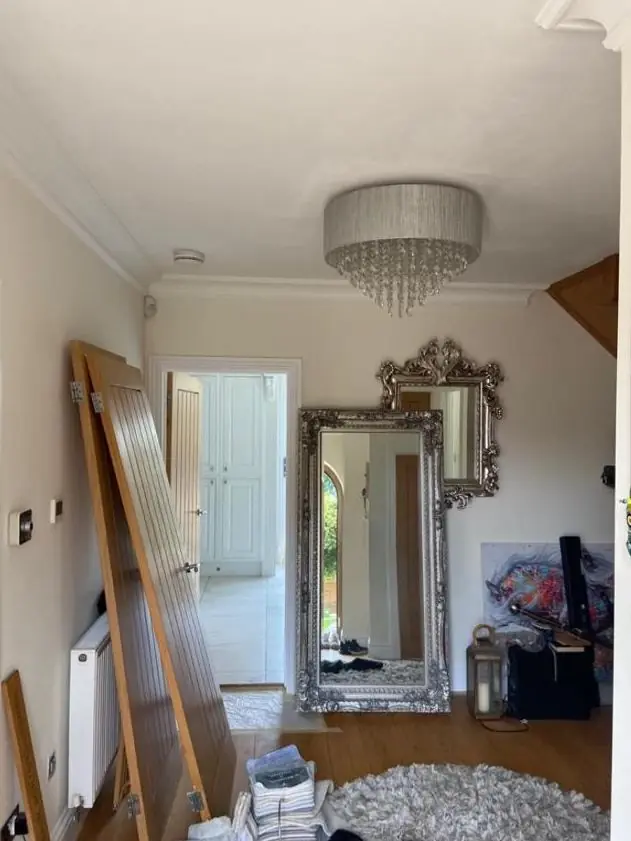
Homes on the post-1960s estates and the newest houses at Hall Farm Close generally have flatter plastered walls and square corners. Here paper can usually go straight onto a sized wall, and the main choices are style and placement: a chimney breast or bed wall in a bold print, or full rooms in a non-woven paper. Removing older vinyl or woodchip from these houses is a common first step.
Our main wallpaper hanging page covers stripping, paper types and how we match patterns. For everything else we do in the village, see our Brixworth page.
Last updated by Dean, DH Painter & Decorator.