DH Painter & Decorator hangs wallpaper and lining paper in Creaton (NN6), a 7.8-mile drive north of Northampton. Dean handles stripping, lining and hanging in the village's ironstone and cob cottages, its tall former farmhouses and the newer houses off Brixworth Road.
Most of Creaton’s older houses were built on the street frontage or the edge of The Green between the 17th and 19th centuries. Their walls have settled, been patched and been re-plastered over a long time, and that history shows the moment a straight-edged wallpaper goes up against them. This page explains how we hang paper in those houses and in the village’s newer homes. The general process is on our wallpaper hanging service page.
Lining paper first on walls that wander
In an ironstone or cob cottage, a wall can bow by a noticeable amount over its height and the corners are seldom square. A patterned paper hung straight onto that surface shows every hollow, and the pattern drifts against the ceiling line. Cross-lining, where lining paper is hung horizontally before the finish paper goes on vertically, gives the paper an even, absorbent base and hides fine cracking in old plaster. It will not make a curved wall flat, and we say so before we start. What it does is stop the defects telegraphing through.
On a bowed wall, a pattern with a small or random repeat usually sits better than a large geometric one. A bold stripe will show up any lean in a wall that is centuries old.
Paper on a wall that has to breathe
Cob survives at 10 and 12 The Green and in several High Street cottages, Lilac Cottage and The Old Cottage among them. These walls move moisture in and out. A heavy vinyl wallpaper acts like a sealed skin, and on a damp-prone solid wall that can lead to mould behind the paper and lifting seams. On walls like these we suggest traditional pulp papers or other breathable papers, hung with a suitable paste, and we check for damp before any paper goes up. Papering over an active damp patch just hides the problem for a season.
Where a house is listed, it is worth asking the council before stripping historic finishes or changing what is on the walls. Like-for-like is the safe route.
Stairwells in the three-storey farmhouses
Creaton’s enclosure in 1782 left farming based in the village itself, which is why houses such as Court House, The Old Bakery and 34 The Green went up to three storeys. Their stairwells give the longest drops of paper in the village. Long drops need:
- A stable platform or tower over the stairs, not a ladder balanced on a tread
- Accurate plumb lines, because an error at the top landing gets bigger with each floor
- Extra rolls ordered from the same batch, as waste on long matched drops is higher
- Careful booking so the hall stays usable while the paste dries
We measure these on site rather than working from room dimensions, because the drop and pattern repeat decide the roll count.
Feature walls in the newer houses
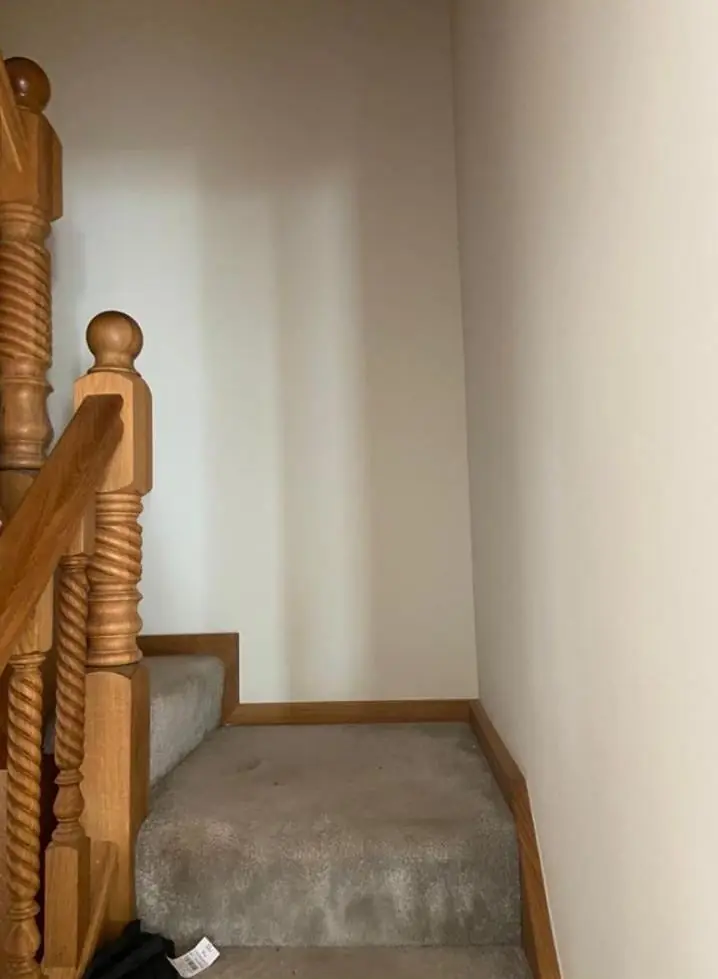
Newer homes, from The Jetty and Court House Close to the Home Farm Close terrace and the Highfield Park conversions of the old Creaton Hospital, mostly have flatter, modern walls. Here a feature wall in a heavier non-woven or vinyl paper is straightforward, and the work is mainly about stripping old paper cleanly, making good and sizing the wall.
Paper and paste come in through the front door, and High Street has little off-road parking, so we sort out unloading before the day. For other work we do here, see the Creaton page.
Last updated by Dean, DH Painter & Decorator.