
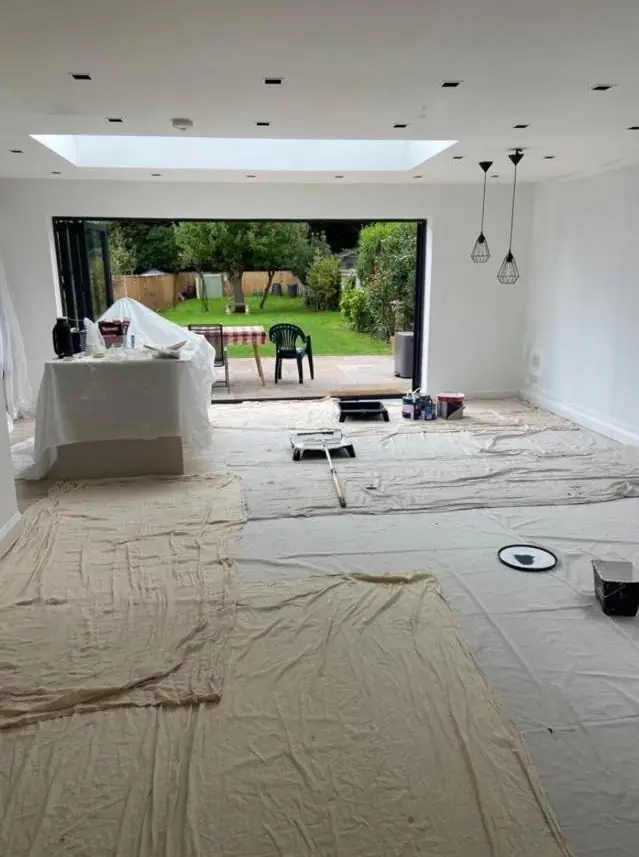
We take on commercial painting in Bugbrooke, 5.1 miles west of Northampton town centre in a straight line and close to the M1 at junction 16. Its premises range from Heygates' flour mill to sports clubhouses, schools and the medical practice, and each one sets its own working hours for us.
| Fact | Detail | Source |
|---|---|---|
| Bugbrooke Mills | Main site and registered office of Heygates; over 200,000 tons of wheat milled a year; test bakery for up to 100 visitors | heygates.co.uk |
| Mill flood warning | Bugbrooke Mill is in Environment Agency flood warning area 055FWFPUNE01 | Environment Agency |
| Sports clubs | Rugby club (1977) on Camp Close, St Michael’s FC (1929) on Camp Hill, cricket club at Camp Farm (FSA register) | Food Standards Agency |
| Campion School | Kislingbury Road; built 1966-68, extended 1971-72 | Wikipedia |
| Medical practice | Bugbrooke Medical Practice, Levitts Road, NN7 3QN | nhs.uk |
A working flour mill on the River Nene
Bugbrooke’s largest business premises is Bugbrooke Mills, the main site and registered office of Heygates. The company says it mills over 200,000 tons of wheat a year there and runs a test bakery that can take up to 100 visitors, development laboratories and a fleet of about eighty trucks. There has been a mill on the site since before the Domesday survey of 1086.
Painting in a building like that runs on the site’s terms, not ours. In practice that means a site induction, working to the client’s permit and hygiene rules in and around food areas, choosing low-odour, fast-drying coatings, and phasing work so production, deliveries and the lab are not held up. The mill also sits low by the river: its postcode is in Flood Zone 2, and the Environment Agency runs a separate flood warning area that names Bugbrooke Mill. Walls and steelwork near the water stay damp longer, so moisture readings decide when coatings go on. Work of that kind is only priced after a walk round with the site’s own maintenance staff, so the method statement and risk assessment fit the building and the hours it runs.
Clubhouses on Camp Close, Camp Hill and High Street
For a village, Bugbrooke has a lot of sports buildings. Bugbrooke Rugby Union Club, founded in 1977, is on Camp Close, the same road as the Community Centre. St Michael’s FC, founded in 1929, has its club bar on Camp Hill. Bugbrooke Cricket Club plays at Camp Farm on High Street, and the conservation area boundary runs in front of its pavilion.
Clubhouses wear hard: studs on floors and skirtings, steam from showers in changing rooms, and bar areas cleaned every day. We use mould-resistant finishes in wet rooms and scrubbable paints in bars and corridors. The seasons give a natural timetable. A cricket pavilion is easiest to paint in the winter, and rugby and football clubhouses are quieter in the summer break.
Can a school or nursery be painted during the holidays?
Yes, and that is usually the only time to do it. Bugbrooke has several education and care buildings:
| Premises | Where | What sets the timing |
|---|---|---|
| Campion School (built 1966-68, extended 1971-72) | Kislingbury Road | Term dates; large areas of corridor and classroom |
| Bugbrooke Community Primary School | High Street | Term dates; only the historic part is in the conservation area |
| Bugbrooke Pre-school | Village Hall, 14 High Street | Shared hall bookings as well as sessions |
| FOK Montessori Nursery | Clardene, 2A Meadway | Open most of the year; room-by-room work |
| Bugbrooke Medical Practice and the pharmacy | Levitts Road | Open to patients; waiting and clinical areas phased |
| Community cafe and food bank | Sunday School, Church Lane | Set opening days |
A secondary school of the late 1960s has a lot of painted blockwork, steel and long corridors, and a summer holiday is a short window for it, so the work is planned in zones in the spring. For nurseries and the surgery we work around sessions and patients, keep wet paint behind barriers, and use paints with low solvent content.
Church, chapel, shops and pubs
Two of Bugbrooke’s public buildings are listed. St Michael and All Angels, dating from the 13th to 15th centuries, is Grade II*, and Bugbrooke Chapel, the Baptist chapel dated 1808, is Grade II. Redecorating inside either is listed-building work, and a Church of England parish church also needs the diocese’s permission (a faculty) for most changes, so the paint system and colours are agreed with the church or chapel and its advisers before we price. Old church walls are usually lime plaster on stone and take breathable paints only.
The village’s smaller commercial frontages, the High Street shops, the two trading pubs and the takeaway on Great Lane, have their own page: shopfront painting in Bugbrooke. We also cover neighbouring villages such as Gayton, Kislingbury and the Heyfords from Northampton. What we do on commercial jobs in general, from method statements to working around staff, is on the commercial painting service page, and the Bugbrooke area page describes the village as a whole. If you are comparing contractors for a club or school job, our guide on how to choose a painter and decorator lists what to ask for.
Last updated .


