DH Painter & Decorator stains and paints wooden gates, fences and other garden timber in Ecton, roughly 4.9 miles north-east of Northampton town centre on the Nene valley slopes. Simple vertical plank gates in the conservation area and modern garden fencing on the newer houses are the two main types of job here.
Two kinds of timber boundary
Ecton’s boundaries split neatly by age. In the historic centre, the conservation appraisal records high stone boundary walls, many over 1.8 metres, broken by simple vertical plank timber gates. Out towards Church View, West Street and Northampton Road, the 20th-century houses have ordinary garden fencing: lap panels, feather-edge boards, posts and gravel boards. The two need different thinking about finish, colour and access.
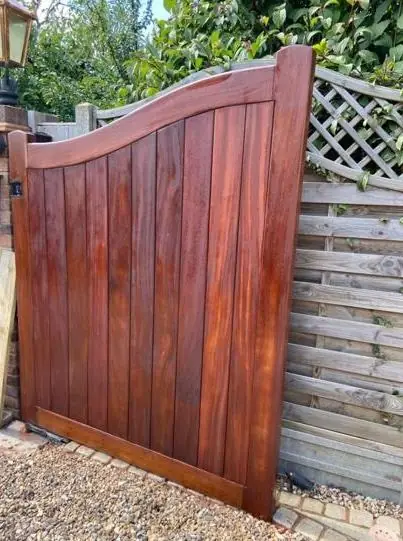
Plank gates in the old walls
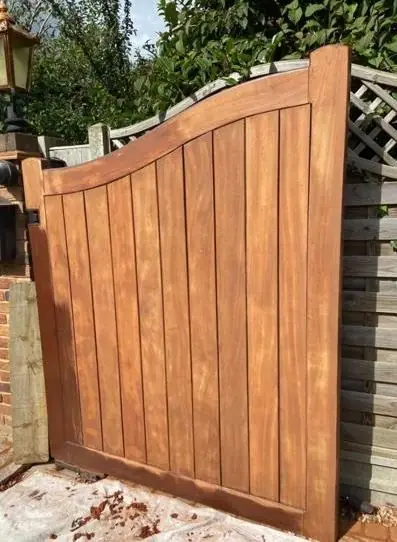
A plank gate set into a lias or ironstone wall is a small thing, but in a conservation area it contributes to the street. The appraisal treats these simple gates as part of the village’s character, and Neighbourhood Plan Policy 7 supports retaining the stone walls they sit in. That shapes the work:
- Colour and finish: traditional painted or stained finishes that sit with honey-brown stone, rather than a bright fence-shed colour.
- Protecting the wall: stone around hinge pins and latch keeps is masked and the coping sheeted, because stain soaks into porous stone and will not come out.
- Repair before finish: the bottom of a ledged gate often sits in wet ground and leaf litter, so we check the end grain of planks and ledges and point out rot that needs a joiner.
- Like-for-like: if a gate is painted now, we usually keep it painted; switching from paint to stain means stripping right back.
Where trees overhang the walls, gates stay damp and grow green algae. We clean that off and let the timber dry properly before anything is applied.
Garden fences on the valley side
Gardens on the village edge back onto open valley farmland to the south, west and east. Fences there get full sun and wind with nothing to break it, so stain fades and timber greys and splits more quickly than in a sheltered town garden. On exposed runs we would normally suggest a pigmented stain or a fence paint with more colour in it, since those hold up longer in strong UV. On shaded fences under the older trees, the issue is the opposite: slow drying and algae, so cleaning and a dry spell matter more than the product.
Ecton homes are fairly large on average (the Neighbourhood Plan gives about a quarter with four or more bedrooms and almost 40% detached), so fence runs can be long. We price by the actual length and condition, and the cost guide explains what moves the price.
Neighbours, hedges and getting round
The far side of a boundary fence belongs to your neighbour, so we only treat it with their agreement. Roads at the southern end of the village are lined with mature hedges, and fences tucked behind planting need the beds sheeted and branches tied back before we can reach them. Gates opening straight onto the High Street footpath are worked from the pavement in short spells, keeping the path clear. Bigger properties near the church and the Hall sit along private service roads, so we agree where to park and when to unload so shared access is never blocked.
Timing matters too. New pressure-treated fencing on a recent extension or replacement run holds a lot of moisture and is usually left to dry out before staining, following the product guidance. Older fences that have greyed on the exposed side want a clean and a dry week before a first coat, so autumn leaf fall from the village trees is something we plan around.
The full method is on our fence and gate staining page, and other work we cover locally is listed on the Ecton page.
Last updated by Dean, DH Painter & Decorator.