DH Painter & Decorator decorates hallways, staircases and landings in Milton Malsor, about 3.2 miles south-west of Northampton town centre. The village's old ironstone cottages have narrow, uneven stairs and low ceilings, while its later infill houses have conventional stairwells, so the access kit and paint choice change from one house to the next.
Old cottage stairs: narrow, crooked and low
A good share of Milton Malsor‘s houses date from the late 16th to the early 19th century: coursed ironstone and limestone cottages, several of them thatched, along High Street, Green Street and Collingtree Road. Their staircases were built for the house, not to a standard. Treads are often uneven, the walls lean, and headroom at the top can be tight under low ceilings and old beams. Some houses are said to have 16th- or 17th-century beams, and the plaster around them is usually old lime rather than gypsum.
That changes the job in three ways. First, a full-size stair platform rarely fits, so we use compact combination ladders with independently adjustable legs and short staging boards. Second, a lime-plastered stairwell needs a breathable emulsion, not a vinyl finish that traps moisture and blisters. Third, there is a lot of handwork: cutting in along beams, rounding wavy corners, and painting banisters and spindles one at a time.
Where hallway paint takes the most punishment here
In a rural village with open fields and public footpaths all round, the hall and stairs carry mud, wet coats, dogs and boots. The soil is mainly sandy, from an ancient riverbed, and it gets walked in. Where an old cottage fronts directly onto High Street or Green Street, there is no porch or front garden to leave the mud in, so the lower walls of the hall take the knocks. We suggest:
- A scrubbable, breathable finish on lower walls in older houses, so you can wipe marks without sealing the plaster.
- A durable eggshell or satin on handrails, newels and skirtings, where hands and boots meet the paint.
- Keeping ground-floor halls near the stream through The Dip under watch for damp. The stream flooded in 1998, and a damp patch must dry and be treated before any paint goes on.
Infill homes and their tall stairwells
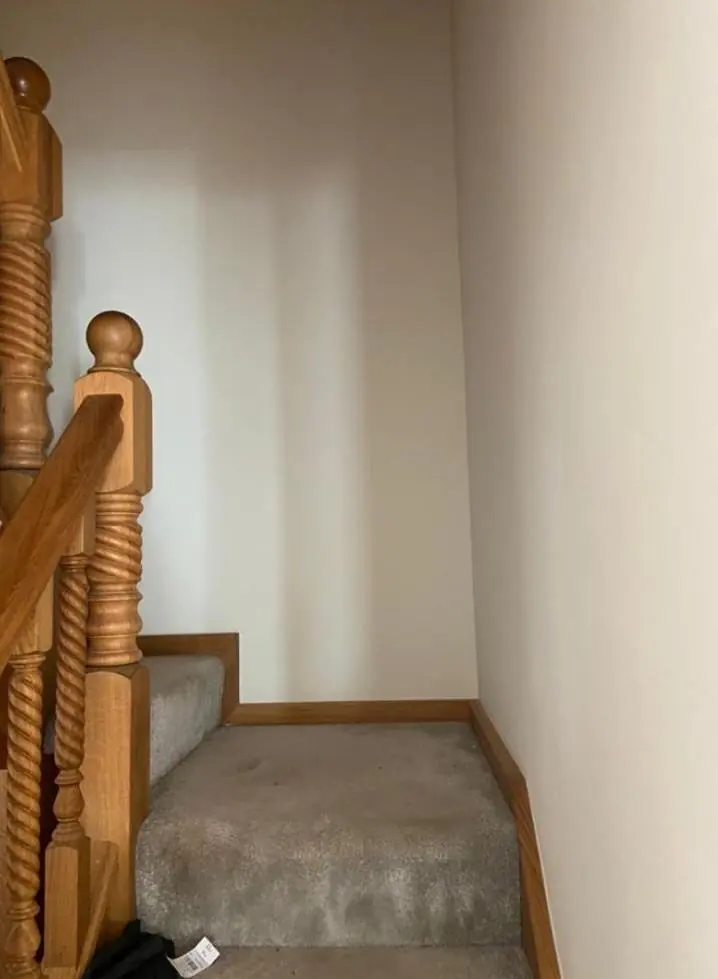
Development in the village is restricted to infill within the boundary, so the newer houses are scattered among the old. These are the ones with the classic problem: a tall wall rising above the stairs, too high for a stepladder. Here we set up a proper stair platform or staging, so the whole height can be reached safely without leaning a ladder on the banister. Walls are usually flat modern plaster, which takes a standard durable emulsion and goes quickly once access is sorted. The main hallway, stairs and landing decorating page explains the access equipment and sequence in more detail.
Keeping the stairs in use while we work
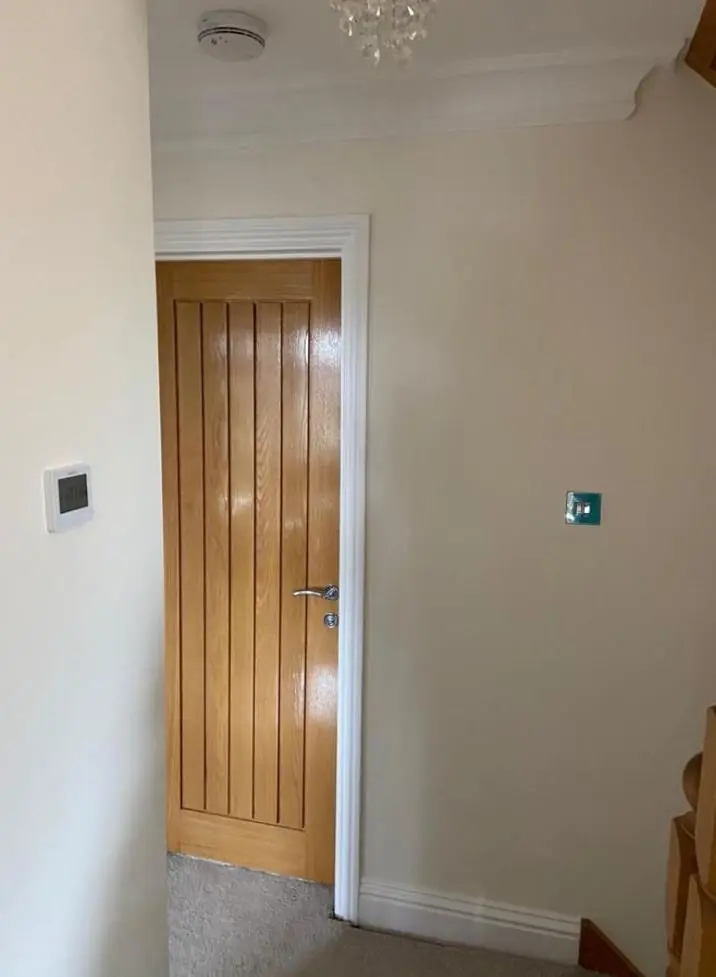
A small cottage usually has one staircase and no second route upstairs, so we work in a set order: ceilings and the highest walls first, then the lower walls, then the woodwork, one side of the treads at a time. You can still get up and down each evening. Painted spindles and handrails are done when the stairs can be left alone long enough to dry. Dust sheets are fixed to treads so they don’t slip. Where a cottage stair turns tightly at the top, the landing is decorated last, once the walls below are dry, so ladders don’t have to stand on fresh paint. Before starting, we agree with you where coats, shoes and anything stored under the stairs will go for the duration.
| House type in the village | Typical access | Typical wall finish |
|---|---|---|
| Listed ironstone or thatched cottage | Compact combination ladder, short boards | Breathable emulsion on lime plaster |
| Larger early 19th-century house | Combination ladder or small platform | Depends on the plaster found |
| Later infill house | Stair platform or staging over the drop | Durable modern emulsion |
For costs, see our painter and decorator cost guide. We give a written quote after seeing the stairwell.
Last updated by Dean, DH Painter & Decorator.