
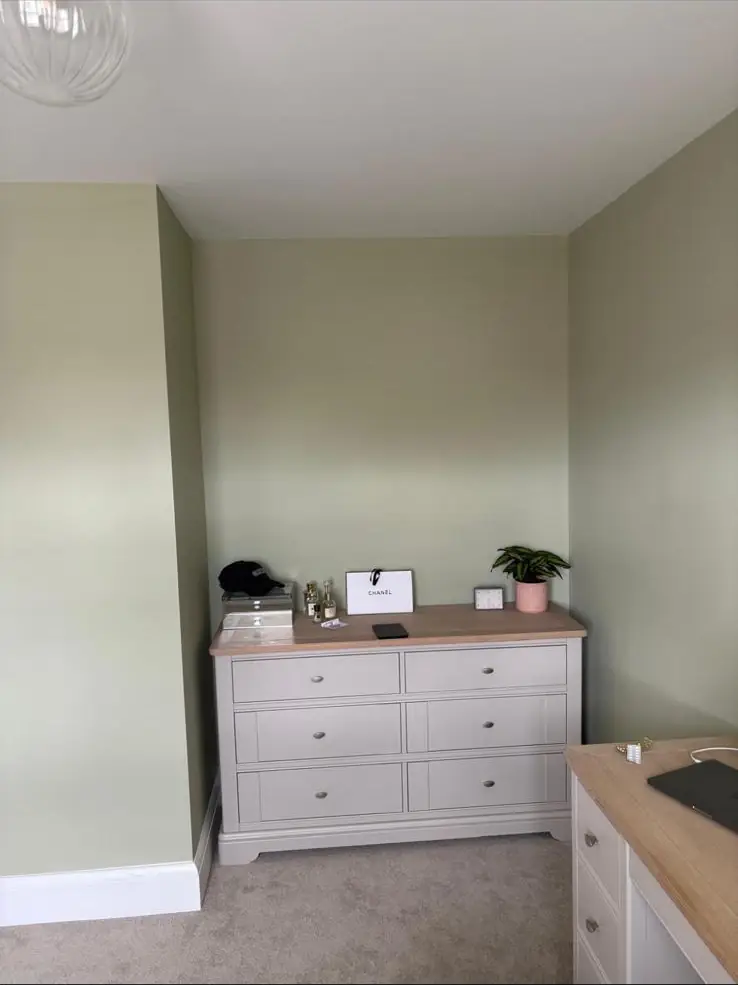
We paint newly plastered walls and ceilings in West Hunsbury, NN4, about 2.1 miles south-west of Northampton town centre. Here new plaster is as likely to be fresh skim on plasterboard in a timber-frame house as wet plaster in an extension or annex on a 1980s detached home, and each is sealed with a mist coat first.
| Fact | Detail | Source |
|---|---|---|
| First bird-street new-build sale | 19 December 2008, Bullrush Walk | landregistry.data.gov.uk |
| Last bird-street new-build sale | 4 December 2009, Mandarin Street | landregistry.data.gov.uk |
| Annexes on the council tax list, area 039B | 10 | GOV.UK |
| Heated by mains gas only | 88.2% of households | Nomis (ONS) |
| Homes built 2009, area 039B | 60 (the bird-street development) | GOV.UK |
New walls in a timber-frame house
West Hunsbury’s newest block of homes is the set of bird-named streets, where HM Land Registry records the first sales as new builds from 19 December 2008 (Bullrush Walk) to 4 December 2009 (Mandarin Street). Every home sampled there on the energy certificate register is timber frame, as are houses on Sarek Park, Claystones and Marlstones. In a timber-frame house the walls are drylined: plasterboard on studs, with no blockwork behind. So when a wall is opened up for new wiring, a moved doorway or a damaged section, the repair is usually new board, either taped and jointed or skimmed with a thin coat of plaster.
The two finishes take paint differently:
- Taped and jointed board has bare paper face next to filled joints. The two absorb paint at different rates, so without a sealing coat the joints show through as flat stripes in a sheen finish.
- Board with a fresh skim behaves like any new plaster. It must dry fully, then it takes a diluted mist coat that soaks in and seals it.
Getting that distinction right is what stops a patch in a timber-frame wall showing through the new paint.
Extensions and annexes on 1980s detached houses
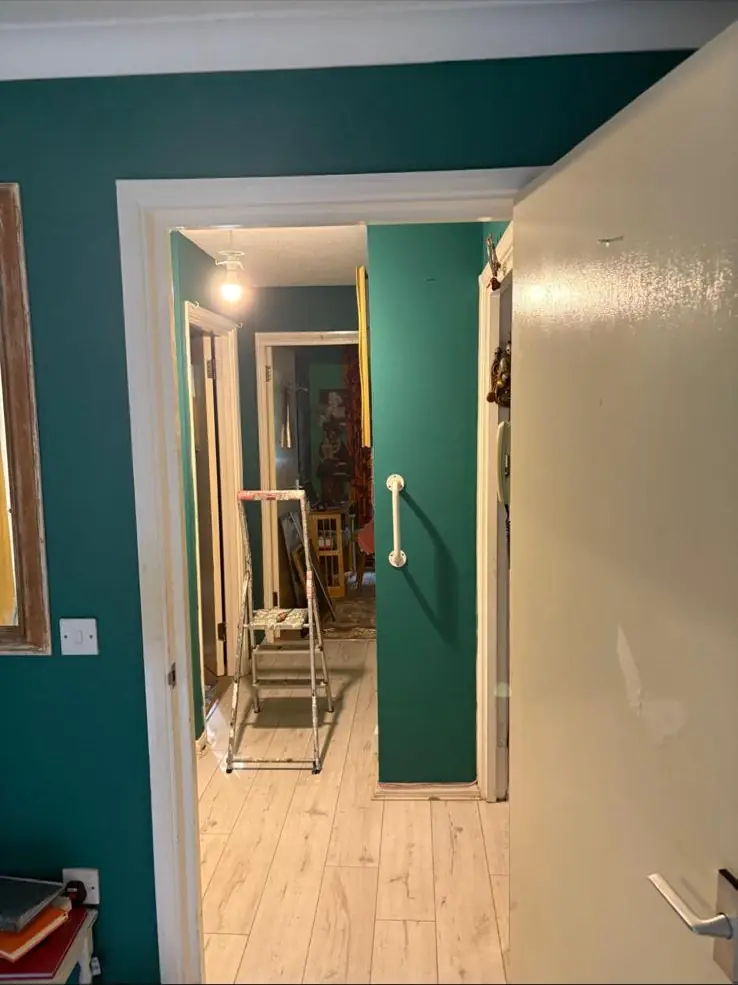
Most of the estate’s houses date from 1983-1992, according to the Valuation Office, and many have been extended since. Listings describe extended houses, garage conversions and annexes, including a five-bed detached house on Bramble End with a self-contained annex, and the Valuation Office counts 10 annexes in one of the estate’s statistical areas. A new extension brings large areas of fresh plaster and, just as important, a join with the original house.
That join is where problems show. The new wall and the old one dry and move differently, and a fine crack often opens along the line where they meet in the first year. We fill it with a flexible filler rather than a rigid one, and where an open-plan room spans old and new, we paint the whole room in one go with paint from the same batch, so the colour and sheen match across both parts.
Garage conversions
Listings on the estate also mention garage conversions, which bring their own new-plaster problems. The old garage door opening is usually filled with new blockwork and a window, and the inside is drylined or plastered to make it a room. So one wall is wet plaster on fresh block, the others are new board on old garage walls, and the floor has been raised. Until the room has had its heating running for a few weeks, it can be colder than the rest of the house and prone to condensation on the new outside wall. We check that wall is fully dry before the mist coat, and we caulk the new skirtings rather than filling them rigidly, because a converted garage tends to move a little in its first year.
When is new plaster dry enough to paint?
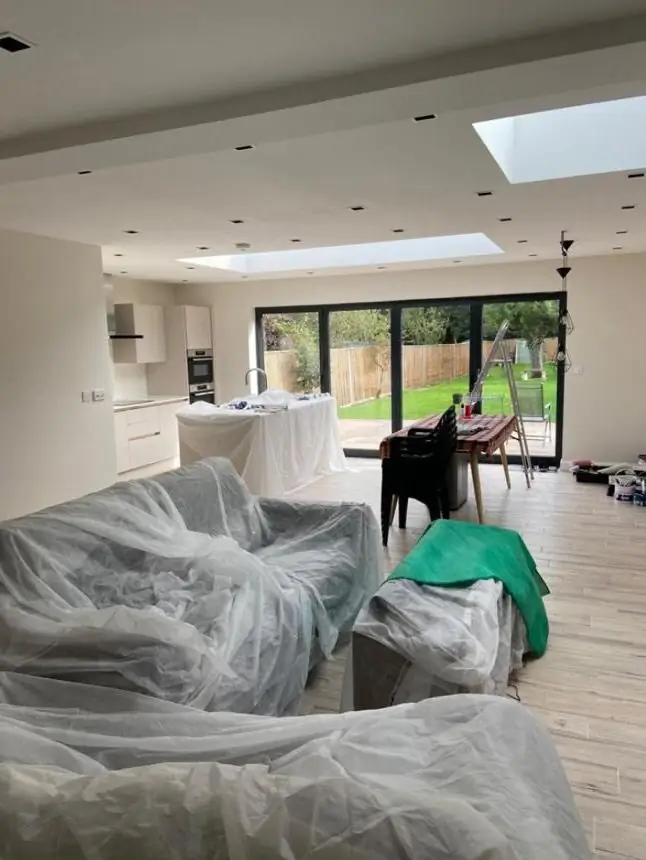
When it has changed from dark pinkish-brown to an even pale pink all over, with no darker patches. How long that takes depends on the thickness of plaster and the room. In the census area covering West Hunsbury, 88.2% of households heat with mains gas only, so in most homes the heating can be run gently to help. Not too hot, though: forcing plaster dry with heaters turned up full can cause cracking and a powdery surface.
| New surface | Where you will find it here | Before paint |
|---|---|---|
| Skim coat on existing board | Repairs in timber-frame homes; reskimmed ceilings | Dry until even pale pink; then mist coat |
| Taped and jointed board | New stud walls, loft and garage conversions | Sealer or mist coat so joints don’t show |
| Plaster on new blockwork | Two-storey and single-storey extensions | Longest drying time; mist coat; flexible filler at the join |
| Annex walls and ceilings | Self-contained annexes on larger plots | As above; finished as its own scheme |
The mist coat itself, and why ordinary emulsion should not be used undiluted on bare plaster, is explained in our guide to painting new plaster. Our main new plaster and extension painting page covers the full method. If the rest of the house is being redecorated at the same time, see interior painting in West Hunsbury, and for everything else on the estate, the West Hunsbury area page.
Sources
- Price Paid Data, NN4 9DA, 9DH, 9DJ, 9DL, 9DN and 9DQ, HM Land Registry (accessed 2026-11-16)
- Council Tax: stock of properties by type and bedrooms, 2026 (CTSOP 3.1), Valuation Office Agency (accessed 2026-11-16)
- Council Tax: stock of properties by build period and band, 2026 (CTSOP 4.1), Valuation Office Agency (accessed 2026-11-16)
- Census 2021 TS046 central heating, eight West Hunsbury output areas, Nomis (ONS) (accessed 2026-11-16)
- Find an energy certificate (searched for 49 West Hunsbury postcodes), GOV.UK EPC register (accessed 2026-11-16)
Last updated .


