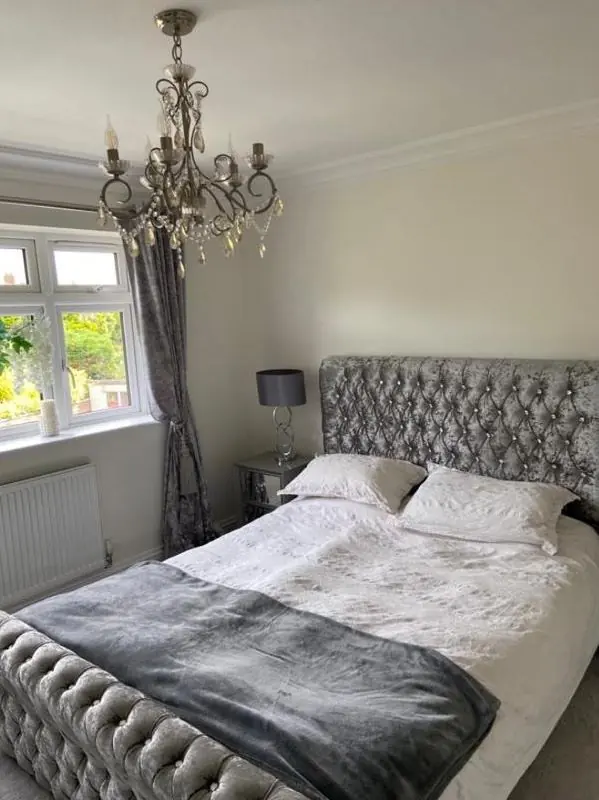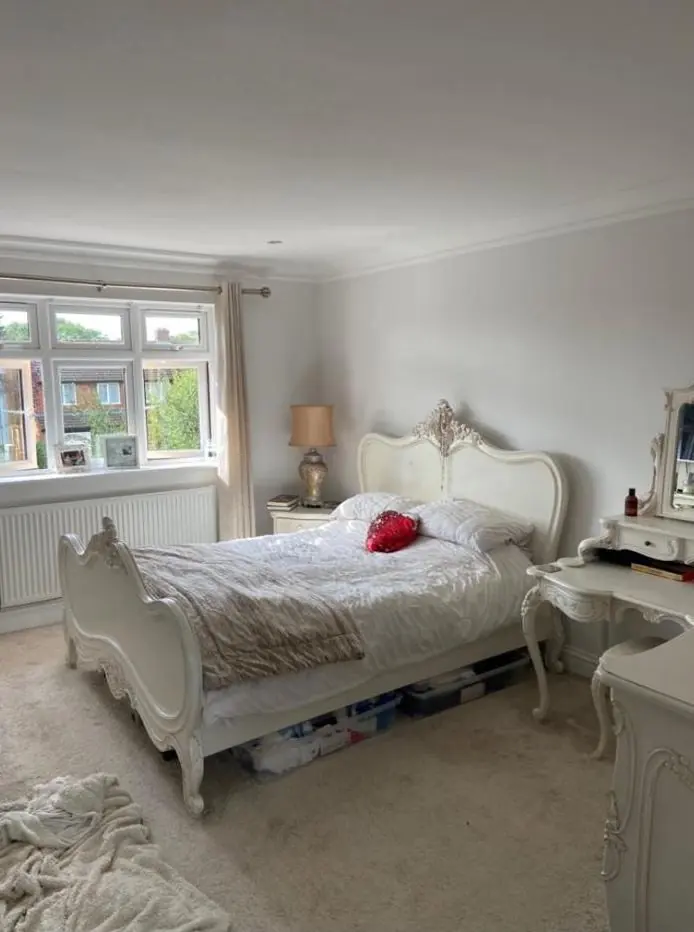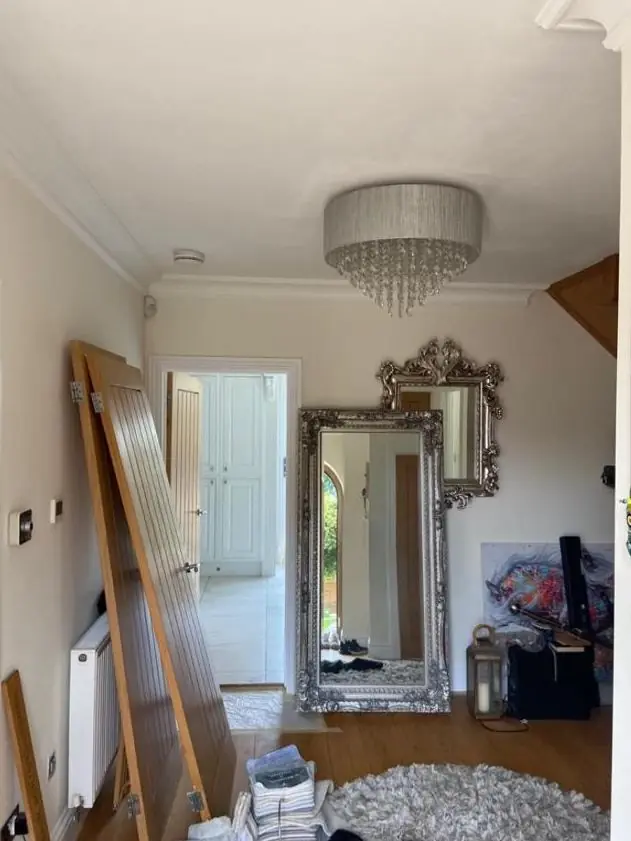
We hang wallpaper and lining paper in Blackthorn, the New Town estate in NN3 about 3.8 miles north-east of Northampton town centre. The houses date from the mid-1970s and are mostly terraced, with flat plastered party walls that take paper well once old layers are removed.
Party walls that suit paper
Most houses in Blackthorn share at least one wall with a neighbour. Census 2021 records terraced homes as 44.9% of the stock around Bridge Court and 64.1% in the adjoining part of the Blackthorn & Rectory Farm ward, with semi-detached houses making up much of the rest. Those party walls are usually flat and plastered, which is good news for paper. A long, unbroken wall with no chimney breast and no bay gives a pattern room to run without being chopped up by returns.
The same flatness makes the long party wall the natural place for a feature. In a terraced living room it is often the wall your sofa faces, so a bold print there reads well without overwhelming a compact room. Where the plaster has fine cracks or old repairs, a layer of lining paper first gives a smoother base and helps the feature paper sit evenly. Lining can also be painted on its own as a simpler route to a uniform finish on tired walls.
Stripping back to sound plaster
A house built around 1974 may have been papered several times since, especially if it was a council home and later sold or let. Before anything new goes up, the old layers come off. Depending on what we find, that means steaming off vinyl and backing paper, scoring and soaking painted-over paper, or carefully lifting textured paper without pulling the plaster face away. Stripping fifty years of paper often pulls up weak plaster, so we allow for patching: filling dents, sealing any blown areas and sanding before sizing the wall.
Stripping is quoted as its own line, because one room may be a quick strip and the next may be three layers deep. You will see that difference before work starts.
Bringing rolls and paste to a footpath-fronted house
Blackthorn was built on Radburn principles, keeping footpaths and roads apart, so a paste table and boxes of rolls usually travel on foot from a parking bay on one of the courts. Space close to the house is limited on Croftmeadow, Pikemead and similar courts, so everything comes in at the start of the day and the table is set up in one room. If the house is a mid-terrace with no side access, the hall floor is covered before anything comes through. Rolls are kept flat, out of direct heat, and batch numbers are checked together before the first length is cut, because a short delivery made up from a second batch can show a shade difference on a long party wall.
Choosing a paper for a 1970s room
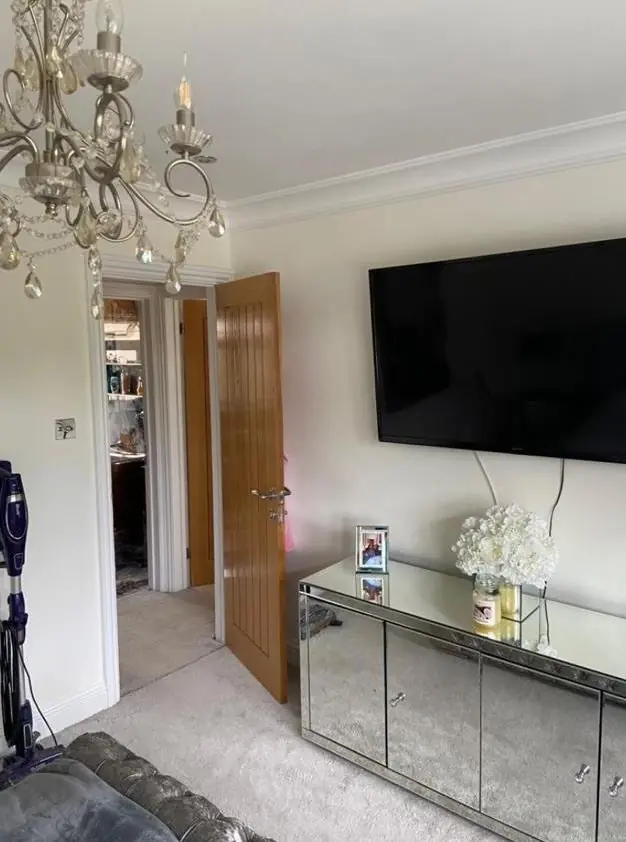
These are modest rooms, so scale matters more than in a large period house. A few points worth weighing up:
- Large-repeat patterns waste more paper per drop on short walls; ask about the pattern repeat before you order.
- Paste-the-wall non-woven papers are quicker to hang and easier to strip later, which suits a let or a house you may sell.
- Vinyl surfaces cope better on stairs and in kitchens, where families brush past the wall daily.
The main wallpaper hanging page covers paper types and our hanging method in more depth, and the Blackthorn area page sets out how we cover the estate. Dean can look at the walls with you, check what sits underneath and give a written quote for stripping, lining and hanging.
Last updated by Dean, DH Painter & Decorator.