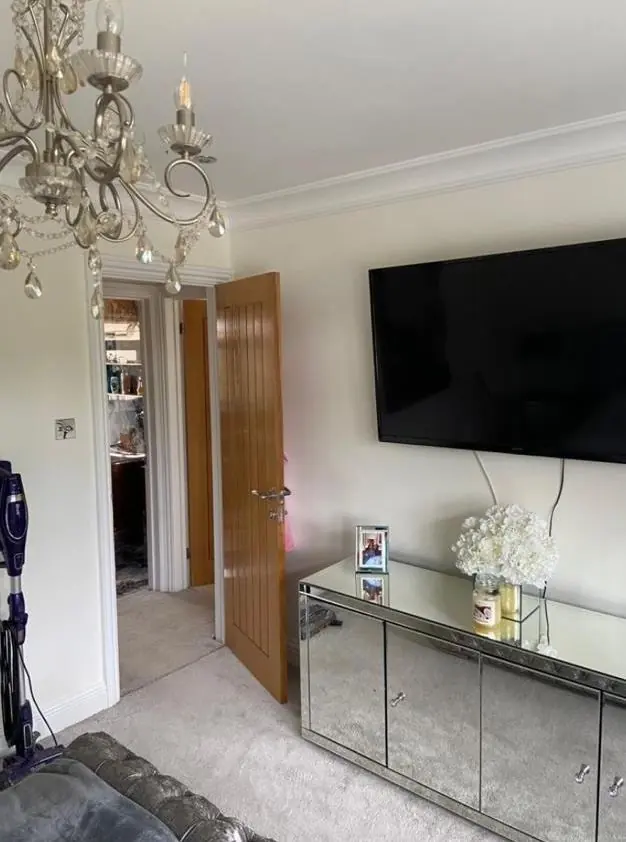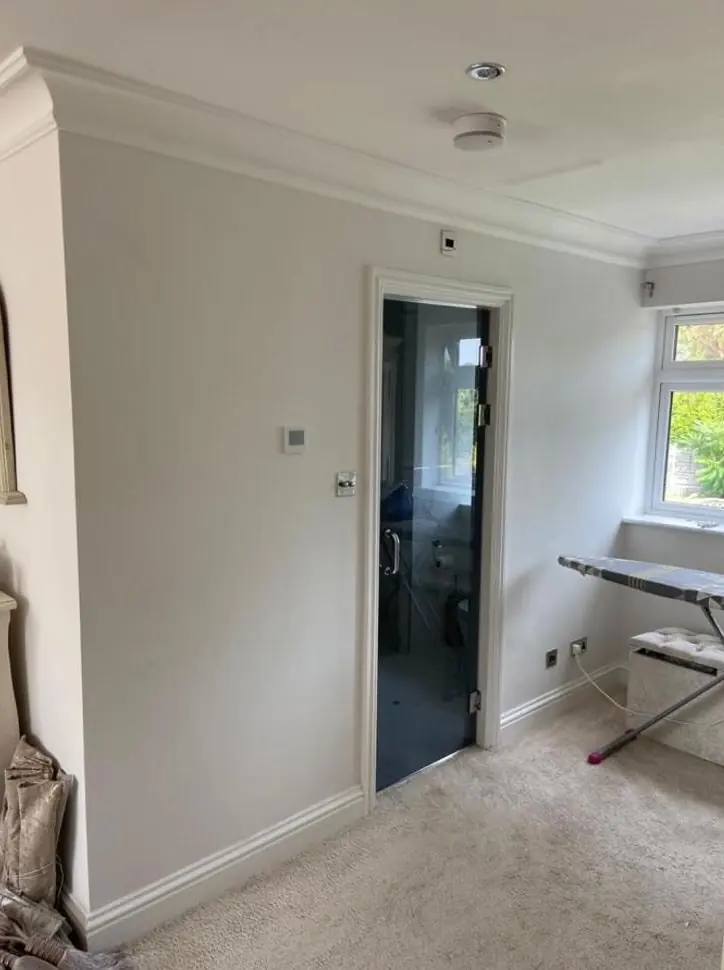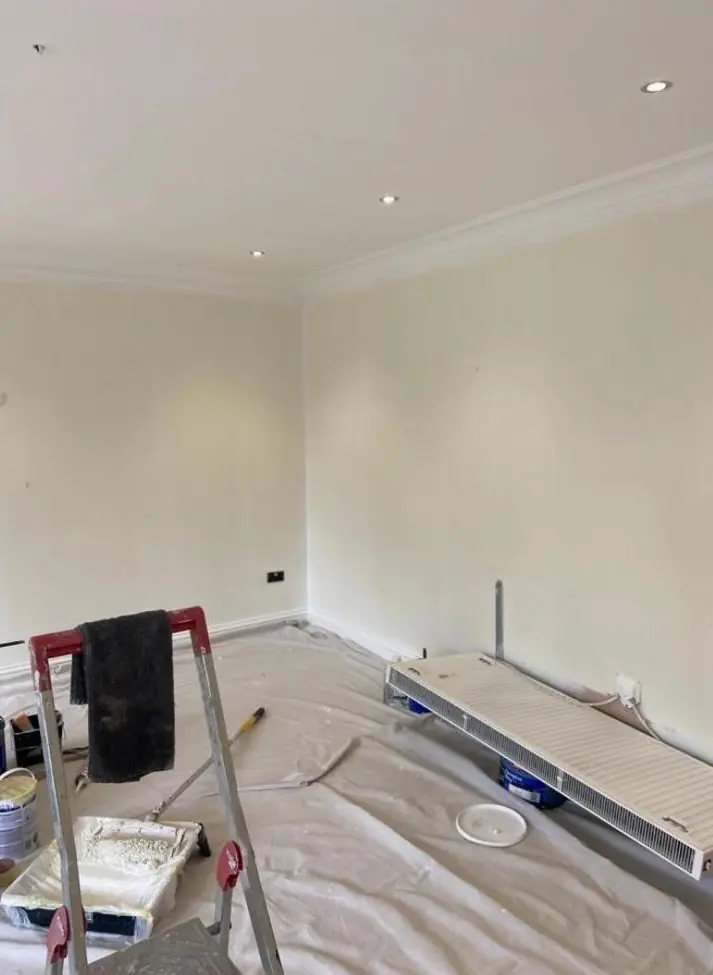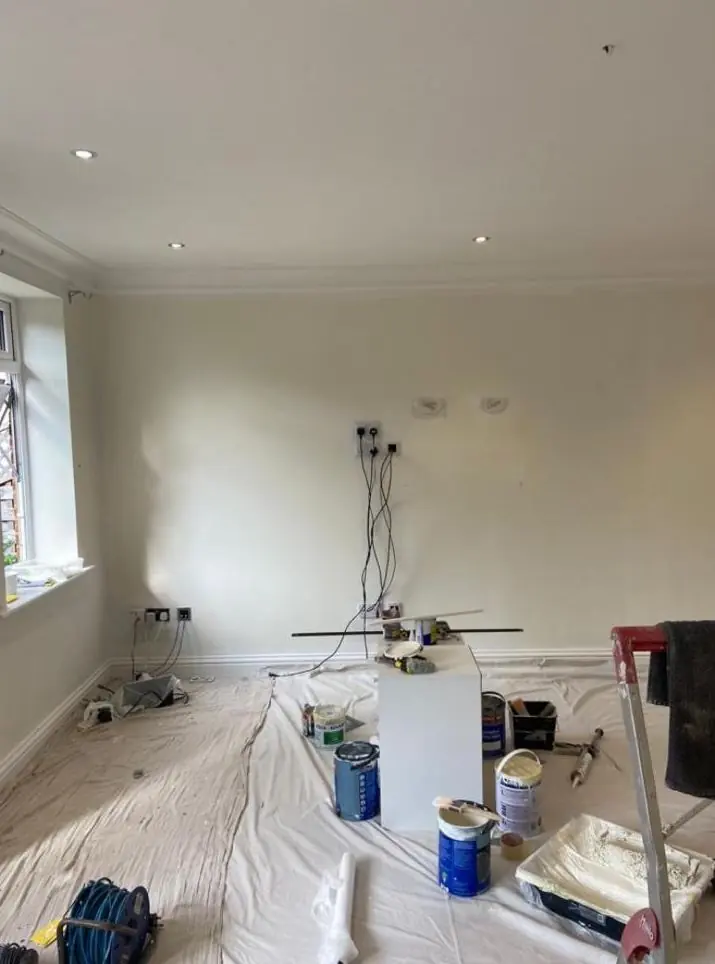
DH Painter & Decorator hangs wallpaper in Little Billing, NN3, about 3.2 miles north-east of Northampton town centre. In the old stone cottages that usually means lining paper and a forgiving pattern; in the newer houses it is mostly feature walls and full rooms.
Papering a stone cottage that was never built square
The oldest houses in Little Billing are rubble stone cottages with thatched roofs: Church Lane Cottage at No. 27, Pyket Cottage, Knight’s Cottage at 16 Orchard Hill, Ox Stalls and the Corn Ricks group. Walls like these were built by hand and plastered over with lime, so they lean, bulge and meet each other at angles that are close to square but not quite. Corn Ricks even has windows cut into the thatch, and rooms behind windows like that usually have short, sloping pieces of wall.
Wallpaper shows all of that. A vertical stripe hung to a plumb line will drift away from a leaning corner, and a straight-matched pattern will run out of line along a sagging ceiling. On a cottage job the first decision is where the eye will land: we usually hang the first drop from the centre of the main wall or a chimney breast and let the small mismatches fall into the darkest corner, rather than starting in a corner and carrying the error across the room.
Lining paper over old lime plaster
Old lime plaster is softer than modern gypsum and often has hairline cracks and hollow patches. Hanging a heavy paper straight onto it can pull weak plaster away when you later strip it. Most cottage rooms are better with a lining paper first, hung horizontally, which gives a sound, even base and spreads the load. We test the plaster before quoting, tapping for hollow areas and checking for loose skim, and repair with lime-compatible filler where needed.
Breathability matters here too. The rubble walls need to dry out through their surface. Vinyl wallpapers and vinyl-faced papers are close to waterproof, so on solid stone external walls we suggest a paper-based or non-woven design instead. These are listed buildings, so if you are thinking of stripping historic paper or panelling, ask West Northamptonshire Council first.
Choosing a pattern for low rooms under the thatch
Rooms with low ceilings and small deep-set casements suit small, loose or random-match patterns, which hide the walls’ irregularities. Large, formal repeats and bold stripes do the opposite. Some practical points:
- A free match or offset pattern hides out-of-true walls far better than a straight match.
- Papering the ceiling of a room with sloping thatch-line walls is fiddly; painting the ceiling and papering the walls is usually the tidier result.
- Order extra rolls. Cutting round beams, reveals and slopes wastes more paper than in a box room of the same size.
Feature walls and full rooms in the newer houses
The housing on the closes, such as Codlin Close, Pearmain Court, Blossom Way and Pear Tree Close, has flat plastered walls and standard ceiling heights. Here a feature wall behind a bed or sofa, or a full room in a heavier designer paper, goes up as normal. The skills involved are covered on our main wallpaper hanging page.
One local point: the back bedrooms along Valley Road and Codlin Close sit against the shaded woodland of the brook corridor. If an outside wall at the back has any damp or condensation, we check it first, because no paste holds well on a wall that stays cold and wet. Any problem gets sorted before the paper goes up.
Arranging a visit
Bring your paper choice and roll numbers to the quote if you can, so we can check batch numbers and pattern repeats. For other work in the village, see our Little Billing page.
Last updated by Dean, DH Painter & Decorator.