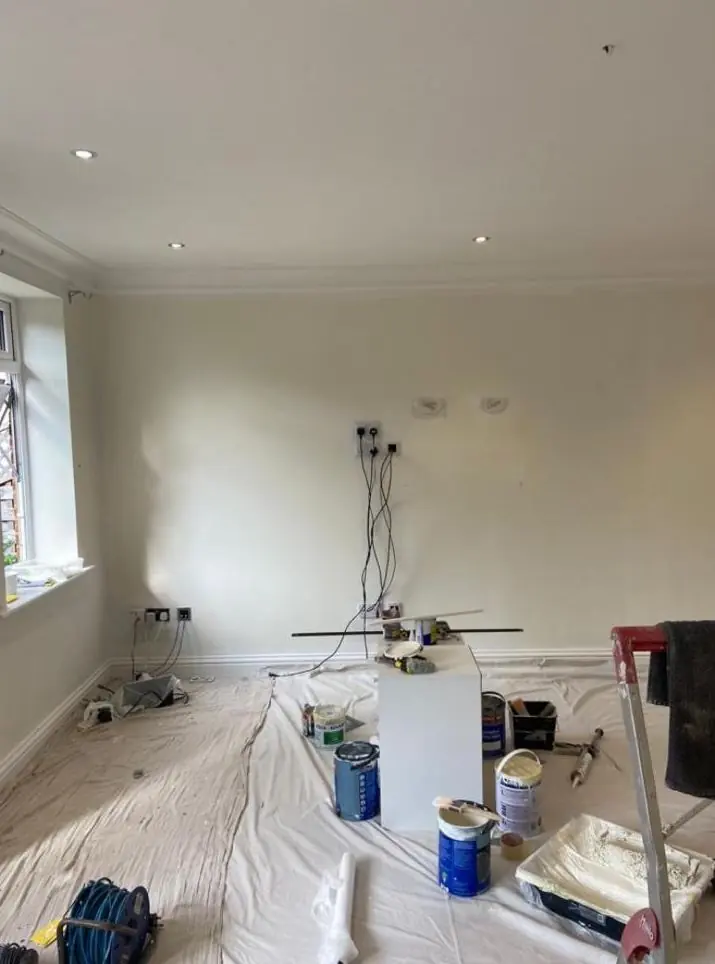
DH Painter & Decorator hangs wallpaper in East Haddon, about 7.3 miles north-west of Northampton in the NN6 area. The village's older walls are lime plaster over coursed lias, limestone or cob, so Dean usually lines them first and chooses papers and pastes that suit an old, breathing wall.
A cob or lias wall is never a straight edge
Wallpaper shows up every flaw in the wall behind it. In East Haddon that matters more than in most places, because so many rooms sit inside walls built between the mid-1600s and late 1700s. The listed cottages on Main Street are coursed lias and limestone, and Nos 4 and 5 Main Street are rendered cob on a lias plinth. Plaster laid over walls like these follows their shape: corners drift out of true, wall faces bow, and the ceiling line can drop several centimetres across one room.
That changes how a paper is chosen and set out. A bold vertical stripe will expose a leaning corner straight away. A small, loose pattern or a plain textured paper hides it. Before you buy, Dean will hold a level against the walls and tell you honestly how a given design will behave in that room.
Lining first, and why it suits old plaster
On lime plaster we nearly always hang lining paper before the decorative paper. It bridges hairline cracks, evens out small dips, and gives the top paper a consistent surface to dry on, so seams do not open as the wall moves with the seasons. On a wall that is very uneven, a heavier grade of lining helps. We hang the lining horizontally where we can, so its joints never line up with the joints of the paper above.
- Fill and sand only loose or cracked areas; sound lime plaster stays as it is.
- Size the wall so the paste does not soak straight into absorbent plaster.
- Line, leave it to dry fully, then hang the finish paper.
Damp, breathability and choosing the paper
Old solid walls need to pass moisture. A heavy vinyl paper on the inside of a cob or stone wall can hold damp in, especially on a weather-facing wall, and East Haddon stands in the Northamptonshire Uplands at 90 to 180 metres. For these walls we lean towards traditional pulp or non-woven papers, which let more moisture through, hung with a paste that suits them. If there is an active damp patch, we say so and recommend getting it sorted before anything is hung, because paper will only hide the problem for a season.
Traditional patterns for the 18th-century rooms
The larger 18th-century houses, East Haddon Hall above all, have taller and more formal rooms. These suit traditional papers: damasks, small florals, stripes in a room whose walls are true enough, or a plain paper above a painted dado. Pattern matching on a tall wall needs careful setting out from the centre of a chimney breast or window, so any half drop falls in the least visible corner. Where a room has panelling or a dado rail, we paper above it and leave the joinery for paint.
Newer houses in the village, with gypsum-plastered walls, are a simpler job and take any modern paper, including vinyls in kitchens and bathrooms.
Arranging the work
The main wallpaper hanging service covers stripping, preparation and paper types in more depth. If you are pairing paper with painted walls, our colour advice can help match the paintwork to the pattern. The East Haddon area page covers the other work we do in the village.
Last updated by Dean, DH Painter & Decorator.