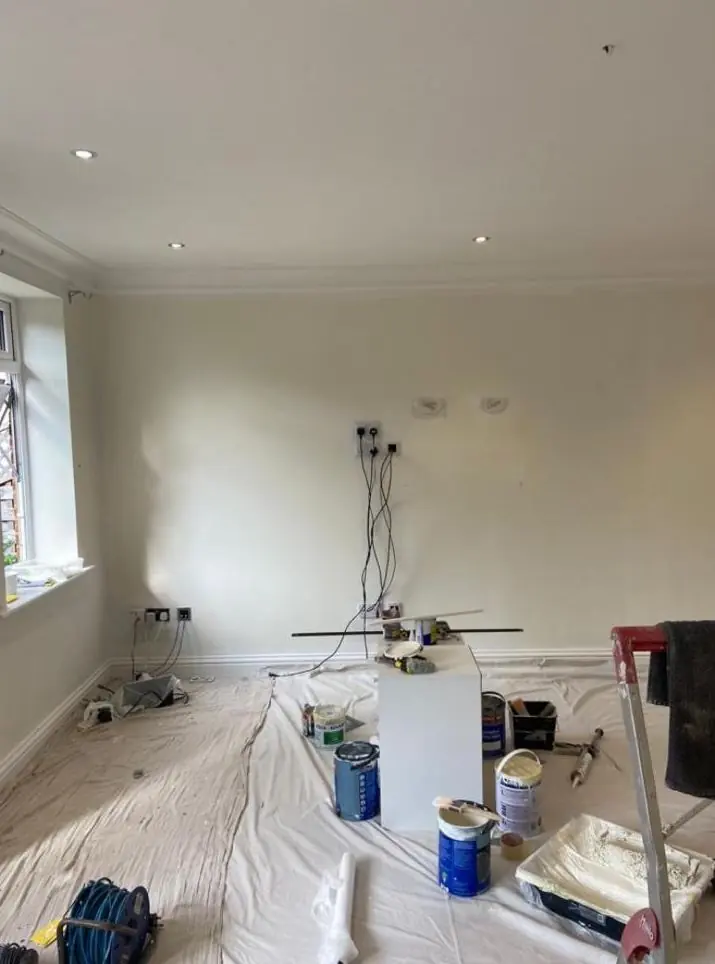
DH Painter & Decorator covers Stoke Bruerne, the Grand Union Canal village about 6.6 miles south of Northampton with a Towcester NN12 address. Dean paints interiors and exteriors across the village, matching materials and timing to old solid stone walls, two conservation areas, tight parking and the summer canal season.
A canal village with four centuries of building
Stoke Bruerne is a small village of 373 people at the 2011 Census, about 6.6 miles south of Northampton town centre, with a Towcester postal address. The Grand Union Canal and its lock flight run straight through the middle, and the south portal of Blisworth Tunnel sits about half a mile to the north. The tunnel and the locks opened in 1805, and for a few years before that the village was one of the busiest inland ports in the country. Away from the water it is still a farming village of limestone cottages, farmhouses and converted barns, with the land falling away into the Tove valley.
For a painter and decorator that history matters, because almost every age of building in the village needs something different. A 1630s thatched cottage, a Victorian brick chapel and a post-war affordable home on Wentworth Way may stand within a few hundred metres of each other, and no single paint suits all three. The sections below go through the main property types and what each one asks of the work.
The thatched and stone cottage core
The village’s earliest homes date from the 1600s and 1700s: modest vernacular cottages in squared limestone rubble, some with ironstone or red brick detail, many built in short terraces hard up to the road. Dated 1636, the two-storey thatched lobby-entry house known as Old Dower House is the oldest building in the conservation area. Rosebud Cottage and Mill Lane’s The Welland also keep their thatch, and the village’s thatched roofs show eyebrow dormers, swept cheeks and rolling eaves.
- Walls: solid masonry without a cavity. Inside and out they need breathable paints, limewash or mineral finishes. Acrylic masonry paint and vinyl emulsion trap moisture in the wall.
- Windows and doors: traditional timber casements with timber lintels and cills survive on most cottages. They need careful repair and oil- or linseed-compatible paint, because their replacement with PVCu is the conservation area appraisal’s main worry.
- Thatch: painting around eyebrow dormers and low eaves means staging and ladders that keep weight off the thatch and keep paint off it.
- Bare stone: unpainted limestone and dry stone walls should stay bare.
Our interior painting and doors and woodwork pages explain the approach in more detail, and the village-specific versions are listed below.
Farmhouses, the model farm and the barn homes
Larger farmhouses stand back from the road with ranges of outbuildings around yards. Rookery House has a 16-light sash with many glazing bars, which needs slow cutting in and sashes freed before painting. Opposite, the U-plan model farmyard put up between 1839 and 1844 for the Grafton Estate’s fourth Duke has been turned into four homes. Manor Farm on Mill Lane and Bruerne House, a three-storey 17th-century house in walled grounds off Bridge Road, add to the larger stock.
Since 1997 the village has been a Restricted Infill Village, so new building is limited to small infill and conversions. That means plenty of fresh plaster sitting beside old stone in barns and extensions. New plaster needs a mist coat, the old walls a breathable paint, and the trick is matching colour and sheen across both. Our new plaster and extension painting page covers that work.
The canalside and its businesses
Along the towpath by the top lock stand two- and three-storey buildings of limestone and red brick under Welsh slate: the former steam mill that became the Canal Museum in 1963, Canalside Cottages, Canal House, Wharf Cottage and The Boat Inn. The Navigation was built on the east side in 1821. This stretch is also covered by the Grand Union Canal Conservation Area.
Exterior work here has to deal with damp air off the water and access towers that must not block the towpath or the locks. The village’s commercial premises are all here too: the two pubs, The Spice of Bruerne restaurant, a gift shop, tearooms and two B&B guesthouses. They are busiest in summer, so their redecoration fits better in the quieter months. See our commercial painting page for how that kind of job is run.
Victorian brick and the newer houses
Brick was made in the village from the 1840s to the 1920s, and the 1879 Wesleyan chapel on Chapel Lane, now a house, used bricks from George Savage’s yard. The Laurels and some canalside cottages are brick too. This red brick is normally left unpainted, so the work is on timber, ironwork and the decorative bargeboards on the Rookery Lane almshouses and the 1880 School House, which need hand preparation and good primers.
The population had fallen to 229 by 1951. Afterwards came a small estate of affordable houses at Wentworth Way and more along Chapel Lane, then detached infill and semis on the east side of Mill Lane, on Rookery Lane and to the south-west of the village. Being ordinary modern construction, they take standard emulsions, masonry paints and stains with no special treatment.
Conservation rules and listed buildings
The Stoke Bruerne Conservation Area was designated in 1991 and its appraisal was adopted in 2016. It covers about 5.7 hectares in three character areas: the Green, the Lanes and the canal. The appraisal counts twelve listed buildings inside the boundary. Across the village the Grade II list takes in The Boat Inn, Canal House, Rookery House, Stoke Top Lock (Lock No. 14), the K6 telephone kiosk on Bridge Road and thatched cottages such as Old Dower House and The Welland. For owners of any of these, a change of front colour or the stripping of historic finishes can require consent, and a call to West Northamptonshire Council beforehand saves trouble. Dean’s colour advice starts from the stone, slate and thatch around you.
Parking, access and timing
Parking restrictions and yellow lines cover the village lanes and are enforced for everyone except residents, and the small plots on the Lanes have no way in from behind. Both Chapel Lane and Mill Lane are tight dead-end lanes, with the old stone bread oven of 5 Mill Lane projecting into the carriageway. Ladders, towers and materials all go through the front, so we protect front gardens and boundary walls on the way in. In summer the canal draws heavy tourist traffic and parking gets harder still, which makes spring and autumn the practical seasons for outside work. Mature trees and hedges shade many gardens, and north-facing or tree-shaded timber dries slowly and picks up algae, so it needs a thorough clean before painting. Our guide on when to paint outside in the UK explains the weather side. Stoke Bruerne is part of the area we cover from Northampton, along with nearby Blisworth, Roade and Hartwell.
Last updated by Dean, DH Painter & Decorator.