
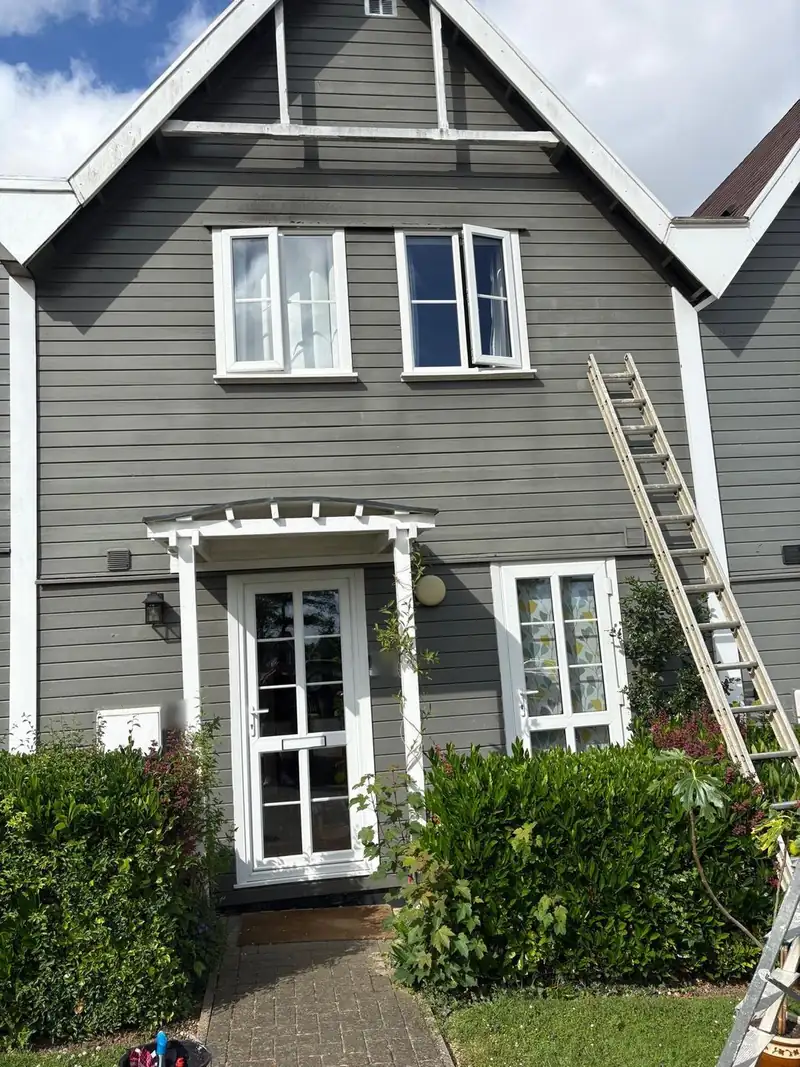
Fascias on Kingsley's Racecourse terraces are often rows of carved modillions rather than plain boards, and many of the houses are three storeys high. Dean repairs and repaints eaves, soffits, bargeboards and dormers across the district by brush, and plans access around the A5095 and Kettering Road. Kingsley is about 1.5 miles north-east of Northampton town centre.
| Fact | Detail | Source |
|---|---|---|
| Modillion eaves | No. 4 and Nos 22, 28 and 30 Kingsley Road (2009 appraisal) | West Northamptonshire Council |
| Sprocketed eaves | No. 90 St George’s Avenue, Arts and Crafts gables | West Northamptonshire Council |
| Listed eaves cornice | 1915 school, St George’s Avenue: deep wooden modillion cornice (Grade II) | British Listed Buildings |
| Article 4 class | Change of roof covering controlled on listed addresses | West Northamptonshire Council |
Modillions and dentils: eaves that are carved, not boarded
On most modern houses a fascia is a plain board. On the Racecourse terraces it is often a run of small carved brackets. The council’s 2009 appraisal records modillions at eaves level on No. 4 Kingsley Road, and on Nos 22, 28 and 30, alongside their stone window heads and cast-iron porches. The White Elephant has a modillioned cornice and dentils, No. 10 East Park Parade has decoration at eaves level, and No. 78 St George’s Avenue, an interwar house, carries understated dentils. Each modillion is a little block with faces on three sides, and every one has to be brushed separately.
That changes how the job is done and how long it takes. Flaking paint is scraped out of the gaps between the blocks, soft timber is cut back and filled or spliced, bare wood is primed, and the undercoat and topcoat go on by brush. Rolling or spraying would leave paint pooled in the recesses and bare edges on the undersides, which is where water gets in. Most of the time on a Kingsley fascia is in that detail, not the length of the run.
Deep overhangs, gables and finials
The interwar houses on St George’s Avenue have their own version. The appraisal describes No. 90 as having sprocketed eaves and large gables in the Arts and Crafts manner, where the roof flares out over a deep overhang. The 1915 school building on the same road, listed at Grade II, has a deep wooden modillion eaves cornice under a sprocketed tiled roof. Deep eaves keep rain off the walls, but their soffits stay in shade and damp, and the timber at the corners and the bottom of the bargeboards is where rot starts.
Higher still, the appraisal notes original ornate dormers on Nos 13-15 East Park Parade, with No. 15 having lost its finial when it was re-roofed, and finials at the roofline are listed among the Queen Anne features of the area. Bargeboards, dormer cheeks and finials are painted from the same scaffold as the fascia, so it is worth doing them together, and a missing or loose finial is better spotted and reported from the scaffold than from the pavement.
Does the Article 4 direction affect eaves work?
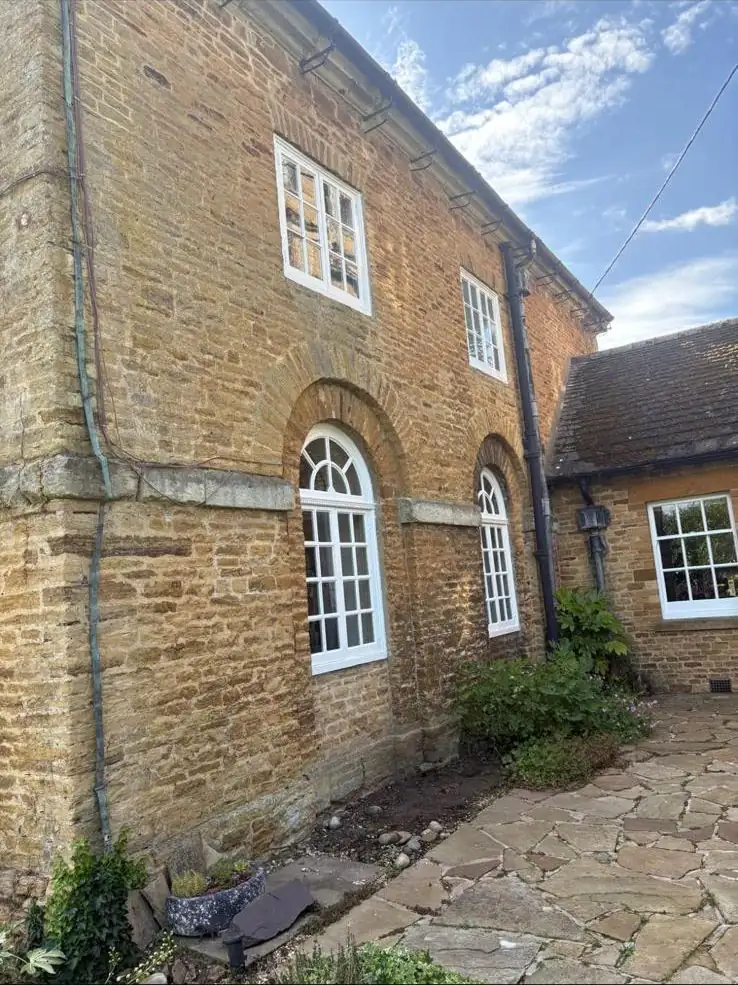
Painting the eaves is not controlled. But one of the classes in the 1990 Kingsley Road Area Article 4 Direction is a change of roof covering, on the fronts of Nos 1-58 East Park Parade, the even numbers 2-84 Kingsley Road and the even numbers 78-140 St George’s Avenue. On those addresses we repair and repaint the existing timber eaves rather than box them in, and if rot means a section of carved cornice has to be remade, it is copied to match. If a roofer is doing work at the same time, any change to the roofline or covering should be checked with West Northamptonshire Council before it starts.
Getting up there: three storeys over a main road
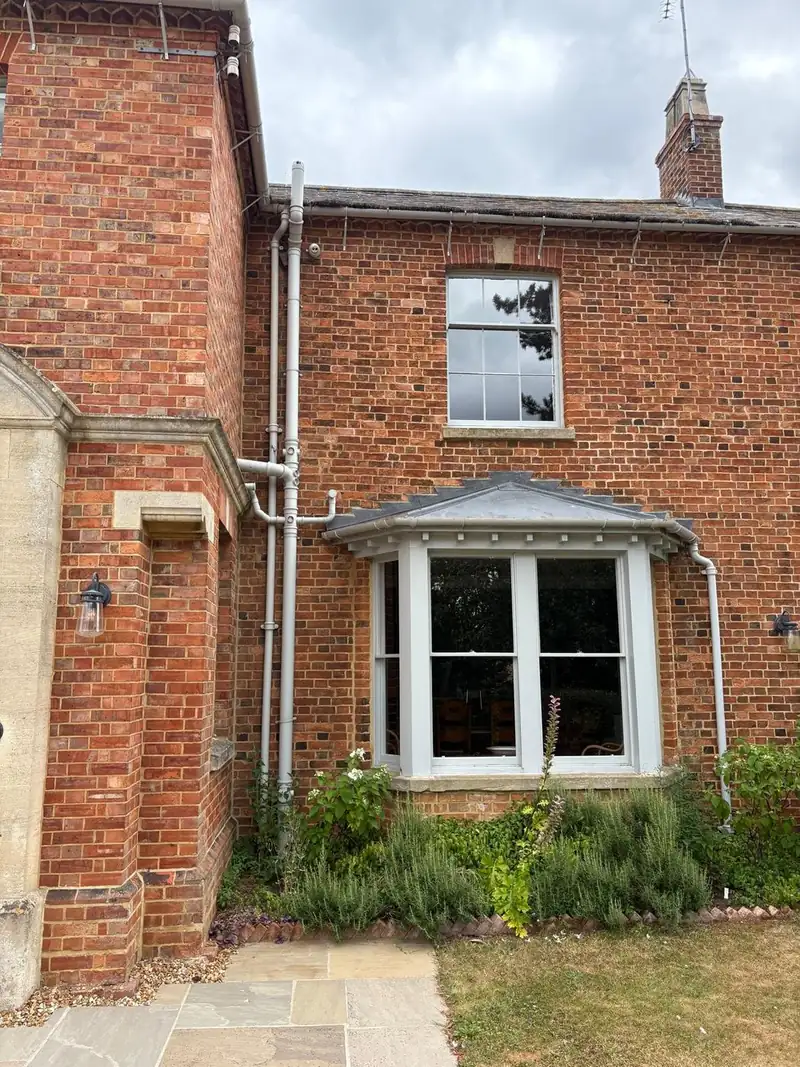
Access is usually the largest part of a fascia job in Kingsley, and it varies from street to street:
- Watkin Terrace is a row of 21 three-storey houses, with eaves to paint on both the Racecourse side and the Beaconsfield Terrace side.
- Nos 106-128 St George’s Avenue and Nos 54-58 Kingsley Road are three storeys, so a full scaffold is the safe choice.
- Kingsley Road is the A5095 and East Park Parade carries the Kettering Road, so scaffolding on the front footway needs a licence from the council and the job is planned around pedestrians.
- The two-storey terraces behind Kingsley Park Terrace and the 1930s houses to the north can often be done from a tower or ladders, which keeps the cost down.
Our cost guide explains how access affects a quote. The main fascia and soffit painting page covers the general method, and if the gutters and downpipes are cast iron, see ironwork painting in Kingsley. The Kingsley area page covers everything else.
Sources
- Kingsley Conservation Area Appraisal and Management Plan (2009), West Northamptonshire Council (accessed 2026-11-17)
- Kingsley Park Middle School, Northampton (Grade II), British Listed Buildings (accessed 2026-11-17)
- Kingsley Road Area Article 4 Direction 1990, West Northamptonshire Council (accessed 2026-11-17)
- NN2 7DN, Kingsley Road, Streetlist (accessed 2026-11-17)
- The White Elephant (formerly the Kingsley Park Hotel), Northamptonshire Historic Environment Record (accessed 2026-11-17)
Last updated .


