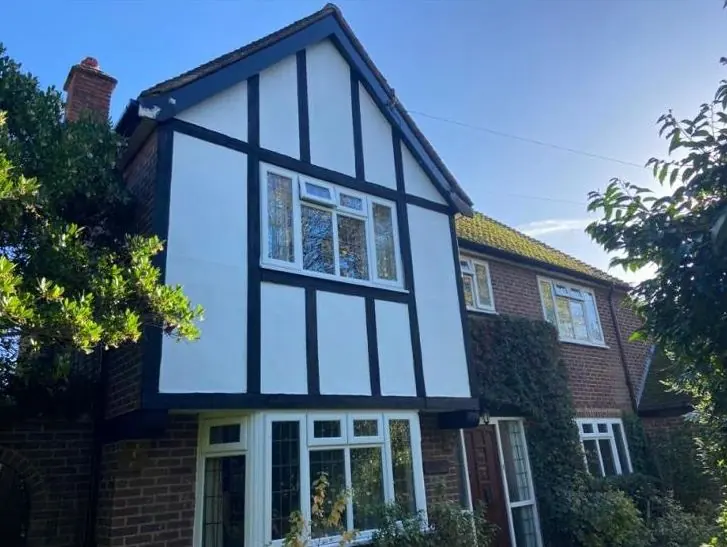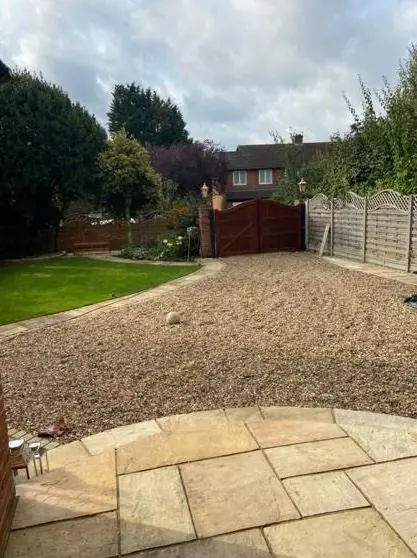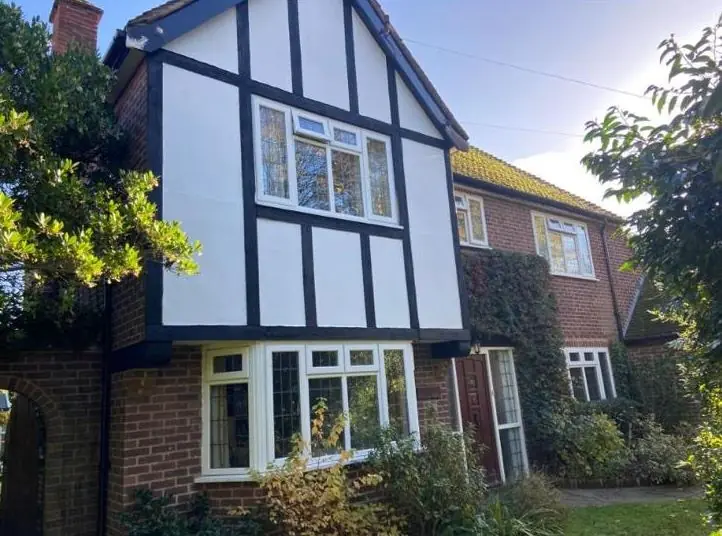
Dean paints timber fascias, soffits, bargeboards, gutters and downpipes in Phippsville, around 1.3 miles north-east of Northampton town centre. The district's 1880s villas and Edwardian semis carry far more roofline timber than a plain house, much of it high up over front gardens.
Counting the edges on a Phippsville roofline
A plain semi has a fascia along the front and back and perhaps a short bargeboard at the side. A Phippsville house rarely stops there. An 1880s villa such as 5 The Drive has a two-storey canted bay topped with a brick parapet, a dormer with a half-timbered gable, and brick stacks. The Edwardian semis and bay-fronted terraces built between about 1905 and 1925 have prominent tiled roofs, attic storeys, gables and deep eaves. Add them up and one house can have several separate fascia runs, two or three bargeboards and soffits that are wide enough to see clearly from the pavement.
That matters for two reasons. The work takes longer than the frontage width suggests, and every joint, mitre and bay roof is a place where water can get behind the paint. When we survey, we check each section rather than the main run only.
Bargeboards and gables with timber detail
Where a gable carries half-timbering, the bargeboard and the black-and-white boarding below it read as one piece, so we treat them together. Soft ends on bargeboards are common where they meet the gutter. Small areas of rot are cut out and filled with a two-part exterior wood repair. Badly decayed lengths need a joiner, and we will tell you so. The scheme then goes back on: knotting and primer on bare wood, undercoat, and a finish coat chosen for exterior timber, with the black and white kept sharp.
On the Arts and Crafts houses at 67-71 Collingwood Road, built around 1920 and locally listed, the brickwork is plain and the exterior work is mostly joinery, fascias and gutters. The tall chimneys there and elsewhere also mean flashings and stacks sit above our work, so we look for staining that points to water coming from higher up before we paint below it.
Where the original timber survives at the roofline, painting rather than replacement is usually the sensible route. Timber that is sound once the old paint is off takes primer and gloss well and keeps the profile of the original boards, which matters on houses where the roofline is part of the period look. Where a section has already been swapped for plastic, we can clean it and, if wanted, paint it with a suitable primer so it matches the rest.
Reaching the eaves from a front garden
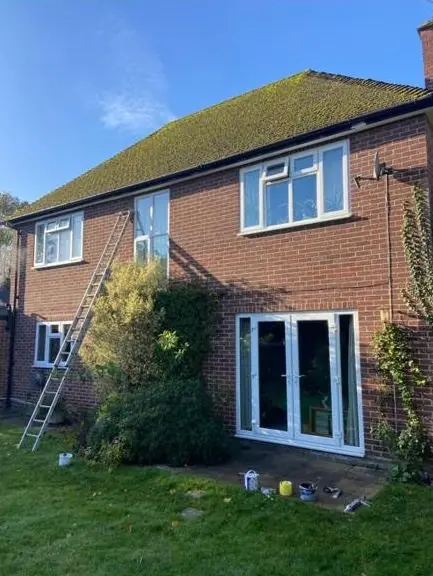
Most Phippsville fascias sit two full storeys up, and on attic-storey semis higher still. Ladders work for short sections. For bay roofs, gables and long runs we use an access tower standing in the front garden, or scaffold where a tower cannot be placed safely. Many original houses are now flats, so we agree with the freeholder or managing agent which garden we can stand in, and tell occupiers when windows will be masked. On the Kettering Road, bus stops limit where we can unload, which we plan for in advance.
Gutters below the park’s trees
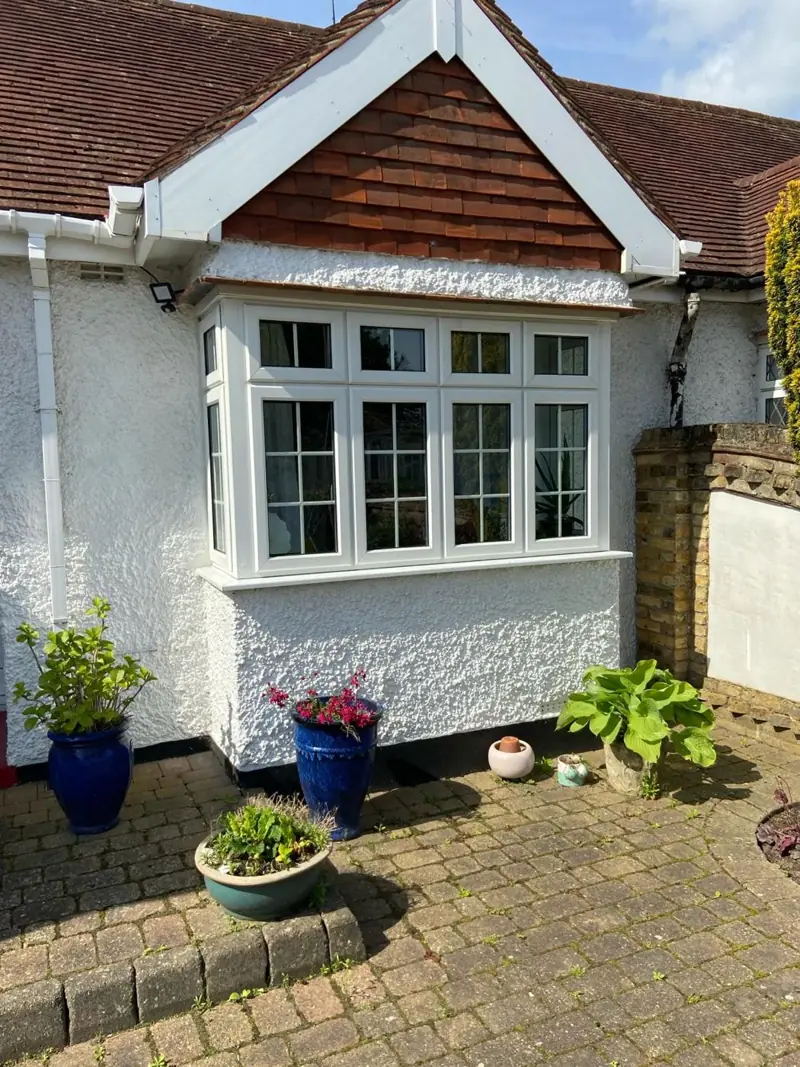
Mature trees stand close to the houses on the Abington Park side, and on the conservation area streets any tree over 76mm across is protected, so cutting back overhanging growth is not a quick fix. Leaves and seeds fill gutters, overflow onto fascias and leave the timber wet for days. We clear the gutters we are painting, check the joints, and paint gutters, brackets and downpipes in the same visit so the whole roofline matches. Booking outside the heavy leaf-fall weeks keeps debris off wet paint.
Our main fascia and soffit painting page covers materials and the process in more detail, and the cost guide sets out how roofline work is quoted. More on the area is on our Phippsville page.
Last updated by Dean, DH Painter & Decorator.