
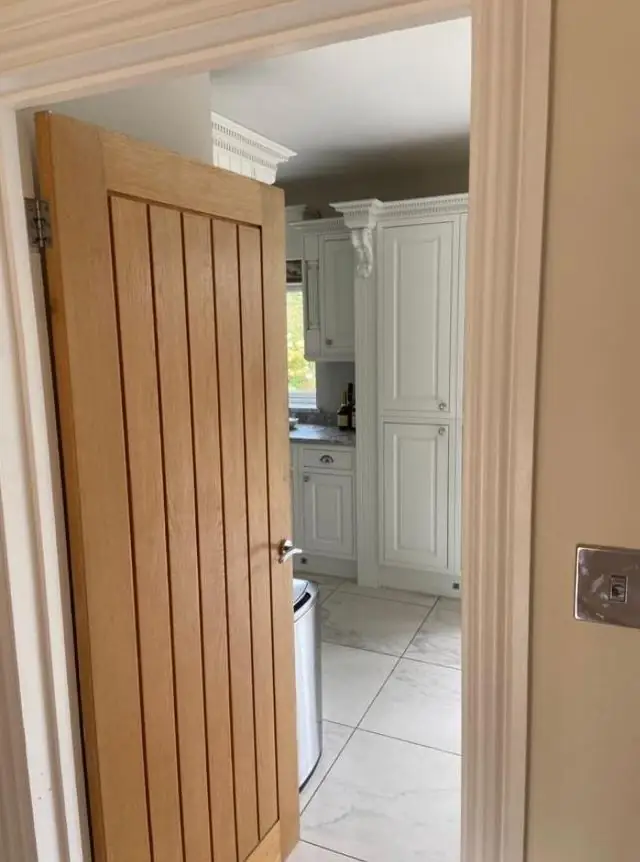


We paint doors, skirtings and other woodwork in Moulton Leys, NN3, about 3.3 miles north-east of Northampton town centre. Many houses still have their original 1970s softwood joinery under decades of gloss, so Dean judges on the visit whether it needs keying and priming or stripping back.
| Fact | Detail | Source |
|---|---|---|
| Woodrush Way listing | Garage with double opening timber doors; 40 years in one family | OnTheMarket |
| North Leys Court listing | Detached single garage with a metal up-and-over door; uPVC double glazing | OnTheMarket |
| Moulton Lodge windows | Three flush sashes with glazing bars under stone lintels | British Listed Buildings |
| Households owning outright, core estate | 50.2% (Census 2021) | Nomis (ONS) |
Fifty years of gloss on the original joinery
Many Moulton Leys houses have had very few owners. In the 2021 Census, half of households in the core of the estate owned their home outright, and one Woodrush Way house was sold after 40 years in the same family. In houses like that, the skirtings, architraves, door linings and stair parts are usually the original 1970s softwood, and each redecoration has added another coat of gloss. By now the mouldings are softened under paint, door edges catch in the frame, and the gloss has gone yellow in rooms that get little daylight.
The fix depends on how thick the build-up is. Where it is sound, we clean, sand to a key and fill the dents before priming and two coats. Where paint has built up so much that door edges bind or a moulding has lost its shape, we strip the worst areas back first. Houses of this age can still have lead in early primer layers, so we test before any dry sanding and use wet abrasives or a chemical stripper where needed.
Do yellowed oil-gloss skirtings have to be stripped?
Not usually. Oil gloss goes yellow over fifty years, most of all in rooms with little daylight, and a water-based satin or eggshell stays white instead. It will not bond to shiny oil gloss by itself, so we wash the old coat, sand it dull and use a bonding primer; stripping is kept for places where the build-up has swamped the mouldings. On moulded doors, paint gathers in the panel recesses, so the panels are painted in sequence to keep the finish even.
| Item | What it usually is here | What it needs |
|---|---|---|
| Skirtings and architraves | Original softwood, many coats of oil gloss | Key and prime for water-based paint, or strip the worst build-up |
| Internal doors | Moulded panel doors, edges thick with paint | Edges eased, then panels painted in order |
| Front door | Timber or composite, taking the weather | Sand and recoat timber; clean composite rather than paint it |
| Timber garage doors | Pairs of side-hung doors, as on a Woodrush Way garage | Bottom rails and joints sealed every few years |
| Stair spindles and handrail | Softwood, painted or varnished | Sanded back; varnish keyed and primed if changing to paint |
Garage doors: timber pairs and metal up-and-overs
Most houses here were built with a single garage, integral or detached. Listings show both kinds of door: a garage with double opening timber doors on Woodrush Way, and a metal up-and-over door on a detached garage in North Leys Court. Timber garage doors take a lot of weather on their bottom rails and on the joints where the boards meet the frame. They need sanding, any bare wood primed, and a fresh coat every few years, before the paint cracks right through. Metal doors are a separate job, covered on our metal garage door and gate page for Moulton Leys.
Less outside woodwork than you might expect
Agents’ listings across the estate describe uPVC double glazing, so most woodwork jobs here are indoors, plus the front door and the garage. The exception is Moulton Lodge, the Grade II listed house on Moulton Way North, which has flush timber sashes with glazing bars. Those are prepared by hand, with fine cutting-in along each bar and a traditional joinery paint, and work that changes their character needs listed building consent.
Front doors around the closes face every direction. One that faces south or west takes the most sun, and its paint dries out and cracks first along the bottom panel and the edge of the glazing beads. A timber door that has weathered grey needs sanding back to sound wood and priming before it is recoated.
For whole rooms, see interior painting in Moulton Leys. How we prepare and paint woodwork is on the main doors, skirtings and woodwork page, our cost guide explains what affects the price of joinery work, and the rest of our work here is on the Moulton Leys page.
Last updated .