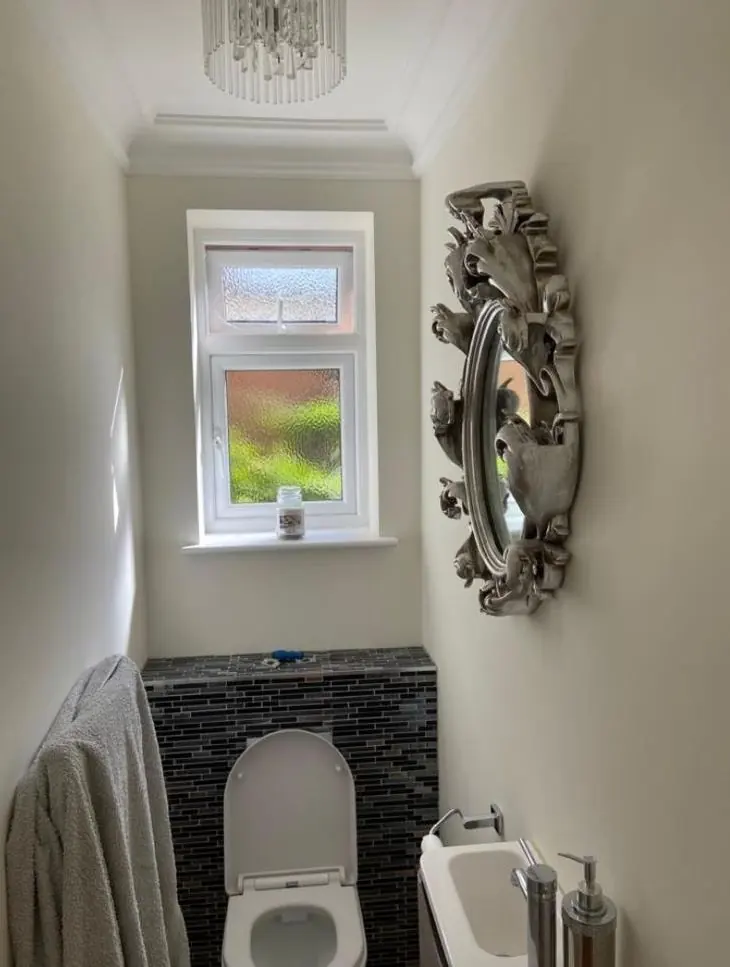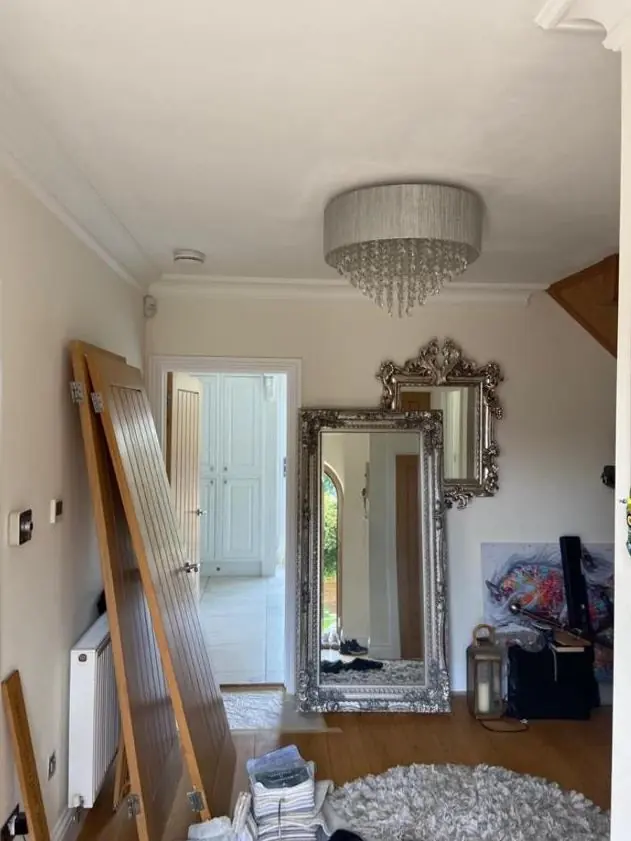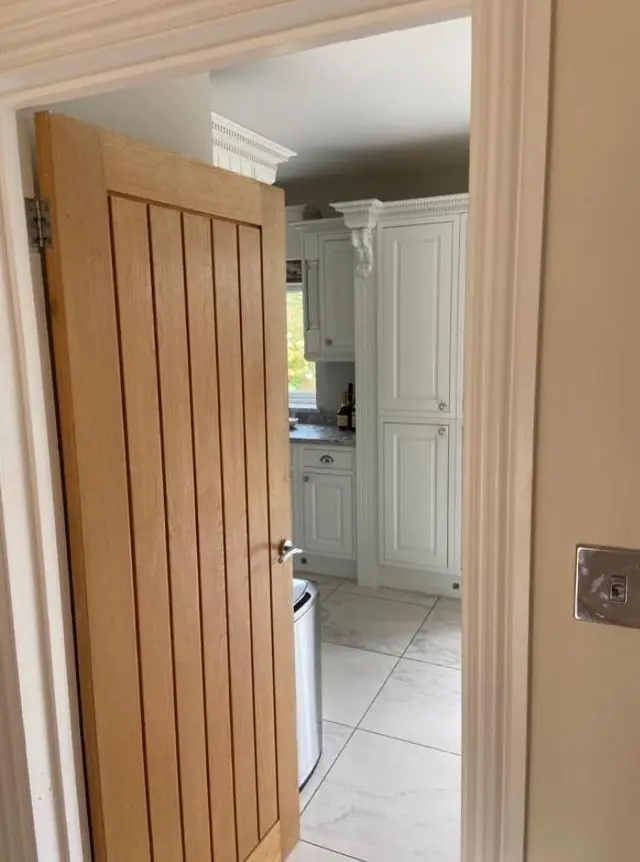
DH Painter & Decorator decorates hallways, staircases and landings in Spinney Hill, NN3, on the Kettering Road side of Northampton. Dean works mainly in the area's 1930s-1950s semis, where a straight staircase rises from the front hall to a landing, and many halls now run through to a rear extension.
The semi-detached hall, step by step
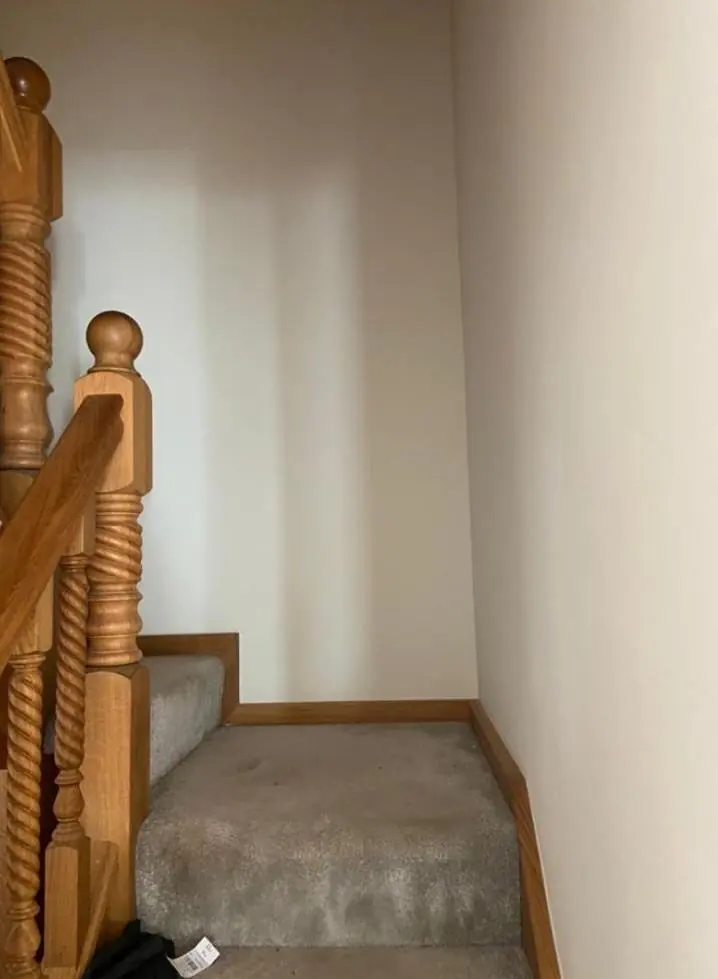
A Spinney Hill semi from the 1930s to the 1950s usually has the same basic hall: the front door opens into a passage, a straight flight of stairs runs up one wall to a landing, and there is a cupboard under the stairs. It is a simpler space than the dog-leg stair of an older terrace, but it still has one awkward wall, the tall one over the stairs, and that is the wall most people can’t reach themselves. We set up a stair platform and boards so the full height can be worked from a level, stable footing instead of a ladder balanced on a tread.
| Part of the hall | What usually needs doing |
|---|---|
| Stairwell wall | Filling settlement cracks at the ceiling line, then two coats from a stair platform |
| Landing ceiling | Stain-blocking where old loft-hatch or roof leaks have marked it |
| Spindles and handrail | Rubbing down worn handrail sections, then hard-wearing satin or a varnish recoat |
| Strings and skirtings | Filling scuffs from decades of foot traffic before repainting |
| Under-stairs cupboard | Often forgotten; painted at the same time so the hall reads as one |
The general method for halls and stairwells is on our main hallway, stairs and landing decorating page.
When the hall now leads to an extension
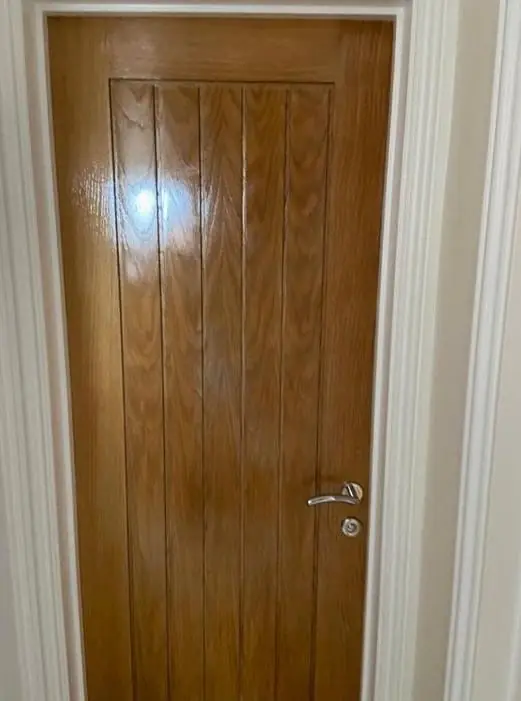
Behind many Spinney Hill semis there is now a newer room, whether a conservatory, a family room or an annexe, and the hall is often the route through to it. That puts new gypsum plaster right next to walls that have been painted many times over since the house was built. The two surfaces take paint differently. New plaster needs a mist coat, and the old walls need cleaning, filling and sometimes a stain block. The join between them, usually at a doorway or a new opening, needs flexible filler so a hairline crack doesn’t appear a few months later. We decide with you where the colour should stop. Running the hall colour into the new room can make the extension feel part of the house, and a clean break at the door frame makes it feel like a separate space.
Finishes for a busy family hall
These are three- and four-bedroom houses, so the hall is where school bags, bikes, pushchairs and shoes all pass through. A flat matt looks good on day one and marks by the end of the week. For the lower walls and stair side we suggest a scrubbable matt or a durable eggshell, which can be wiped without leaving shiny patches. Some owners want a dado or simple period-style panelling on the lower wall of the hall. It suits a 1930s house and gives the scuffed zone a tougher surface. For the woodwork we use a hard-wearing satin that stands up to knocks better than an older-style gloss.
Communal stairs at Manfield Grange
Manfield Grange occupies the old Manfield Orthopaedic Hospital, a Grade II building whose list entry describes a Jacobean staircase, panelling, screens and plasterwork. Decorating a communal stair there is a different job from decorating a semi. It is managed through the building’s agent, and original features may need listed building consent before anything changes. Paint there should be a traditional type that can be removed later without harm, and the work is planned so residents can still use the stairs. We start by agreeing what is covered by the listing.
Arranging the work
Most Spinney Hill semis have a front driveway, so the van and dust sheets stay at the property rather than on Kettering Road. For homes facing the girls’ school, kit comes in after the morning drop-off. Our Spinney Hill page covers the area more broadly.
Last updated by Dean, DH Painter & Decorator.