Dean paints fascias, soffits, bargeboards and gutters on houses in Spratton, roughly 6.5 miles north of Northampton town centre in the NN6 area. The village mixes thatched cottages that have little or no fascia with slate-roofed Georgian houses and outbuildings whose rooflines do need repainting every few years.
Not every Spratton roof has a fascia
Fascia work in Spratton depends on the roof. A thatched cottage, such as 2 or 10 Yew Tree Lane, Home Farmhouse or 7 Manor Road, usually has no fascia board in the ordinary sense. The thatch overhangs the wall and sheds water clear of it, so there is no gutter board to paint and often no soffit at all. What timber there is tends to be tucked up under the thatch at the gables. That kind of house rarely needs a roofline job. If it has one, it is a small amount of careful hand work with no ladders resting on the thatch and no heat used to strip paint.
Slate changes the picture. Spratton House at 5 Church Road, Northbank House on Manor Road and Spratton Hall all have slate roofs, as does the former coach house at Spratton House. Slate roofs carry fascias, gutters and often bargeboards on the gables, and those boards take the full force of run-off from steep roof slopes.
Bargeboards and steep old rooflines
On the 18th century houses the gables are often steep, and that means bargeboards high up on the gable ends. Painting them is mainly an access question. A two-storey gable can sometimes be reached safely from ladders with stand-offs; anything taller, or above a conservatory or lean-to, is better done from a tower. Holly House on Church Road, at three storeys, is a clear case for a tower or scaffold. Church Road also has a locally listed boundary wall, raised to 12 feet in an old family dispute, and tall walls like that can limit where a tower or ladder foot can stand, so access along that lane is worked out on the visit rather than assumed.
Once up there, the job follows the usual order: check for soft timber, scrape back loose paint, spot-prime bare wood, undercoat and top coat, then paint the gutters and brackets. The full method is on the main fascia and soffit painting page.
Outbuildings, stores and later houses
The coach houses and outbuildings in the village often have plain timber boards at the eaves rather than moulded fascias. They are low enough for ladder work but have usually been left longer between coats, so there is more bare and greyed timber to deal with. We treat those with a primer that suits weathered wood before undercoat.
Any later houses outside the historic core will have ordinary boxed eaves, and for those the main service page method applies as it would anywhere. The village-specific work is on the older buildings above.
Colour at the eaves in a conservation village
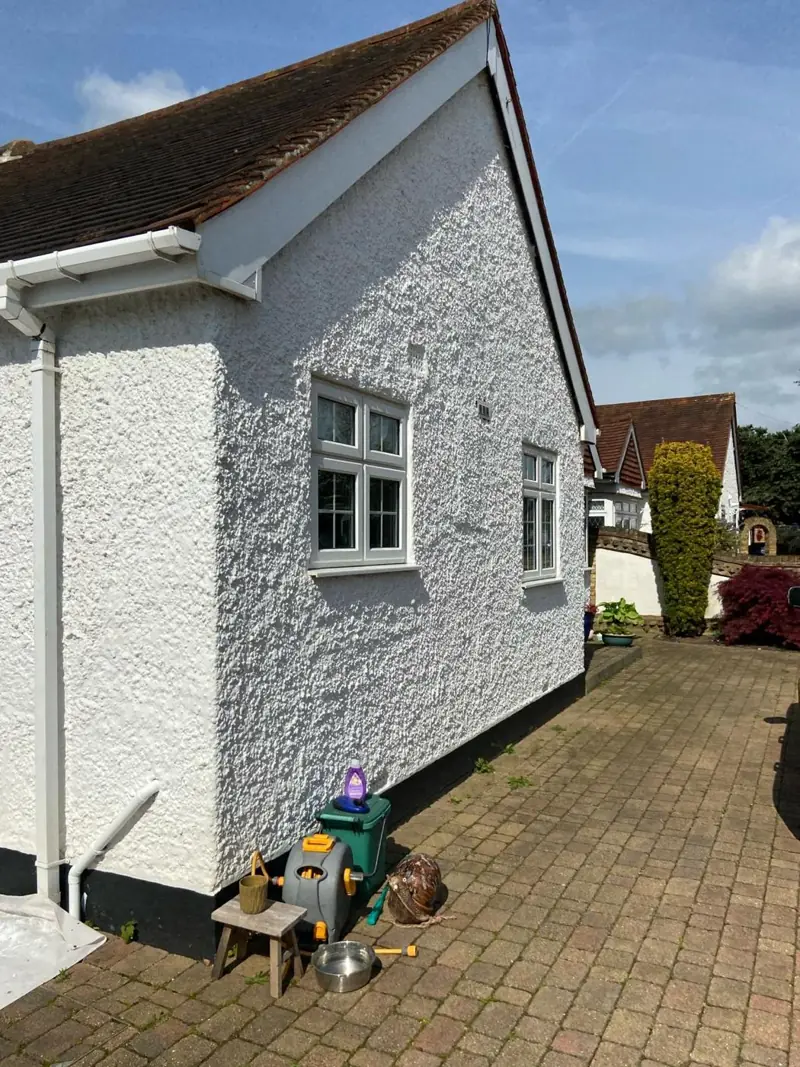
In the village core a roofline should be quiet. White or off-white boards with black gutters are a common choice against ironstone, lias and slate. A dark roofline in a heritage green or grey can suit some stone houses too. A bold new roofline colour on a Church Road or Manor Road frontage is one to discuss with West Northamptonshire Council, the authority behind the 2021 conservation area appraisal, and remember that Grade II houses need consent for anything other than a like-for-like repaint.
Slate-roofed Georgian houses of Spratton House’s age may still carry cast iron gutters and downpipes; if so, they are wire-brushed, primed and painted on the same visit as the boards. Height and access drive most of the cost of roofline work; our guide to decorating costs explains the other factors. The Spratton area page lists the other services we cover in the village.
Last updated by Dean, DH Painter & Decorator.