
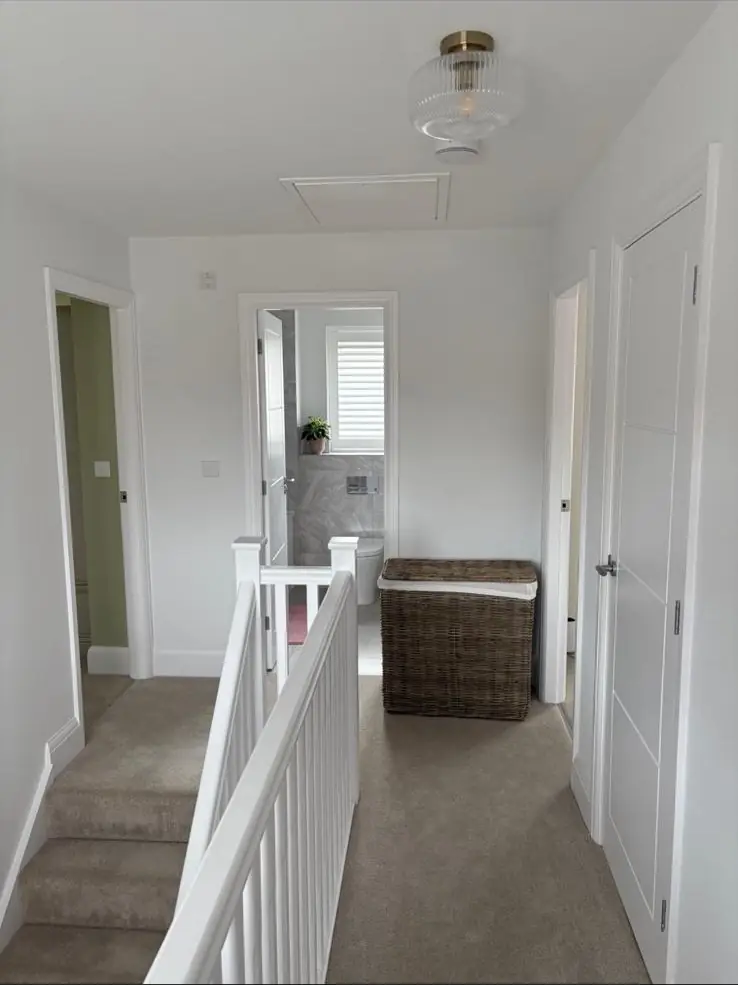
Dean hangs wallpaper, feature walls and lining paper in homes across Nether Heyford and Upper Heyford, 6 miles west of Northampton. The regular plastered rooms of the post-war and 1960s houses take paper well; the village's old stone cottages need more preparation before any pattern goes up.
| Fact | Detail | Source |
|---|---|---|
| Homes built 1945-1954 | 90 of 750 properties (12%) | GOV.UK |
| Rolfe Crescent, South View, Close Road area | 78.8% semi-detached (Census 2021 output area) | Nomis (ONS) |
| Bliss Close | Eight new-build sales recorded between late 2011 and 2013 | landregistry.data.gov.uk |
| Bliss Close density | 33 homes per hectare, the highest in the village | netherheyfordparishcouncil.gov.uk |
| Heyford Cottage, 6 The Green | Grade II; leaded casements, crown glass and diamond-pattern panes | British Listed Buildings |
Plastered rooms in post-war houses and semis
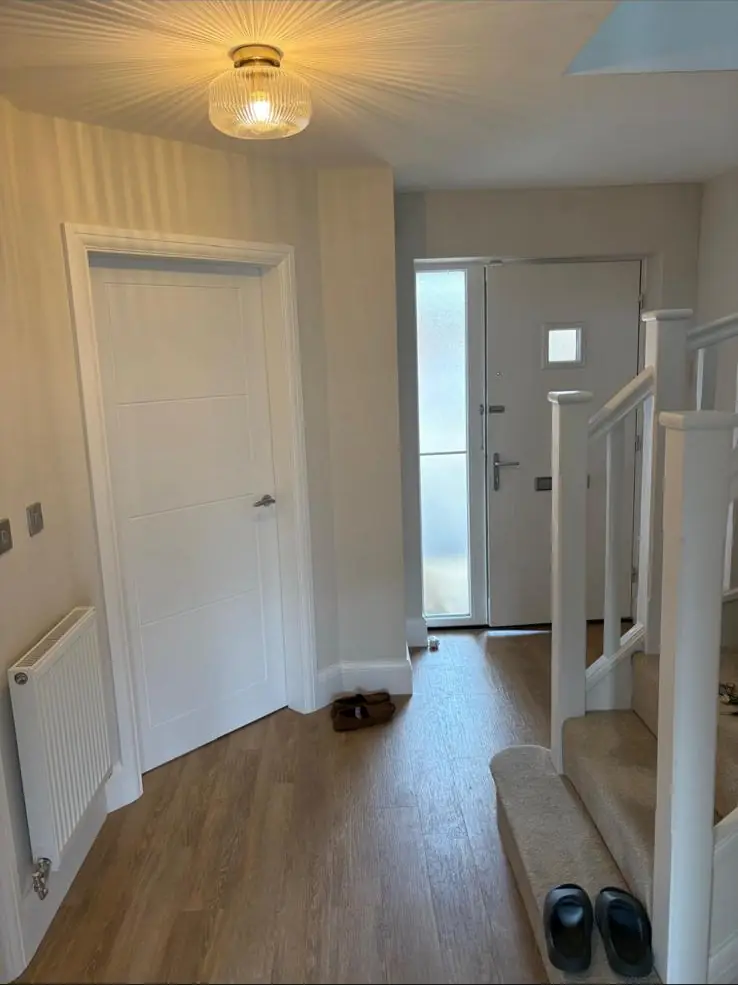
Wallpaper is easiest to hang well on plastered walls that are close to flat and corners that are close to square, and a good part of the Heyfords offers exactly that. The Valuation Office counts 90 homes built between 1945 and 1954, close behind the 100 built before 1900 and second only to the 270 from 1965-72 among the post-war years. Separately, the Census output area that takes in Rolfe Crescent, South View, Close Road and Western Avenue is 78.8 per cent semi-detached, with the neighbourhood plan measuring 117 homes there at about 23 to the hectare.
Rooms in semis of that kind tend to be rectangular, with a chimney breast in the front room and a short run of wall over the stairs. Those are the walls people most often want papered: a feature wall either side of a chimney breast, a whole bedroom in a small pattern, or a busy design behind a bed. The jobs that take time are the ones hidden under the old paper. Houses of this age often have several layers to strip, and the plaster under them may be patched, so we steam off, fill, sand and size before the first length is pasted. Our main page on wallpaper hanging explains pasting, matching and the different paper types.
Lining stone and lime walls before papering
The cottages round The Green and Church Street are another matter. Their walls are coursed ironstone or limestone with lime plaster on the inside face, and none of them is flat. A heavy, patterned paper hung straight onto a wall like that shows every hollow and lifts where the lime is soft or dusty. So in those houses the walls are first brushed down and any loose lime consolidated, then hung with lining paper, usually horizontally so its joints never line up with the decorative paper on top.
A practical point: a stone wall that is damp at the base will push paper off from behind however well it is hung. Valley-floor houses near the brooks and springs sit lower and wetter than those on the slope, so on those walls we check moisture before quoting. If a wall needs to breathe, a paper may be the wrong finish and a breathable paint the better one; the Heyfords interior painting page covers those paints. Common wall types and what each needs:
| Wall | Where in the Heyfords | Before papering |
|---|---|---|
| Lime plaster on ironstone or limestone | Listed and older cottages, The Green and Church Street | Consolidate, check for damp, cross-line |
| Plaster on brick, papered many times | 1945-1954 and 1960s houses | Strip, fill, sand, size |
| Plasterboard with builder’s matt emulsion | Bliss Close (2012) and later homes | Seal the thin first coat, then size |
Can wallpaper go up in a listed cottage?
Usually yes, but the parish has 25 listed entries and listing covers the inside as well as the outside. Hanging paper on a wall that has carried paper before is ordinary redecoration. Taking off historic wall finishes, or papering over something the listing values, such as panelling, is different and may need listed building consent from West Northamptonshire Council. Heyford Cottage on The Green, for example, is listed with leaded casements, crown glass and a stone-flagged hall, and rooms like that suit a quiet, period-appropriate pattern rather than a bold modern one. We are happy to talk through papers before you order, as rolls bought by mistake are hard to return.
First decoration in Bliss Close
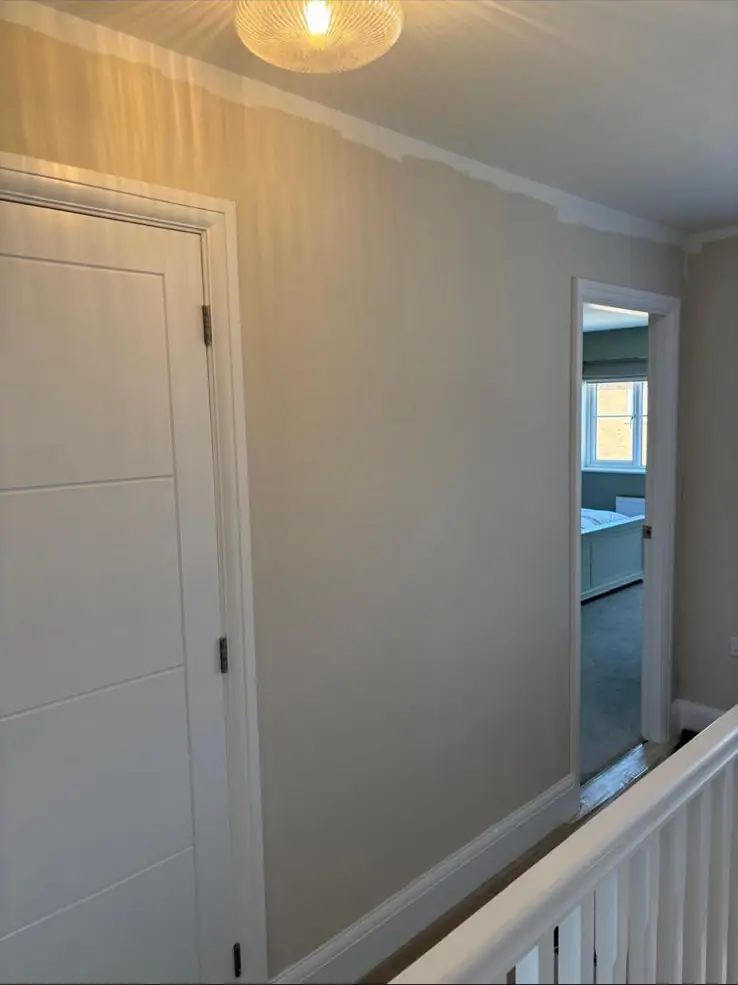
Bliss Close, built in 2012, is the largest group of new homes in the village in recent decades: Land Registry records eight new-build sales there between late 2011 and 2013, and the neighbourhood plan puts the development at 33 homes to the hectare, by far the densest part of the village. Where a room has never been redecorated since it was built, it may still be in the builder’s thin matt emulsion. Paper will not hold well on that, because the paste soaks the paint and the first coat lets go. The wall is sealed with a proper primer or a sizing coat first, then hung. Hairline cracks from the frame settling are filled at the same time. For prices, our cost guide explains what affects a papering quote, and the Heyfords area page covers other work in the village.
Sources
- Council Tax: stock of properties 2026, table CTSOP4.1, Valuation Office Agency (accessed 2026-11-16)
- Census 2021 TS044 Accommodation type, LSOA E01027287 and output areas, Nomis (ONS) (accessed 2026-11-16)
- Price Paid Data (new-build sales, NN7 Heyford localities), HM Land Registry (accessed 2026-11-16)
- Nether Heyford Neighbourhood Plan 2022-2029 (made version, September 2023), Nether Heyford Parish Council (accessed 2026-11-16)
- Heyford Cottage, 6 The Green, British Listed Buildings (accessed 2026-11-16)
- Listed buildings in Nether Heyford, British Listed Buildings (accessed 2026-11-16)
- Nether Heyford Conservation Area Appraisal and Management Plan (2012), West Northamptonshire Council (accessed 2026-11-16)
Last updated .


