
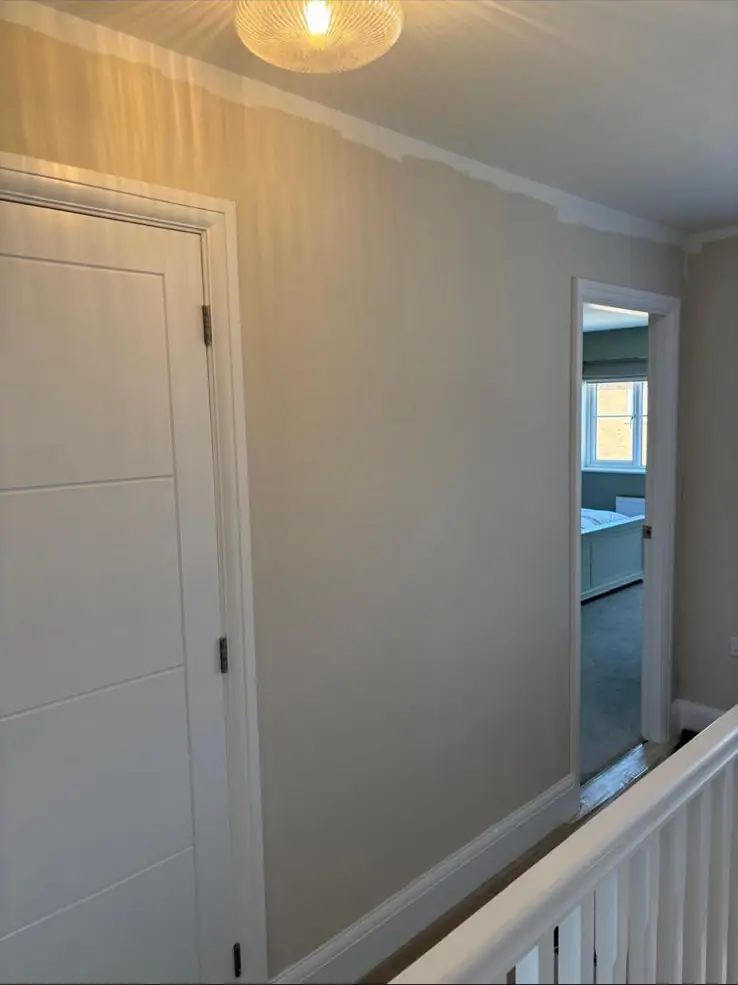
DH Painter & Decorator paints the inside of homes across Wellingborough, about 9.7 miles north-east of Northampton town centre in a straight line. Nearly half the town's households live in a three-bedroom home, so a typical interior job is a three-bed semi or terrace, which can be decorated a room at a time while the family stays in, and the age of the house, which changes sharply from district to district, decides how much preparation each room needs.
Three bedrooms, decorated while you live there
Almost half of Wellingborough’s households (48.5%) live in a three-bedroom home, according to the 2021 census for the town’s built-up area. The semi-detached house is the commonest type at 32.4% of households, with terraces close behind at 28.7%. So a typical interior job in this town is a three-bed semi or terrace, often with people living in it while the work goes on.
That decides how Dean runs it. One room is cleared, sheeted and finished before the next is opened up. Furniture goes to the middle of the room under dust sheets rather than out into the hall, and the bedrooms are taken in an order that always leaves somewhere to sleep. Kitchens and bathrooms are fitted around your routine, because nobody can do without those for long.
Most houses here are modest in size: Council Tax Bands A and B account for 64% of the town’s properties in the Valuation Office Agency’s March 2026 count. Room sizes are fairly predictable, so the age of the house is what really changes the job.
Which part of town, and what the walls are likely to be
Wellingborough grew in waves, and each district has its own mix. VOA records of when properties were built show how different two addresses a mile apart can be:
| District (ONS statistical area) | When most homes were built | What the interior preparation tends to involve |
|---|---|---|
| Central Wellingborough | 30.0% before 1900 | Old plaster with cracks and patched repairs, ceilings with old coatings, woodwork carrying many layers of gloss |
| Victoria & Isebrook (Midland Road and Mill Road side) | 31.5% before 1900, 33.3% from 2009 on | Two different jobs in one district: Victorian terraces and recent homes |
| Croyland and Kingsway | 58% built 1919 to 1964 | Interwar and post-war houses, often with picture rails and older ceilings |
| Queensway | 49.4% built 1965 to 1972, none recorded before 1945 | Flatter walls of that era: filling knocks and cutting in cleanly |
| Redwell | 71% built 1973 to 1999 | Later plasterwork, usually with sound previous coats to paint over |
A terrace on Rock Street and a semi on Queensway might have bedrooms of the same size, but they are not the same job. In the older house Dean expects cracks along the ceiling lines, patches where gypsum has been used to repair lime plaster, and doors and skirtings that need sanding back rather than a quick key. In a 1960s or 70s house the walls are usually flatter, and most of the time goes on filling dents, sealing bare repairs and cutting a straight line where wall meets ceiling.
Painting over old plaster in the Victorian streets
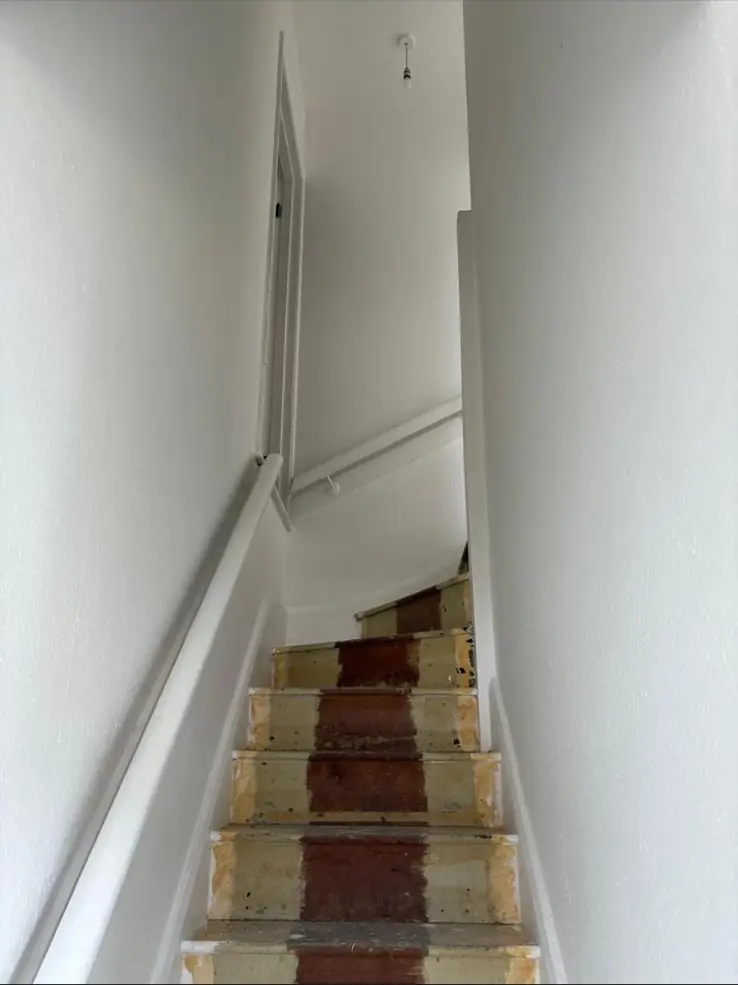
Most old plaster takes paint well if it is sound and the right paint goes on it. The checks come first. Dean taps the walls for hollow patches, looks for flaking distemper on ceilings (it has to be washed off or sealed, or new emulsion lifts with it), and spot-primes fresh filler so it does not show through as a dull patch. Where the plaster is lime, a breathable emulsion is a safer choice than a heavy vinyl.
Some walls in the oldest terraces are simply too uneven for a flat paint finish to look right. Lining paper under the emulsion hides a lot, and our wallpaper hanging page for Wellingborough explains when that is worth doing. Parts of the town sit low beside the Nene, the Ise and Swanspool Brook, and houses there can carry damp in the lower walls, so a moisture reading is taken before paint goes on any ground-floor wall that looks marked.
| Fact | Detail | Source |
|---|---|---|
| Households with three bedrooms | 48.5% (Census 2021, Wellingborough built-up area) | Nomis (ONS) |
| Most common home type | Semi-detached, 32.4% of households (Census 2021) | Nomis (ONS) |
| Properties in Council Tax Bands A and B | 64% (VOA, March 2026) | GOV.UK |
| Queensway homes built before 1945 | None recorded (VOA build period counts) | GOV.UK |
Listed interiors in the town centre
The Wellingborough Town Centre Conservation Area holds 93 listed buildings, and a listing covers the inside of a building as well as the front. The Hind Hotel on Sheep Street, listed Grade II*, keeps a 17th-century staircase and 18th-century panelling, for example. On interiors like that, anything beyond like-for-like redecoration, such as stripping original joinery or changing how panelling is finished, needs listed building consent from North Northamptonshire Council first. If you own a listed house in the centre, check before the quote, and Dean will work to whatever the consent allows.
The general method we follow in every house is on our interior painting service page. Costs depend on the rooms and their condition, so we quote in writing after a visit; the painter and decorator cost guide shows what moves the figure. Everything else we do in the town is on our Wellingborough page.
Sources
- Census 2021 TS050: Number of bedrooms, Nomis (ONS)
- Census 2021 TS044: Accommodation type, Nomis (ONS)
- Council Tax: stock of properties, 2026 (table CTSOP4.1, build period), Valuation Office Agency
- Wellingborough Town Centre Conservation Area, Heritage Check
- The Hind Hotel, Wellingborough (Grade II*), British Listed Buildings
- MSOA names, House of Commons Library
Last updated .


