Dean paints interiors in Great Doddington, the Nene Valley village about 8.3 miles east of Northampton town centre in the NN29 postcode. Inside, the village splits into old stone cottages with attics, converted barns and 20th-century bungalows and houses, and each needs different paint and preparation.
One long street, four very different interiors
Great Doddington runs for about a mile and a half along a single main street, and walking it end to end takes you through roughly four centuries of building. The historic core around Church Lane, Lower Street, Doctors Lane and the western High Street is a designated conservation area of coursed limestone cottages and farmhouses, several of them listed and some dating back to the 1600s. Old barns on three of the farms, Top, Glebe and Grove, have been turned into homes. Outside the conservation area, the village is mostly 20th-century ribbon development, including a 1960s/70s bungalow scheme on the High Street and the newer St Nicholas Court. The paint, prep and access for a room depend on which of these it sits in, so that is the first thing Dean asks about.
| Where the room is | What it usually means inside |
|---|---|
| 17th-century cottage in the conservation area | Uneven, often lime-based plaster, low ceilings, attic rooms, breathable paint |
| Barn conversion (Top, Glebe or Grove Farm) | Tall walls, exposed beams and stone, a tower rather than a stepladder |
| 1960s/70s bungalow or ribbon house | Gypsum plaster, standard ceiling heights, conventional emulsions |
| Post-war infill in traditional limestone (Lower Street, Doctors Lane) | Newer than the cottages around it; we check whether walls are lime or gypsum before choosing paint |
Why the cottage walls get a different paint
The conservation area appraisal describes the oldest houses as two-storey cottages and farmhouses with or without attics, built of limestone with ironstone dressings. Walls of that age were plastered in lime, and lime plaster handles moisture by letting it pass through. A modern vinyl emulsion forms a skin over it, and in a solid stone wall with no cavity, damp that can’t get out tends to show up as blistering, flaking or a tidemark low on the wall. So in these cottages Dean tests what is already on the walls, then works with breathable mineral or clay-based paints where the plaster calls for it.
The surfaces themselves are rarely flat. Old lime work follows the stone underneath, so the walls bow and the corners are rounded. Filling every undulation would make an old room look like a new-build and cost a lot of time, so cracks and loose patches get repaired while the softness of the wall is kept. Cutting a straight line where a wall meets a sloping attic ceiling or a timber lintel is where the hours go in these houses, and the quote reflects that.
Barns at Top Farm, Glebe Farm and Grove Farm
The barn conversions bring the opposite problem: scale. Tall stone and brick walls, big openings where cart doors once were, and exposed beams overhead mean that much of the painting is done from an access tower rather than a ladder. Where plastered panels meet exposed stone or brick, every edge has to be cut in by hand, because masking tape will not seal against a rough stone face. Red brick and stone left on show are not painted. If a beam has been stained or waxed, it needs protecting before any ceiling paint goes near it.
Some of these conversions were finished with modern plaster, and fresh plaster needs a mist coat before anything else. Our guide to painting new plaster explains why.
Gypsum walls in the bungalows and St Nicholas Court
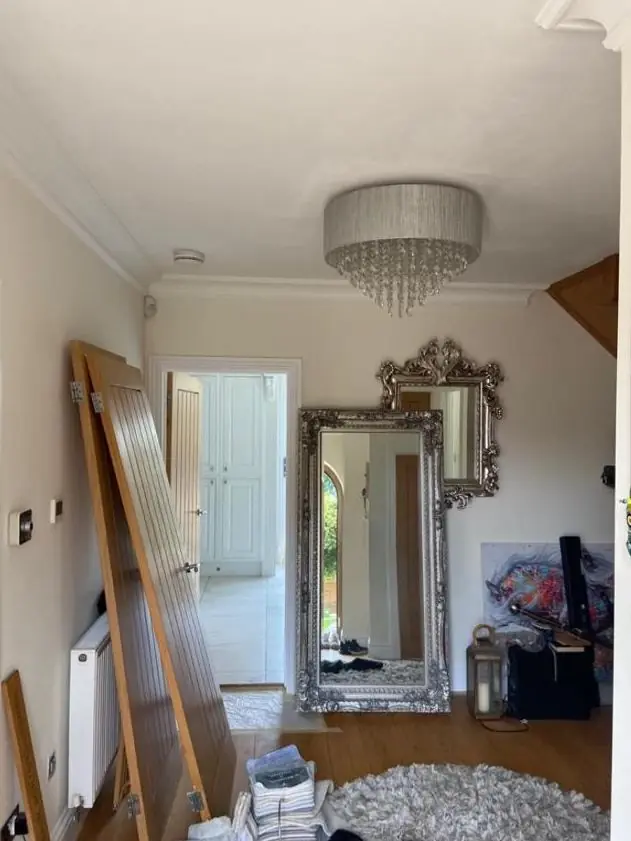
The 1960s/70s bungalows at 44 to 54 High Street, the other 20th-century houses towards Earls Barton and Wellingborough, and St Nicholas Court are built in a conventional way, with plasterboard or gypsum-plastered walls. Rooms there are painted with standard trade emulsions and satinwood or eggshell on the woodwork, and a bungalow’s single level makes access simple. A living room, a couple of bedrooms or a full repaint can usually be planned room by room while you live in the house. The general method, from filling to final coat, is set out on our main interior painting page.
Getting to you
Great Doddington lies 8.3 miles east of Northampton town centre in a straight line, and we cover it from our base there. Interior work avoids most of the footway problems that exterior jobs face on the High Street, but cottages built up to the pavement edge still mean the van can’t always stand directly outside, so dust sheets and materials are carried in from wherever parking allows. The Great Doddington page describes the village’s other house types and the rest of our services there.
Last updated by Dean, DH Painter & Decorator.