DH Painter & Decorator paints house exteriors in Yardley Gobion, the NN12 village about 9.7 miles south of Northampton town centre. Dean paints the conservation-area cottages and formal stone houses along the High Street and Moorend Road, and the 1950s-70s estate houses below the old core. Quotes are free.
Two villages under one name
From the outside, Yardley Gobion splits into two quite different jobs. The old linear village runs along the High Street, Grafton Road and Moorend Road and meets at Elm Green. Its houses are mostly light yellow and grey limestone, laid as coursed rubble on the 17th and 18th-century cottages and as squared stone or ashlar on the formal houses such as Prospect House, Manor Farm and The White House. South of that lies the post-war estate built between the 1950s and 1970s, which more than doubled the village. There the work is softwood fascias, door frames, doors and fencing, with no conservation-area rules attached.
So the first thing Dean does on a visit is work out which of the two your house belongs to, because the paint systems, the preparation and the paperwork are different.
Weather on the valley ridge
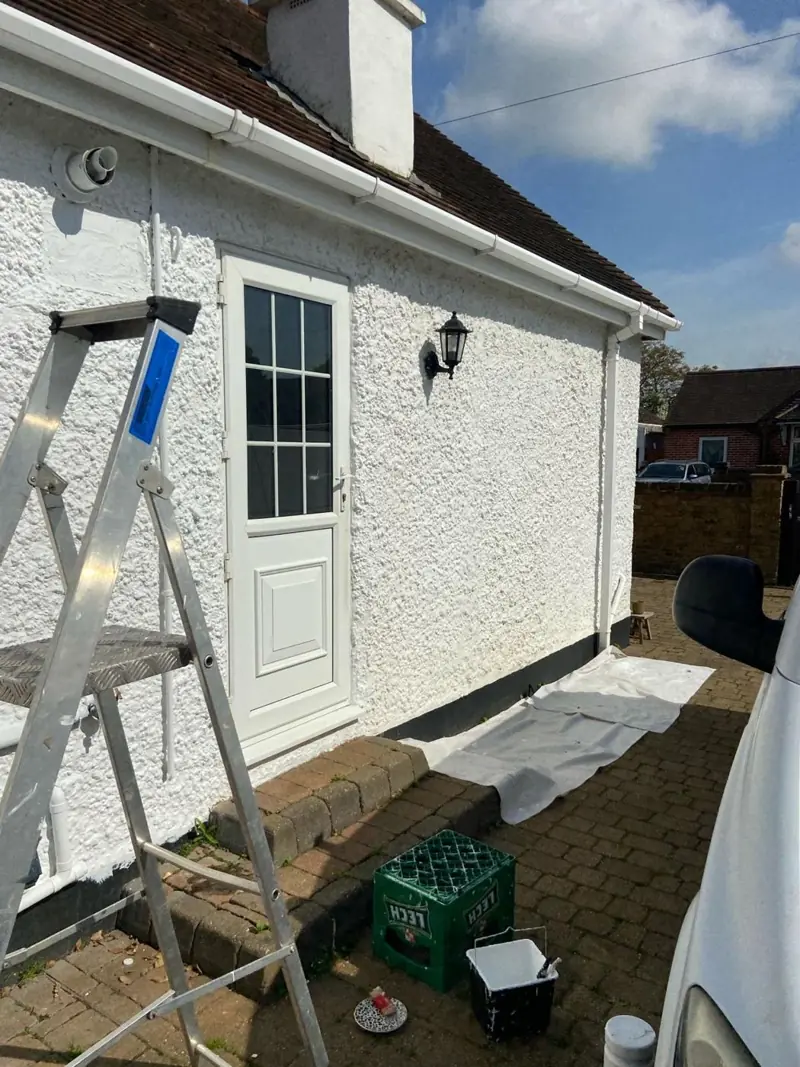
The village sits high on the side of the Tove Valley with open views across the floodplain. Those views come at a price: north- and east-facing elevations catch the wind and rain coming across the valley, and paint on them breaks down sooner than on a sheltered street in town. Add the mature trees in gardens and on the greens and you get shade, leaf drop and green growth on the cooler faces.
In practice that changes the order of work:
- a fungicidal wash and rinse on shaded walls, sills and doors before any sanding
- exposed elevations booked for a settled spell, ideally late spring to early autumn (see our guide on when to paint outside in the UK)
- extra attention to bottom rails and sills on the weather side, where water sits longest
Casements, sashes and plank doors in the conservation area
The Yardley Gobion Conservation Area, designated in 1999 and covered by an appraisal adopted in 2013, names small cumulative changes as its biggest threat. It singles out uPVC replacements for timber windows and doors as something to avoid. Keeping the existing joinery painted and sound is the straightforward answer, and it is where most exterior work in the old village lies.
| House type | Joinery to expect | How we approach it |
|---|---|---|
| Vernacular cottages, e.g. Moorend Road and the High Street | Side-hung timber casements, timber lintels, plank doors | Seal exposed end grain, fill and prime bare timber, oil-based or linseed systems |
| 18th-century formal houses | Six-over-six sashes with narrow glazing bars, panelled doors, fanlights, door surrounds | Hand preparation, careful cutting-in, sashes eased so they still run |
| Post-war estate homes | Softwood fascias, frames and doors | Standard exterior systems chosen for exposure |
Fine pieces like the rococo shell hood at Prospect House or the pilastered door surrounds elsewhere are hand-scraped and rubbed down, never power-sanded. Over a dozen buildings in the conservation area are listed, and changing an external colour on one may need consent from West Northamptonshire Council, so we raise that before any colour is chosen.
Narrow lanes, low eaves and thatch
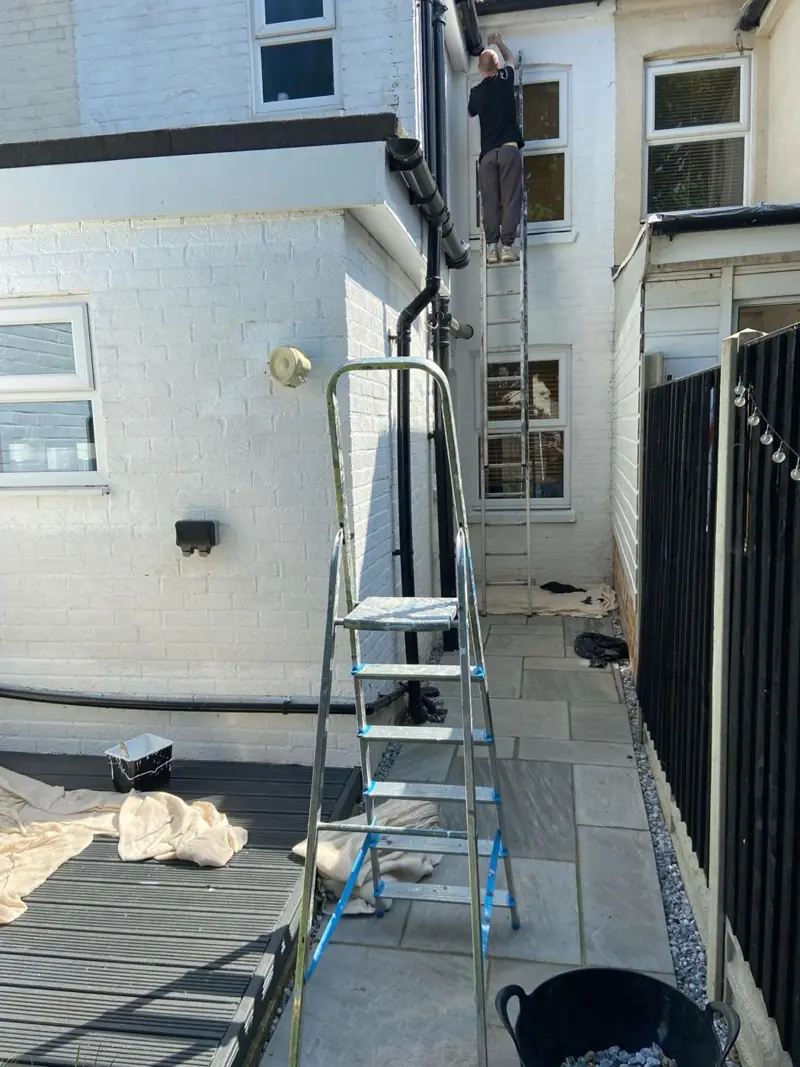
Access is the other local factor. Moorend Road is narrow and undulating with houses on the street edge, Chestnut Road is closed in by walls, and Mount Pleasant is reached down a single-track gravel entrance. We plan van parking before the start date and, where a ladder or tower would stand on the pavement, check whether a permit is needed. Some cottages are still thatched with low eaves, so ladders are footed clear of the thatch and nothing leans against it.
We cover Yardley Gobion from our Northampton base. For the general method behind our exterior work, see the main exterior painting page, or read about the village as a whole on our Yardley Gobion area page.
Last updated by Dean, DH Painter & Decorator.