
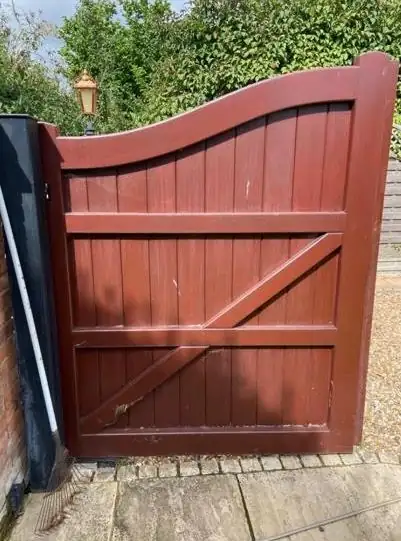
Metal gate and railing painting in Yardley Gobion includes listed ironwork, such as the iron gates between the 17th-century gatepiers at Potterspury Lodge, railings set on stone walls, and cast-iron casements on a listed cottage. Dean covers the village from our Northampton base, about 9.7 miles north.
The listed gates at Potterspury Lodge
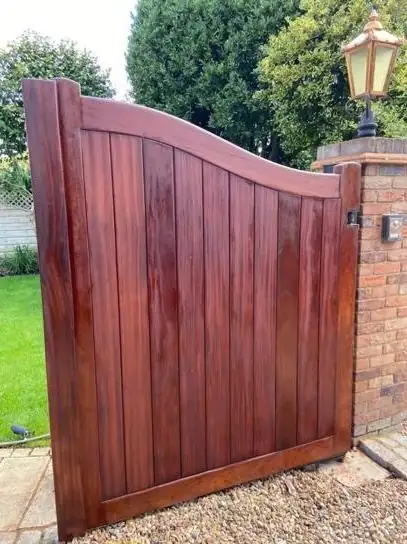
Listed ironwork in the parish hangs between a pair of late 17th-century gatepiers with ball finials at Potterspury Lodge, the country house in the west of the parish that is now Cambian Potterspury Lodge School. The gatepiers are listed Grade II in their own right, and the list entry records that they are linked by iron gates. Painting listed ironwork is upkeep when it keeps the existing colour and finish, but stripping it back to bare metal by abrasive blasting, or changing its colour, is the kind of work to discuss with West Northamptonshire Council first.
On old wrought or cast iron, the preparation matters more than the paint. Loose rust and flaking paint come off with hand tools and wire brushes, taking care not to round off scrolls and finials. Bare spots are primed straight away, the same day, with a rust-inhibiting metal primer, then finished in two coats of a traditional oil-based or alkyd metal paint. Old layers on historic ironwork can contain lead, so it is tested before any rubbing down, and dust is controlled.
Railings on stone walls along the High Street
Railings are a recognised boundary in the village’s conservation area. One run tops the stone wall in front of St Leonard’s Church, which stands raised above the High Street. Railings fixed into stone usually fail first where each bar enters the coping: water collects in the socket, the iron rusts and swells, and the swelling can crack the stone. So the bases get the most attention. They are cleaned out, treated, primed and sealed so water runs off rather than into the joint, and the limestone round them is masked so no paint marks the stone.
Metal in the village takes several forms, and each needs something slightly different:
- Listed iron gates, Potterspury Lodge: hand preparation, lead test, traditional finish in the existing colour.
- Railings on stone walls, St Leonard’s Church and elsewhere in the old village: bases cleaned and sealed, stone masked.
- Cast-iron lattice casements, Melita Cottage on Grafton Road: careful cutting-in round glazing, with the thatch kept clear.
- Thin metal glazing bars, round-headed windows at 12 High Street: fine brushwork; the house is on the Article 4 schedule.
- Modern steel gates and railings on the newer houses: degreased, etch-primed if galvanised, then finished.
Cast-iron casements at Melita Cottage
Melita Cottage at 5 Grafton Road is a listed, thatched cottage, originally a row of three, and its list entry records cast-iron lattice casements. Metal windows like these are uncommon on a thatched cottage and need patient work. Each small pane sits in a lattice of thin bars, so the bars are cleaned and primed by hand, any loose putty is renewed, and paint is cut onto the glass by a millimetre or two to seal the putty line. Opening casements are eased so they close properly after painting. Ladders are kept off the thatch, and solvents are kept well away from it. As a listed building, the colour stays as it is unless the council agrees a change.
| Fact | Detail | Source |
|---|---|---|
| Listed gatepiers | Late 17th-century gatepiers with ball finials at Potterspury Lodge, linked by iron gates (Grade II) | British Listed Buildings |
| Church railings | Railings on top of the stone wall in front of St Leonard’s Church, High Street | West Northamptonshire Council |
| Cast-iron casements | Lattice casements recorded at Melita Cottage, 5 Grafton Road (Grade II, thatched) | British Listed Buildings |
| Boundary guidance | The 2013 appraisal suggests metal railings as a suitable replacement boundary | West Northamptonshire Council |
New railings as a boundary
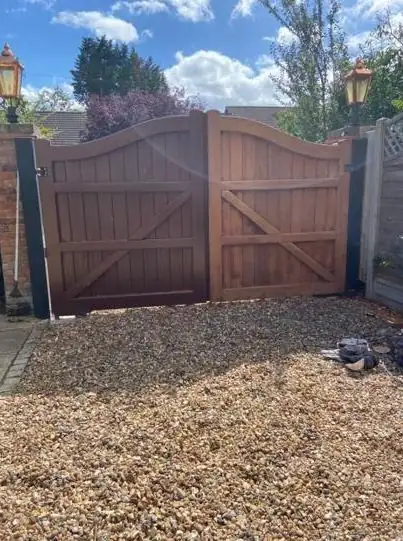
The 2013 conservation area appraisal suggests metal railings as a suitable replacement where a boundary has been lost. New railings are normally galvanised steel, which needs either weathering or an etch primer before paint will stick; painting straight onto new galvanising is a common cause of peeling. A satin or gloss black is the usual finish beside limestone, though dark green and grey also suit the village. At the properties named in the 1999 Article 4 direction, putting up or altering a gate, fence or wall facing a road, open space or waterway needs planning permission, so new railings there go through the council first. Timber gates and fences are covered on our Yardley Gobion fence and gate page.
The full method and products are on our main metal gate and railing painting page, and the Yardley Gobion area page covers the village’s other work. Metal primers need warmth and a dry surface to cure, which is why ironwork follows the same calendar as our exterior painting timing guide.
Sources
- Listed Buildings in Yardley Gobion, South Northamptonshire, British Listed Buildings (accessed 2026-11-17)
- Potterspury Lodge, Yardley Gobion, British Listed Buildings (accessed 2026-11-17)
- Yardley Gobion Conservation Area Appraisal and Management Plan (2013), West Northamptonshire Council (accessed 2026-11-17)
- Article 4(2) Direction, Yardley Gobion (1999), West Northamptonshire Council (accessed 2026-11-17)
Last updated .


