DH Painter & Decorator paints doors, frames, skirtings, architraves and window joinery in Great Houghton, a hilltop village about 2.7 miles south-east of Northampton town centre. Dean covers the conservation area and the newer housing south of the old railway cutting, and quotes for free.
Keeping the original doors: what GHNDP2 means for paintwork
Great Houghton’s Neighbourhood Development Plan, made in May 2022, includes policy GHNDP2. It expects original features in the conservation area, including windows and doors, to be kept rather than swapped for new units. For a painter, that changes the job. In the 12.2 hectares of the village core north of the former railway, woodwork is usually old timber that has been painted many times. It needs stripping back where layers have failed, splits and soft spots repaired, and a fresh paint system built up. A replacement door in a new finish is not the usual answer here.
So a front door on The Green or High Street often takes longer than its size suggests. Flaking areas are scraped and feathered, bare timber is primed, gaps between the frame and the stone reveal are filled with a flexible filler, and the colour is matched to what the house had before. On the 17 listed buildings, any change of external colour needs listed building consent, so we check that before suggesting a new shade.
Casements, sashes and leaded lights in the stone houses
Many of the 17th-century houses have flush timber casements under wooden lintels, as recorded at 20 and 22 The Green, dated 1675. Others have sashes, like the pedimented-dormer front of Great Houghton House. The Manor House at 1 Willow Lane has leaded, stone-mullioned casements. Each needs different handling:
- Flush casements: paint has to stay off the meeting edges so the window still closes, and the putty line is sealed with a small overlap onto the glass.
- Sashes: the runners and staff beads are kept free of build-up so the sash still slides.
- Leaded lights in stone mullions: cut in by brush with masking, never sprayed, and with no paint on the stone.
The Manor House is thatched, and any thatched building rules out heat guns and open-flame stripping. On old joinery near thatch we strip with scrapers, abrasives and chemical strippers instead.
Skirtings and internal doors from the 1600s to the 1980s
Inside the older houses, skirtings and door linings were fitted to walls that were never straight. Long gaps open up between timber and lime plaster, and a rigid filler will just crack out again. We use a flexible caulk sparingly and accept a little irregularity rather than trying to force a modern straight line onto a 350-year-old wall. Old softwood doors often have resin knots and many layers of oil-based gloss, so we key and prime them properly before any water-based satin goes on.
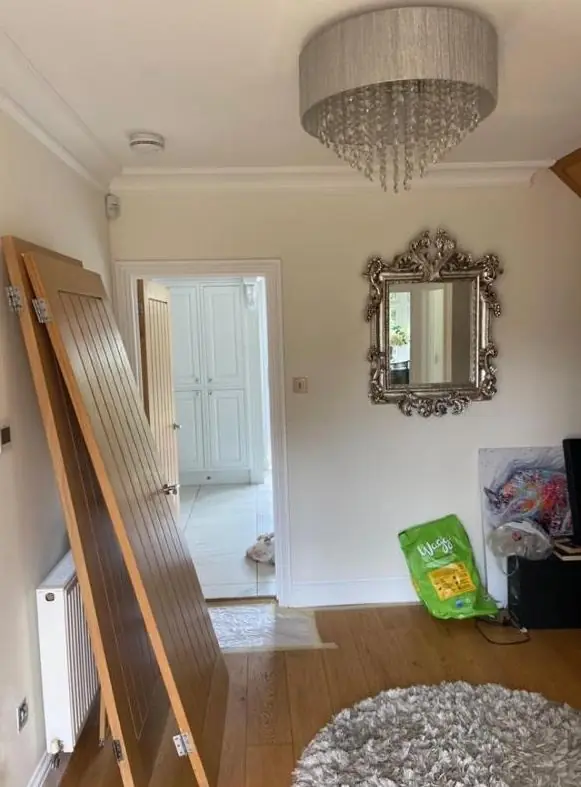
South of the old railway cutting the picture is very different. The 1960s and 1970s houses, the 1980s estate that stops at Leys Lane, and newer closes such as Rectory Close and Lime Farm Way mostly have machined softwood or MDF skirtings and moulded or flush internal doors. There the work is cleaning, sanding, filling dents and repainting in a durable satin or eggshell, often in a day or two per floor. The general method is on our door and skirting painting page.
Weather on the hilltop and the outside face of the door
The village climbs from about 200 ft to 326 ft above sea level, and residents report frosty winters with some snow. South- and west-facing doors and frames take the most wind and rain and break down first, usually at the bottom rail and the threshold. On those faces we use a microporous or durable gloss system and pay extra attention to the end grain. Mature trees in the conservation area keep some doorways shaded and damp, so we wash off mould before painting and wait for dry weather.
High Street is narrow and busy, with parked cars and through traffic, and there are no footpaths at The Cross. Outdoor woodwork there is planned so wet doors, dust sheets and steps don’t block the road or the people walking along it. For the wider picture of property types in the village, see our Great Houghton area page.
Last updated by Dean, DH Painter & Decorator.