DH Painter & Decorator hangs wallpaper in Hackleton, the NN7 village about 4.7 miles south-east of Northampton. Dean lines the uneven lime-plastered walls of the old Main Road cottages before papering, and hangs feature walls and full rooms on the flatter walls of the estates built behind the main road.
Why the plaster decides the paper
Wallpaper shows every flaw in the wall underneath, so in Hackleton the age of the house matters more than the pattern you pick. Along Main Road, the 17th and 18th-century limestone cottages have lime-plastered walls that bow and dip with the stone behind them. On the estates built behind the road between 1939 and 2000, and on newer streets such as Oak Way, the walls are flatter plaster or plasterboard. Each needs a different kind of preparation before the first length goes up. The few Victorian red-brick houses around Chapel Lane sit between the two: older plaster, but usually more regular rooms, and where a picture rail survives it gives a natural line to paper up to.
Lining the old cottage walls first
Hanging a printed paper straight onto uneven lime plaster rarely lasts. Joins open where the wall curves, and a pattern drifts off level across a wall that leans. In the old cottages we normally hang lining paper first, run horizontally when the decorative paper will hang vertically, so the joints in the two layers never coincide. The lining also gives an even, consistently absorbent surface over patchy old plaster.
Lime plaster is softer than gypsum and holds moisture differently, so we check that the wall is dry and sound before hanging anything on it. Loose or hollow plaster has to be dealt with first, because paper hung over it will come away with it. Where earlier owners have papered over paper, which is common in houses this old, we strip back to the plaster rather than add another layer.
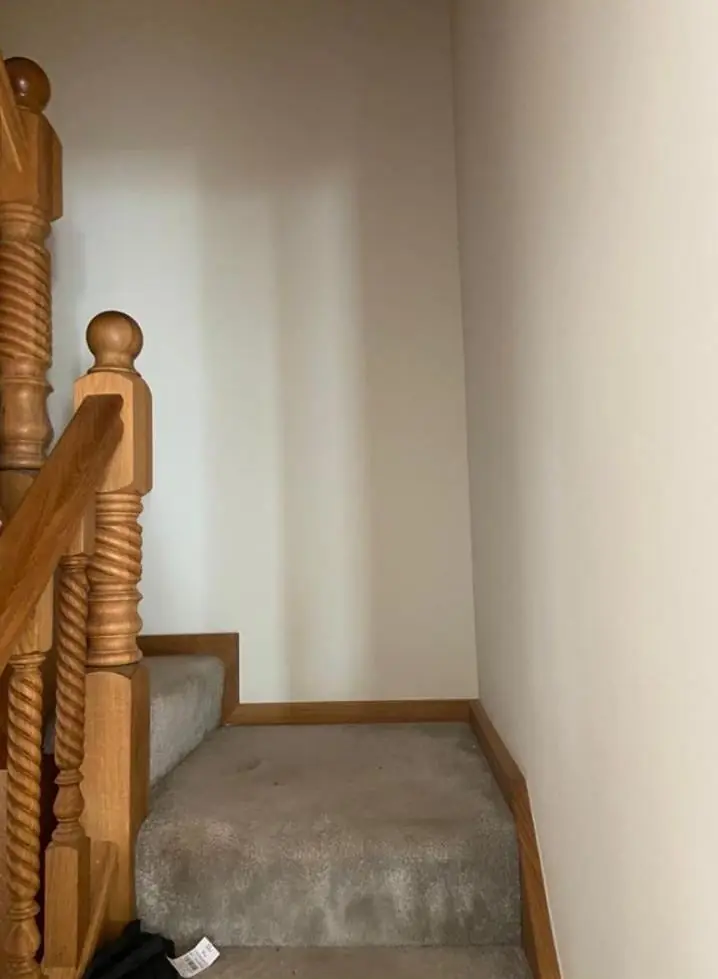
Ceilings in these rooms dip and rise, so a large repeat will look out of true somewhere along the top. Dean will suggest where to start the pattern, usually centred on the chimney breast or the main window, so any drift ends up in a corner nobody looks at. Cottage staircases in the old core are steep and narrow, so papering a stairwell there means setting up staging on the stairs and handling long drops in a tight space, which we allow for in the quote.
Feature walls on the cul-de-sacs
The semis, detached houses and bungalows on the cul-de-sacs north of the main road are where feature walls work well. Straight walls and square corners let a bold geometric or large-scale print run true from ceiling to skirting. The chimney breast in an estate semi, the wall behind a bed, or the tall wall up the stairs in a two-storey house are common choices. Bungalows on the housing-association estate have simple, regular rooms that suit one papered wall with paint on the rest.
Newer homes on Oak Way and Lyne Walk may still have the builder’s paint on, and freshly plastered walls in any extension need sealing with size or a thinned coat before paper goes on. Without it, the paste soaks in unevenly and the paper can be hard to slide into place.
Which approach suits which Hackleton wall
| Wall | Where you find it | How we hang |
|---|---|---|
| Uneven lime plaster over limestone | Main Road cottages and farmhouses | Strip back, repair, cross-line, then hang |
| Old plaster on early brick | The Jetty Cottages | Check for hollow patches, line, then hang |
| Flat plaster or plasterboard | 1939 to 2000 cul-de-sac estates | Fill and size, then paste-the-wall or traditional paper |
| New plaster | Oak Way, Lyne Walk, recent extensions | Let it dry fully, seal, then hang |
Our wallpaper hanging page covers stripping, lining and pattern matching in more depth. Hackleton is about 4.7 miles from our Northampton base on the B526, and the Hackleton page describes the rest of the village’s housing.
Last updated by Dean, DH Painter & Decorator.