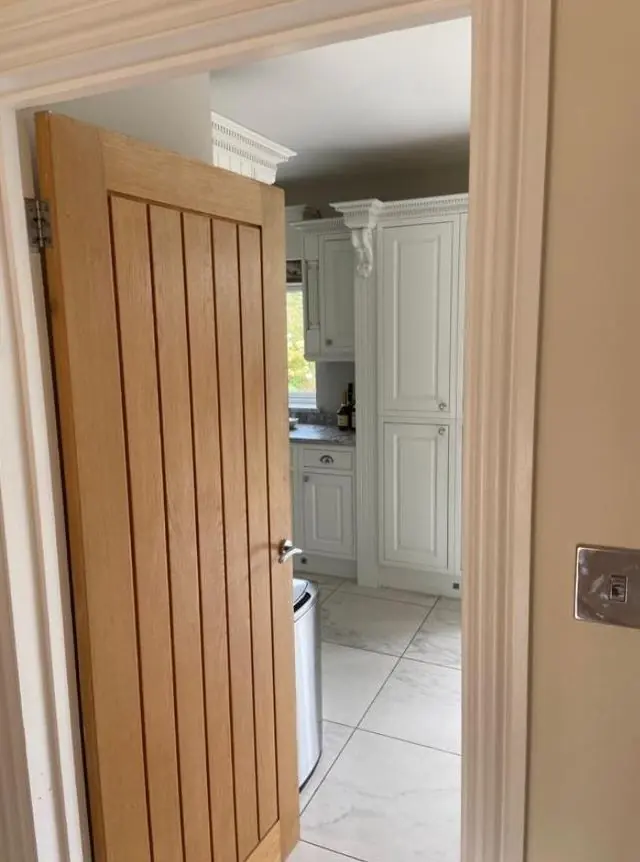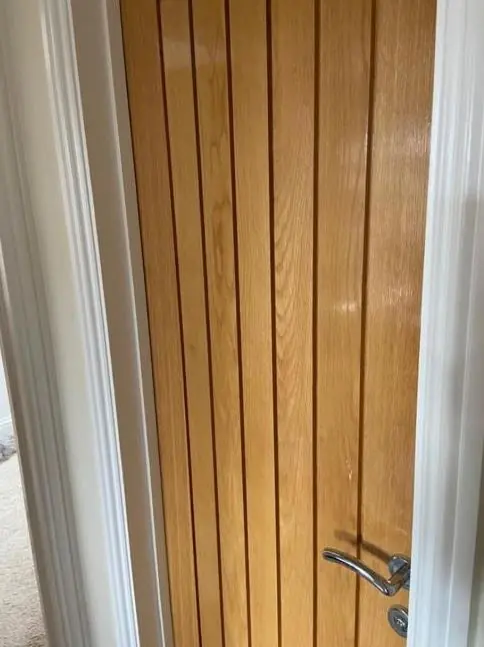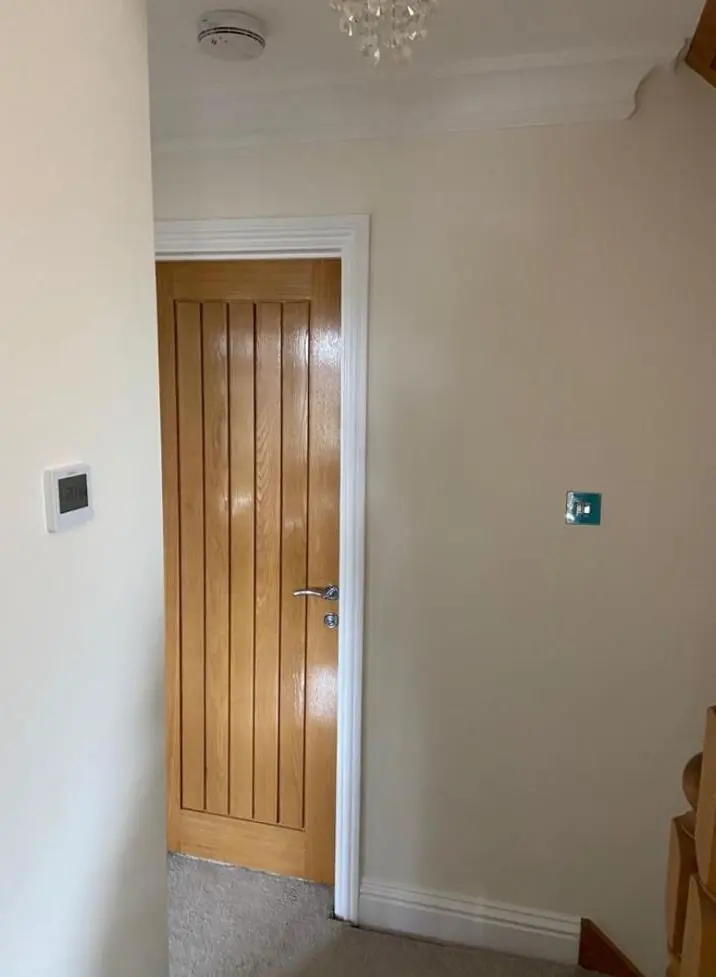
Dean paints internal doors, skirtings, architraves, picture rails and front doors in Headlands, the NN3 suburb about 2.2 miles north-east of Northampton town centre. Most houses here were built around 1939, so the joinery is often original and carries decades of gloss that needs dealing with before it is repainted.
The joinery inside a 1939 semi
Street-level data puts the most common build year on The Headlands, Longland Road, Fullingdale Road and Bush Hill at 1939. Houses of that date were fitted out with softwood joinery that is still in place in many of them: panelled internal doors, skirtings far deeper than a modern ogee board, moulded architraves, and a picture rail running round the front bay lounge and often the bedrooms too. A typical three-bed semi here has a hall, front lounge, rear dining room, kitchen, three bedrooms and a bathroom, so there are usually eight or nine doors and frames and a long run of skirting before you even count the staircase.
The windows tell a different story. Agent listings for the area mostly describe uPVC double glazing, so in a lot of homes the painted woodwork has shrunk to doors, skirtings, rails and window boards. That makes a woodwork-only job realistic: it can be done without redecorating the walls, and on a semi whose walls are still in good order it lets the joinery be brought up to date on its own.
Eighty-odd years of gloss
The usual problem is thickness. Doors that have been glossed by each owner since the war stop closing cleanly, panel mouldings lose their crisp edges, and the beading on deep skirtings turns rounded and lumpy. Yellowed oil-based gloss is common too, especially on skirtings near radiators and doors in rooms that get little daylight.
Before quoting we look at each piece and sort it into one of three piles:
- Sound paint: washed, keyed, filled where dented, and given an undercoat and top coat.
- Thick but stable: sanded back hard on the edges and faces that bind, then recoated.
- Cracked, crazed or flaking: stripped back to a firm edge, sometimes to bare timber on the worst doors.
Paint applied to houses of this age before the 1960s may contain lead in its lower layers, so we test heavily layered joinery before sanding or stripping it. Where lead shows up we switch to wet abrading and low-heat stripping, keep the room closed off and bag the waste. The general preparation sequence for woodwork is on our main door and skirting painting page.
Post-war doors on Upland Road
Upland Road is the exception in the district. It was built later, between 1939 and 1979 with a median of 1958, and is mostly social-housing semis, flats and maisonettes. Homes of that period more often have flush doors and plainer, shallower skirtings. There is less paint build-up to deal with, but flush doors show every brush mark and roller line in a satin finish, so they need a smoother application and good light while we work.
Front doors on a shared frontage
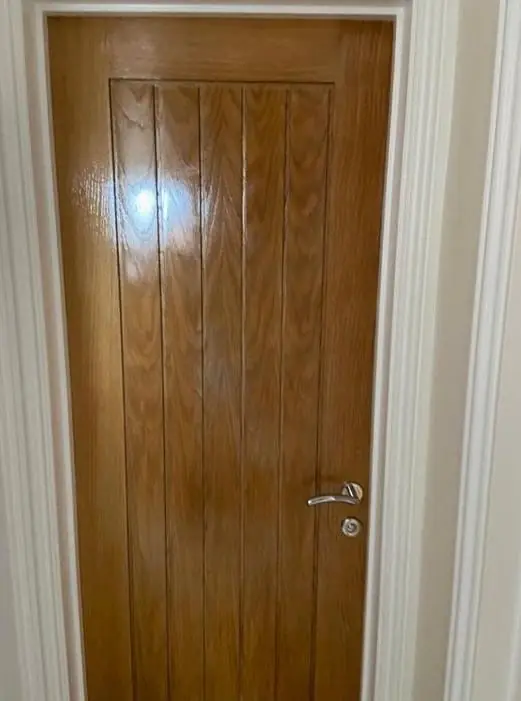
Because the council’s conservation area list has nothing for Headlands, a front door here can go any colour without an application. The Abington Park Conservation Area starts just over Wellingborough Road, but the sources do not place any Headlands street inside it. The real consideration is the semi-detached pair. Two owners share one double-bay front, and a door colour that sits well with the brick and with the house next door looks deliberate rather than random. Where a timber front door or a timber side gate has survived, we use an exterior gloss or satin system on it. Where a door has been replaced with uPVC or composite, ordinary gloss will not bond and a specialist coating is needed, which we will explain at the quote.
Practical points for a Headlands job
Most semis here have a driveway, so the van can usually park off the road and doors can be worked on in the hall or a garage with dust sheets down. We paint one or two rooms’ worth of doors at a time so you are never left with every door in the house wet. If you want a sense of how this sort of job is priced, our painter and decorator cost guide explains what affects the figure, and the Headlands area page covers the other work we do on these houses.
Last updated by Dean, DH Painter & Decorator.