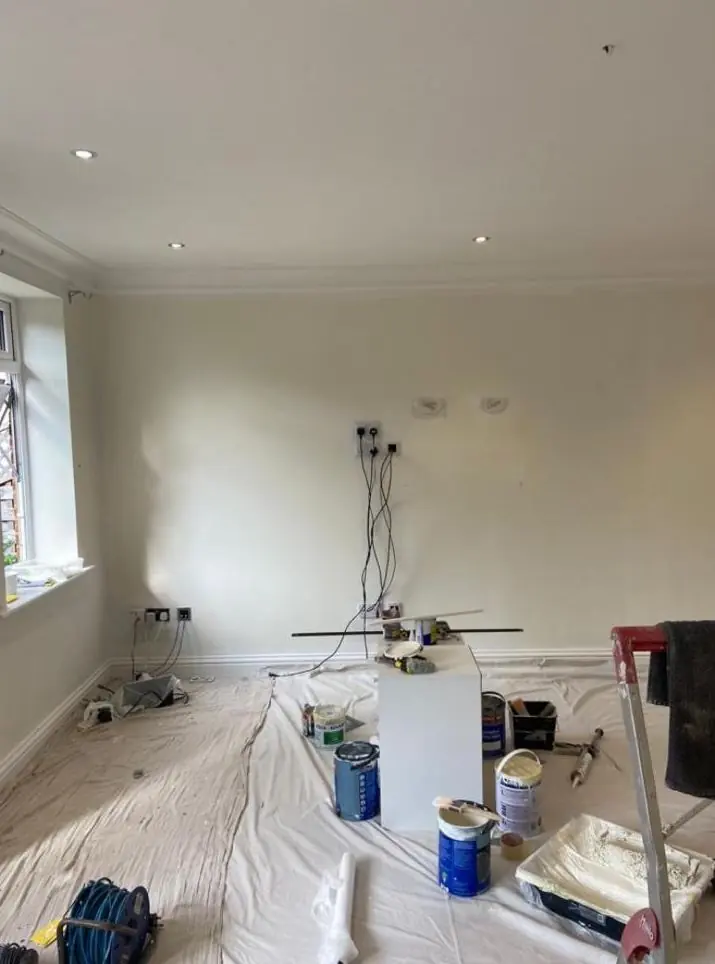
Dean gives colour and finish advice in Little Billing as part of a decorating job, about 3.2 miles north-east of Northampton town centre. In the old core, colours have to sit with local limestone and thatch and may need council approval; on the closes it is about light and setting.
The palette is already on the walls in the old core
The stone in Little Billing’s old houses comes from the Northampton Sand formation. The Great Billing Conservation Area Appraisal describes two kinds: a pale, sandy limestone known locally as Pendle, and a darker, iron-rich ironstone, both dug from pits on the north side of the Nene valley. You can see both in the village. The listed cottages on Church Lane and Orchard Hill are coursed rubble, Corn Ricks has ironstone quoins at the corners, and 2 Orchard Hill has smooth ashlar dressings round its openings.
That stone, with straw-coloured thatch above it, sets the colour range for the joinery. Our usual approach is to pick from it rather than fight it:
- Casements and door frames in soft off-whites, stone or putty shades that sit with the pale limestone, rather than brilliant white.
- Ledged doors in deeper, earthy colours, such as olive, dark green or a muted red, which echo the ironstone.
- The ironstone quoins and ashlar stay bare. They are part of the colour scheme, and we protect them from splashes.
Is the colour change yours to make?
Unlike Great Billing and Weston Favell on either side of it, Little Billing has no conservation area, so the council’s appraisals say nothing about its colours. What protects the old core is listing. Ten buildings are listed, from the Grade II* church of All Saints to Hastings Cottage, and listed building consent applies to changes that affect their character. A new front-door colour or a different finish on a listed cottage can count. We will tell you where we think a choice might need consent, but the council’s conservation officer has the final say, so ask before the work is booked.
For the later houses, no conservation area or Article 4 direction applies, so the choice is yours.
Colour-washed fronts need a colour that matches the coating
Two listed buildings already carry colour. Hastings Cottage, a 17th-century thatched cottage, has a colour-washed cement render, and the Old Rectory has a colour-washed stone east front. On walls like these the colour and the coating are one decision. A limewash comes in soft, slightly chalky tones and weathers gently, while a mineral silicate gives more choice but behaves differently. We find out what the existing coat is before suggesting a colour, because a shade card for modern masonry paint is not much use on a wall that must stay breathable.
Light on the slope and by the brook
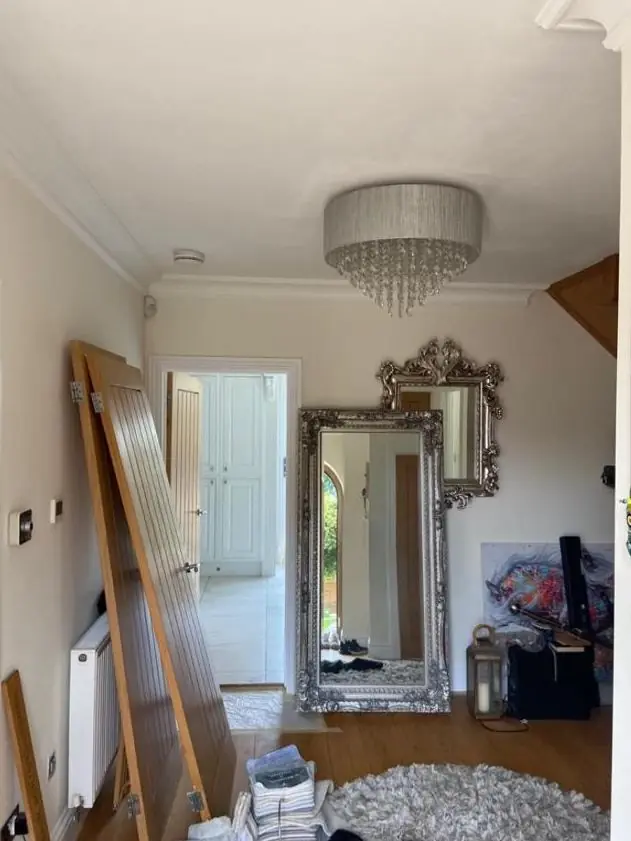
The village sits on a south-facing slope above the Nene, so rooms on the south side of houses on the higher ground get warm sun. Pale neutrals can bleach out there, while slightly deeper tones hold their colour. Rear rooms on Valley Road and Codlin Close are the opposite case, facing the woodland along Billing Brook and the pocket park, and green light filtering through trees can make cool greys look drab. Warmer whites and colours with a little yellow or red in them usually work better.
In a brook-side back room, the useful test is a sample patch on the wall opposite the window, viewed when the trees are in leaf, because summer canopy along the brook changes the light far more than it does in a front room facing the road.
Sheen, as well as shade
Inside the Church Lane and Orchard Hill cottages, finish matters as much as colour. A flat or matt finish hides the undulations of their lime plaster, while eggshell and satin pick out every bump. More on how we approach this is on our main colour and finish advice page. For other services in the village, see our Little Billing area page.
Last updated by Dean, DH Painter & Decorator.